



EU consumer confidence readings collapse to record lows; EUR/GBP
The increased inflation and fears of low supply of natural gas, combined with risk of a recession, are causing consumer sentiment in the Eurozone to fall to record lows.
Share this:

The German GfK Consumer Confidence for August was weaker than expected with a reading of -30.6 vs and expectation of -28.9 and a lower revised reading to -27.7. The headline print was a new record low. In addition, the French Consumer Confidence for July was 80 vs an expectation of 80 and a prior reading of 82. This was the lowest reading since June 2013. Also, the Italian consumer confidence for July was 94.8 vs an expectation of 98.6 and a prior reading of 98.3. This was the lowest reading since the height of the pandemic in May 2020. The EU Consumer Confidence flash reading for July, released on July 20th, was -27 vs an expectation of -24.9 and a previous reading of -23.8. Like Germany’s GfK, this was also a record low. The final July reading is due out tomorrow.
There main reasons given for the sharp deterioration in confidence were related primary to the Russian invasion of Ukraine. The first was due to fears of low supply of natural gas. The second was fears of a recession as the war sparked inflation, specifically in energy and good. In addition, Italian was also worried about political uncertainty.
The ECB recently hiked rates by 50bps to 0.00%, despite falling consumer confidence levels and lower PMI readings. However, inflation has been red hot and the ECB had to do something to try and slow it down. The flash CPI is due out on Friday, with expectations of 8.6% YoY vs 8.6% YoY previously. Could we have hit peak inflation?
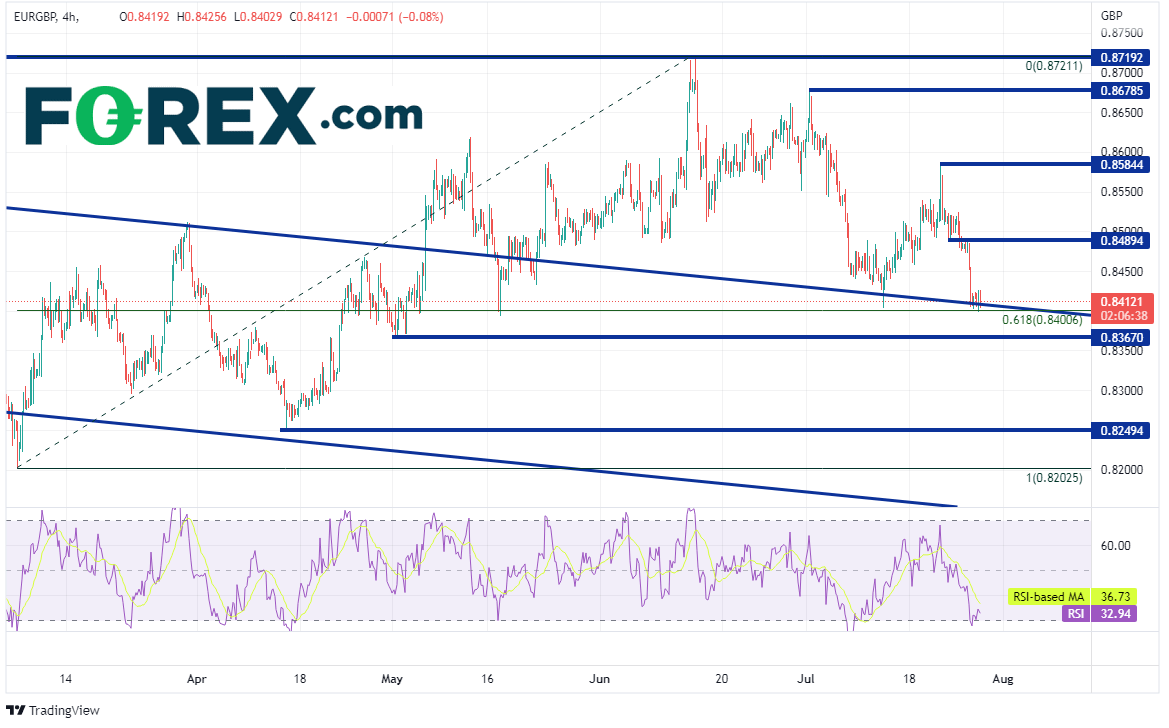
EUR/GBP broke above the channel the pair has been in since April 2021 on May 14th, near 0.8480 and went on to make a local high at 0.8729 on June 15th. The pair has been pulling back since and is currently sitting on key support at previous lows, the top downward sloping line from the long-term channel, and the 61.8% Fibonacci retracement level from the lows of March 7th to the highs of June 15th near 0.8400. If EUR/GBP breaks through the support level, the next level horizontal support is near 0.8367, then additional horizontal support near 0.8250. Below there, price can fall to the lows of March 7th at 0.8203. However, if 0.8400 holds and EUR/GBP bounces, the first level of horizontal resistance is at 0.8489, then again at 0.8585. Above there, price can move to the highs of July 22nd at 0.8679.
Source: Tradingview, Stone X
The Euro has been on the move lower as of late. The increased inflation and fears of low supply of natural gas, combined with risk of a recession, are causing consumer sentiment in the Eurozone to fall to record lows. EUR/GBP is one of the currency pairs taking the brunt of the falling Euro. Will it continue lower? 0.8400 is a key level to watch to find out!
The German GfK Consumer Confidence for August was weaker than expected with a reading of -30.6 vs and expectation of -28.9 and a lower revised reading to -27.7. The headline print was a new record low. In addition, the French Consumer Confidence for July was 80 vs an expectation of 80 and a prior reading of 82. This was the lowest reading since June 2013. Also, the Italian consumer confidence for July was 94.8 vs an expectation of 98.6 and a prior reading of 98.3. This was the lowest reading since the height of the pandemic in May 2020. The EU Consumer Confidence flash reading for July, released on July 20th, was -27 vs an expectation of -24.9 and a previous reading of -23.8. Like Germany’s GfK, this was also a record low. The final July reading is due out tomorrow.
There main reasons given for the sharp deterioration in confidence were related primary to the Russian invasion of Ukraine. The first was due to fears of low supply of natural gas. The second was fears of a recession as the war sparked inflation, specifically in energy and good. In addition, Italian was also worried about political uncertainty.
The ECB recently hiked rates by 50bps to 0.00%, despite falling consumer confidence levels and lower PMI readings. However, inflation has been red hot and the ECB had to do something to try and slow it down. The flash CPI is due out on Friday, with expectations of 8.6% YoY vs 8.6% YoY previously. Could we have hit peak inflation?
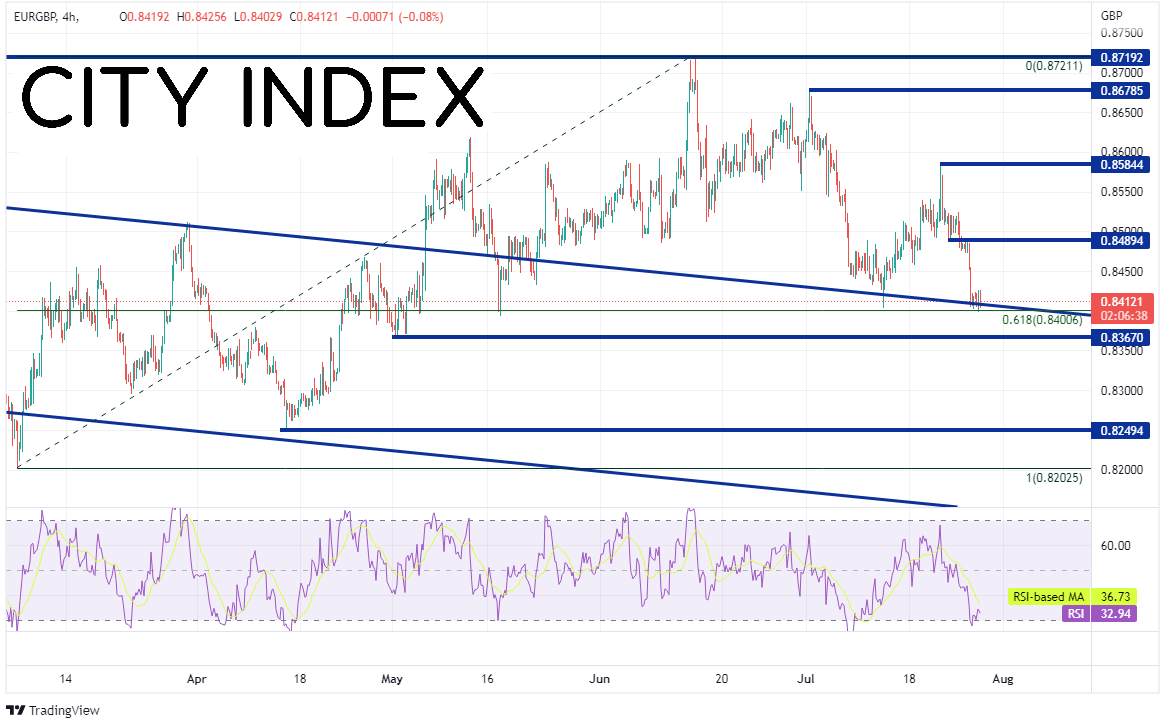
EUR/GBP broke above the channel the pair has been in since April 2021 on May 14th, near 0.8480 and went on to make a local high at 0.8729 on June 15th. The pair has been pulling back since and is currently sitting on key support at previous lows, the top downward sloping line from the long-term channel, and the 61.8% Fibonacci retracement level from the lows of March 7th to the highs of June 15th near 0.8400. If EUR/GBP breaks through the support level, the next level horizontal support is near 0.8367, then additional horizontal support near 0.8250. Below there, price can fall to the lows of March 7th at 0.8203. However, if 0.8400 holds and EUR/GBP bounces, the first level of horizontal resistance is at 0.8489, then again at 0.8585. Above there, price can move to the highs of July 22nd at 0.8679.
Source: Tradingview, Stone X
Trade EUR/GBP now: Login or Open a new account!
• Open an account in the UK
• Open an account in Australia
• Open an account in Singapore
The Euro has been on the move lower as of late. The increased inflation and fears of low supply of natural gas, combined with risk of a recession, are causing consumer sentiment in the Eurozone to fall to record lows. EUR/GBP is one of the currency pairs taking the brunt of the falling Euro. Will it continue lower? 0.8400 is a key level to watch to find out!
Learn more about forex trading opportunities.
Related tags:
Latest market news




Open an account in minutes
Experience award-winning platforms with fast and secure execution.
Economic calendar
Web Trader platform
Our sophisticated web-based platform is packed with features.
Related articles
NZD/USD Forecast: Kiwi faces historic breakdown as RBNZ survey looms
NZD/USD is teetering above support that held through the pandemic and Liberation Day turmoil. With RBNZ hawks repeatedly disappointed, today's inflation expectations survey could open the door to a slide towards the GFC lows.
USD/JPY, AUD/JPY: Central Bank Divergence Creates Two-Way Risk
USD/JPY eyes a breakout above 160, while AUD/JPY faces further losses as Fed, RBA and BoJ interest rate expectations diverge.

DXY, GBP/USD, AUD/USD, USD/CAD, USD/JPY, Gold Weekly Technical Outlook 11 16 2026
Sr. Technical Strategist Michael Boutros highlights the levels that matter on the USD Majors, commodities, and equity indices charts this week.

StoneX Financial Ltd (trading as "FOREX.com") is an execution-only service provider. This material, whether or not it states any opinions, is for general information purposes only and it does not take into account your personal circumstances or objectives. This material has been prepared using the thoughts and opinions of the author and these may change. However, FOREX.com does not plan to provide further updates to any material once published and it is not under any obligation to keep this material up to date.
This material is short term in nature and may only relate to facts and circumstances existing at a specific time or day. Nothing in this material is (or should be considered to be) financial, investment, legal, tax or other advice and no reliance should be placed on it. No opinion given in this material constitutes a recommendation by FOREX.com or the author that any particular investment, security, transaction or investment strategy is suitable for any specific person.
The material has not been prepared in accordance with legal requirements designed to promote the independence of investment research. Although FOREX.com is not specifically prevented from dealing before providing this material, FOREX.com does not seek to take advantage of the material prior to its dissemination. This material is not intended for distribution to, or use by, any person in any country or jurisdiction where such distribution or use would be contrary to local law or regulation. For further details see our full non-independent research disclaimer and quarterly summary.