



EU CPI comes in much higher than expected
CPI out of the Eurozone was high and the Russia/Ukraine conflict should only make it increase due to soaring energy costs.
Share this:

The main driver of currencies this week has been the Russian invasion into Ukraine. However, traders can’t overlook the most important piece of economic data when it comes to interest rates: inflation. After the stronger than expected harmonized readings for February CPI from Germany, Italy, Spain, and France, it’s not surprising that the headline print for the Eurozone Flash CPI was stronger than expected. The reading was 5.8% YoY vs 5.4% YoY expected and 5.1% YoY in January! This was a record high for Euro Zone CPI. Core CPI, which excludes energy, food, alcohol and tobacco, was up 2.7% YoY vs 2.5% YoY expected and 2.3% YoY in January.
It should be noted that the ECB targets 2% inflation and that February’s increase was before energy prices began to skyrocket because of the Russia/Ukraine conflict. Will continued high CPI cause the ECB to move up it’s timeline for decreasing asset purchases, or even allow the markets to look for a rate hike sooner than the end of year?
ECB’s de Guindos said earlier today that the invasion of Ukraine by Russia will not only have an impact on the economy in the Eurozone, but it will also have an impact on inflation. Therefore, it would seem, that de Guindos is expecting inflation to continue to rise. The next ECB interest rated decision meeting is next week
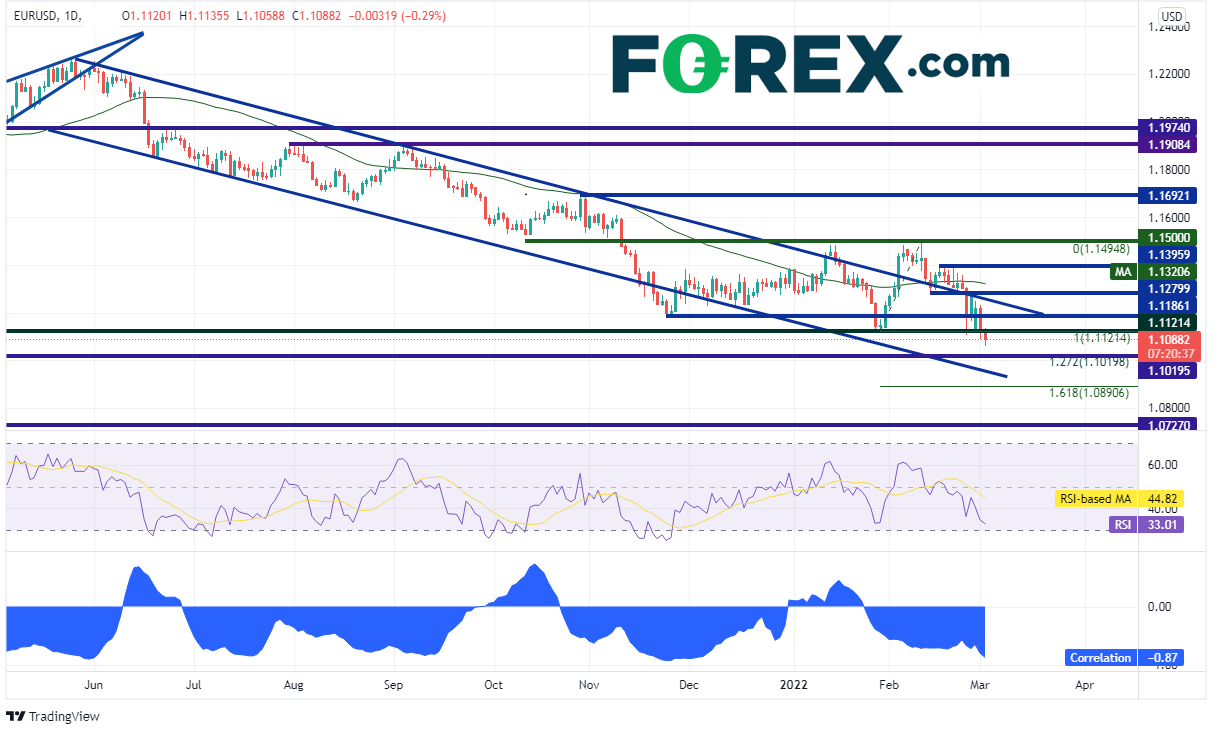
EUR/USD has been moving lower in a downward sloping channel since May 2021. Today, the pair reached its lowest level since May 2020, near 1.1059. Notice that the correlation coefficient between the EUR/USD and USD/RUB is -0.87. A correlation coefficient of -1.00 means that there is a perfectly negative correlation between the 2 assets and that they move In opposite directions 100% of the time. A reading below -0.80 is considered a strong negative correlation. Therefore, if USD/RUB continues to move higher, one can expect EUR/USD to continue to move lower.
Source: Tradingview, Stone X
On a 240- minute timeframe, price has moved convincingly below the January 28th lows and is threatening the 127.2% Fibonacci extension from those lows to the highs from February 10th, near 1.1020. Horizontal support from April 2020 also sits that that level. Below there is the bottom trendline of the long-term channel near 1.0950, then the 161.8% Fibonacci retracement from the recently mentioned timeframe near 1.0890.

Source: Tradingview, Stone X
However, EUR/USD is trading in a descending wedge. Expectations are that price will break out to the upside of the wedge. The target is a 100% retracement of the wedge. In addition, the RSI is diverging with price, an indication that EUR/USD may move higher. Resistance is at the previous support level of 1.1121, then the top trendline of the long-term channel (near the highs of the wedge) near 1.1250. Horizontal resistance sits just above there at 1.1280.
CPI out of the Eurozone was high and the Russia/Ukraine conflict should only make it increase due to soaring energy costs. Traders need to consider whether this will be enough for the ECB to make changes to their asset purchase plan when then meet next week.
The main driver of currencies this week has been the Russian invasion into Ukraine. However, traders can’t overlook the most important piece of economic data when it comes to interest rates: inflation. After the stronger than expected harmonized readings for February CPI from Germany, Italy, Spain, and France, it’s not surprising that the headline print for the Eurozone Flash CPI was stronger than expected. The reading was 5.8% YoY vs 5.4% YoY expected and 5.1% YoY in January! This was a record high for Euro Zone CPI. Core CPI, which excludes energy, food, alcohol and tobacco, was up 2.7% YoY vs 2.5% YoY expected and 2.3% YoY in January.
It should be noted that the ECB targets 2% inflation and that February’s increase was before energy prices began to skyrocket because of the Russia/Ukraine conflict. Will continued high CPI cause the ECB to move up it’s timeline for decreasing asset purchases, or even allow the markets to look for a rate hike sooner than the end of year?
ECB’s de Guindos said earlier today that the invasion of Ukraine by Russia will not only have an impact on the economy in the Eurozone, but it will also have an impact on inflation. Therefore, it would seem, that de Guindos is expecting inflation to continue to rise. The next ECB interest rated decision meeting is next week.
Trade EUR/USD now: Login or Open a new account!
• Open an account in the UK
• Open an account in Australia
• Open an account in Singapore
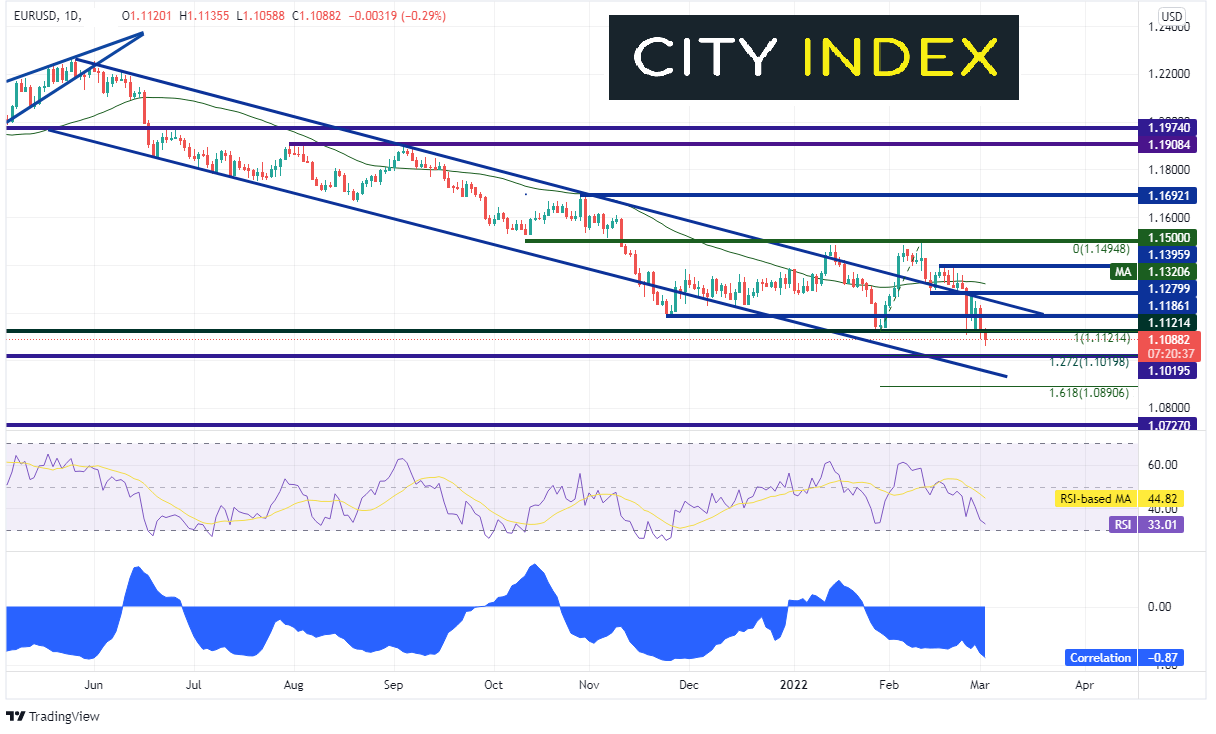
EUR/USD has been moving lower in a downward sloping channel since May 2021. Today, the pair reached its lowest level since May 2020, near 1.1059. Notice that the correlation coefficient between the EUR/USD and USD/RUB is -0.87. A correlation coefficient of -1.00 means that there is a perfectly negative correlation between the 2 assets and that they move In opposite directions 100% of the time. A reading below -0.80 is considered a strong negative correlation. Therefore, if USD/RUB continues to move higher, one can expect EUR/USD to continue to move lower.
Source: Tradingview, Stone X
On a 240- minute timeframe, price has moved convincingly below the January 28th lows and is threatening the 127.2% Fibonacci extension from those lows to the highs from February 10th, near 1.1020. Horizontal support from April 2020 also sits that that level. Below there is the bottom trendline of the long-term channel near 1.0950, then the 161.8% Fibonacci retracement from the recently mentioned timeframe near 1.0890.

Source: Tradingview, Stone X
However, EUR/USD is trading in a descending wedge. Expectations are that price will break out to the upside of the wedge. The target is a 100% retracement of the wedge. In addition, the RSI is diverging with price, an indication that EUR/USD may move higher. Resistance is at the previous support level of 1.1121, then the top trendline of the long-term channel (near the highs of the wedge) near 1.1250. Horizontal resistance sits just above there at 1.1280.
CPI out of the Eurozone was high and the Russia/Ukraine conflict should only make it increase due to soaring energy costs. Traders need to consider whether this will be enough for the ECB to make changes to their asset purchase plan when then meet next week.
Learn more about forex trading opportunities.
Related tags:
Latest market news




Open an account in minutes
Experience award-winning platforms with fast and secure execution.
Economic calendar
Web Trader platform
Our sophisticated web-based platform is packed with features.
Related articles
DXY, GBP/USD, AUD/USD, USD/CAD, USD/JPY, Gold Weekly Technical Outlook 11 16 2026
Sr. Technical Strategist Michael Boutros highlights the levels that matter on the USD Majors, commodities, and equity indices charts this week.
Gold and silver forecast: Precious metals extend drop but seasonality hopes keeps bullish case alive
It has been a risk off session so far today with stocks, gold and especially silver (-4%) all taking a drop. Gold has fallen to a fresh 2026 low and its now more than $100 below the psychologically important $4,000 mark. A firmer US dollar, rising US rate expectations and fading safe-haven demand have combined to undermine the metal, despite continued central bank buying. This year has so far been a bad one for gold.

EUR/USD forecast: Dollar strength puts 1.1000 support in the spotlight | Currency Pair of the Week
The dollar extended its recent advance at the start of the week, with weakness across risk-sensitive assets reinforcing demand for the US currency. US equity futures slipped ahead of Nvidia’s earnings on Tuesday and an expected stock market debut by Anthropic later this week. Both events represent important tests for an AI trade that has become increasingly vulnerable to shifts in sentiment. In FX, EUR/USD nearly tested the psychologically important 1.1000 level, before bouncing modestly off its lows.
StoneX Financial Ltd (trading as "FOREX.com") is an execution-only service provider. This material, whether or not it states any opinions, is for general information purposes only and it does not take into account your personal circumstances or objectives. This material has been prepared using the thoughts and opinions of the author and these may change. However, FOREX.com does not plan to provide further updates to any material once published and it is not under any obligation to keep this material up to date.
This material is short term in nature and may only relate to facts and circumstances existing at a specific time or day. Nothing in this material is (or should be considered to be) financial, investment, legal, tax or other advice and no reliance should be placed on it. No opinion given in this material constitutes a recommendation by FOREX.com or the author that any particular investment, security, transaction or investment strategy is suitable for any specific person.
The material has not been prepared in accordance with legal requirements designed to promote the independence of investment research. Although FOREX.com is not specifically prevented from dealing before providing this material, FOREX.com does not seek to take advantage of the material prior to its dissemination. This material is not intended for distribution to, or use by, any person in any country or jurisdiction where such distribution or use would be contrary to local law or regulation. For further details see our full non-independent research disclaimer and quarterly summary.