



EUR GBP continues downside bias after ECB BoE
EUR/GBP has been falling sharply since early November as the pound has gained back some traction after hitting Brexit-driven, multi-decade lows against the US dollar in October. At the same time, the euro has been weighed down by continuing economic worries in Europe and a consistently dovish European Central Bank (ECB).
Share this:

EUR/GBP has been falling sharply since early November as the pound has gained back some traction after hitting Brexit-driven, multi-decade lows against the US dollar in October. At the same time, the euro has been weighed down by continuing economic worries in Europe and a consistently dovish European Central Bank (ECB).
Both the ECB and Bank of England (BoE) have issued their latest policy decisions, and not much has changed as a result. The ECB continued to lean rather unmistakably towards the dovish side last week as it extended its quantitative easing program for a longer-than-expected nine months – to December of 2017. Although the central bank also confirmed that it would begin tapering its bond purchases starting in April, it was careful not to characterize this as a tapering-to-zero. Meanwhile, the BoE, which just issued its decision on Thursday, continues to maintain a neutral policy stance. As expected, no interest rate changes were made, and the central bank remains torn between expectations of higher inflation pressures and the specter of a looming Brexit process. Governor Mark Carney said on Thursday that the Bank of England can now respond “in either direction.”
Therefore, on the dovish-to-hawkish central bank spectrum, the ECB staunchly remains the most dovish while the Fed is clearly the most hawkish, and the BoE falls somewhere in-between. What does this likely mean for these central banks’ respective currencies? We’ve already clearly seen the sharply positive effect of Wednesday’s hawkish Fed outlook on the US dollar. Likewise, last week’s dovish QE extension by the ECB led to a euro sell-off. As for the pound, the BoE’s neutral stance is less of a currency-mover than other central banks’ stances. Against the euro, however, the pound is likely to continue holding the edge due to the modest but significant monetary policy divergence between the ECB and BoE.
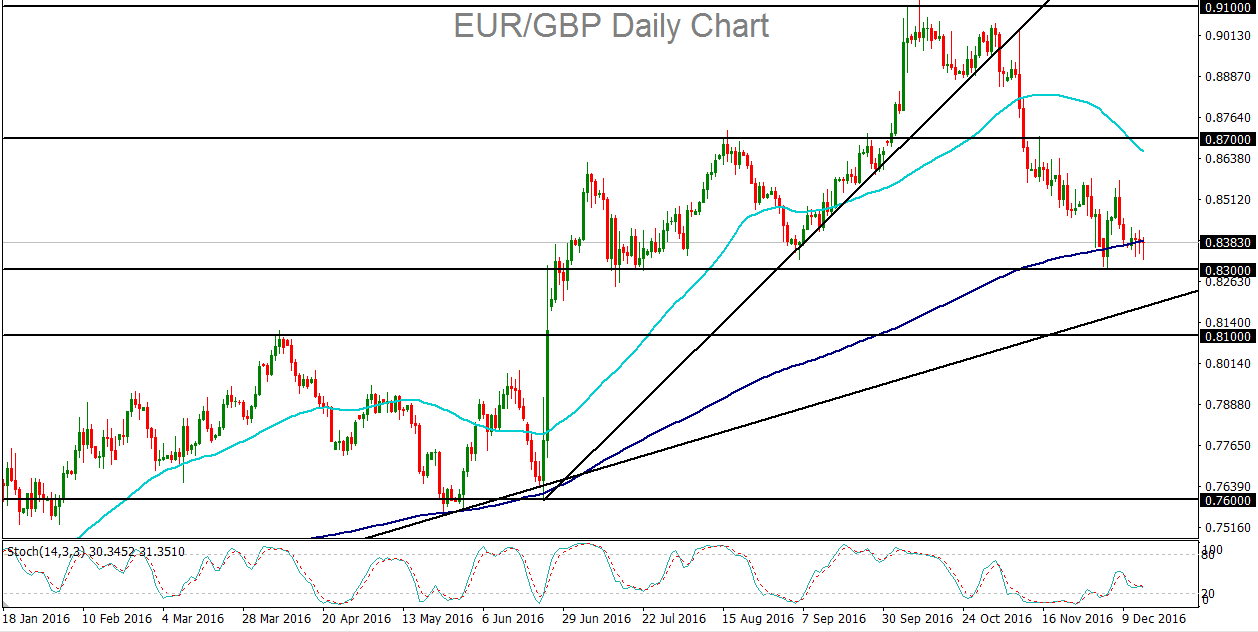
From a price action perspective, as noted, EUR/GBP has been falling sharply since early November, after the currency pair broke down below a steep uptrend line that has been in place since June’s UK Referendum. After breaking down below that trend line, EUR/GBP followed-through further to break down below the key 0.8700 support level. Most recently, price sharply extended its slide then bounced from the major 0.8300 support area last week. Currently, the currency pair has once again dropped to approach this important level. With any continuation of the downside momentum for the euro and rebound for the heavily oversold pound, a breakdown below the 0.8300 support level could open the way in the near-term towards downside targets at 0.8100 support and the 0.8000 psychological level.




Open an account in minutes
Experience award-winning platforms with fast and secure execution.
Economic calendar
Web Trader platform
Our sophisticated web-based platform is packed with features.
Related articles

GBP/USD approaches breaking point as US yields surge
A historic repricing of US interest rate expectations has propelled the dollar higher, leaving GBP/USD testing a crucial support level ahead of UK GDP.

EUR/USD Analysis: U.S. Inflation Data Keeps Pressure on the Euro
The trading week continues to unfold and the latest session has once again highlighted weakness around the euro against the U.S. dollar. EUR/USD is down nearly 0.3%, reflecting that the European currency continues to struggle to sustain a consistent recovery in the short term.


EUR/USD Forecast: Euro Under Pressure After Strong NFP Data
As the trading week comes to an end, the euro has once again struggled to sustain a meaningful recovery against the U.S. dollar, highlighting renewed weakness within EUR/USD price action. During the final trading session of the week, the pair declined nearly 0.7%, reflecting that confidence around the European currency remains limited in the short term.
StoneX Financial Ltd (trading as "FOREX.com") is an execution-only service provider. This material, whether or not it states any opinions, is for general information purposes only and it does not take into account your personal circumstances or objectives. This material has been prepared using the thoughts and opinions of the author and these may change. However, FOREX.com does not plan to provide further updates to any material once published and it is not under any obligation to keep this material up to date.
This material is short term in nature and may only relate to facts and circumstances existing at a specific time or day. Nothing in this material is (or should be considered to be) financial, investment, legal, tax or other advice and no reliance should be placed on it. No opinion given in this material constitutes a recommendation by FOREX.com or the author that any particular investment, security, transaction or investment strategy is suitable for any specific person.
The material has not been prepared in accordance with legal requirements designed to promote the independence of investment research. Although FOREX.com is not specifically prevented from dealing before providing this material, FOREX.com does not seek to take advantage of the material prior to its dissemination. This material is not intended for distribution to, or use by, any person in any country or jurisdiction where such distribution or use would be contrary to local law or regulation. For further details see our full non-independent research disclaimer and quarterly summary.