



Financial stocks battered as yield curve flattens
Global equities are once again opening the week on the back foot as a joint story from the Wall Street Journal and Bloomberg further exacerbated US-China trade tensions.
Share this:

Global equities are once again opening the week on the back foot as a joint story from the Wall Street Journal and Bloomberg further exacerbated US-China trade tensions. The report alleges that the US will increase scrutiny of Chinese investments in certain US industries deemed critical to economic and national security.
This morning, US Treasury Secretary Mnuchin tweeted that the report was “false, fake news” (the next mutation of the #fakenews epidemic?), but seemingly confirmed a very similar policy was in the works. Stock traders have opted to “sell first and ask questions later,” driving the Dow Jones Industrial Average down over 400 points midway through the trading day, with the tech-heavy NASDAQ Composite falling by more than 2.5% as of writing.
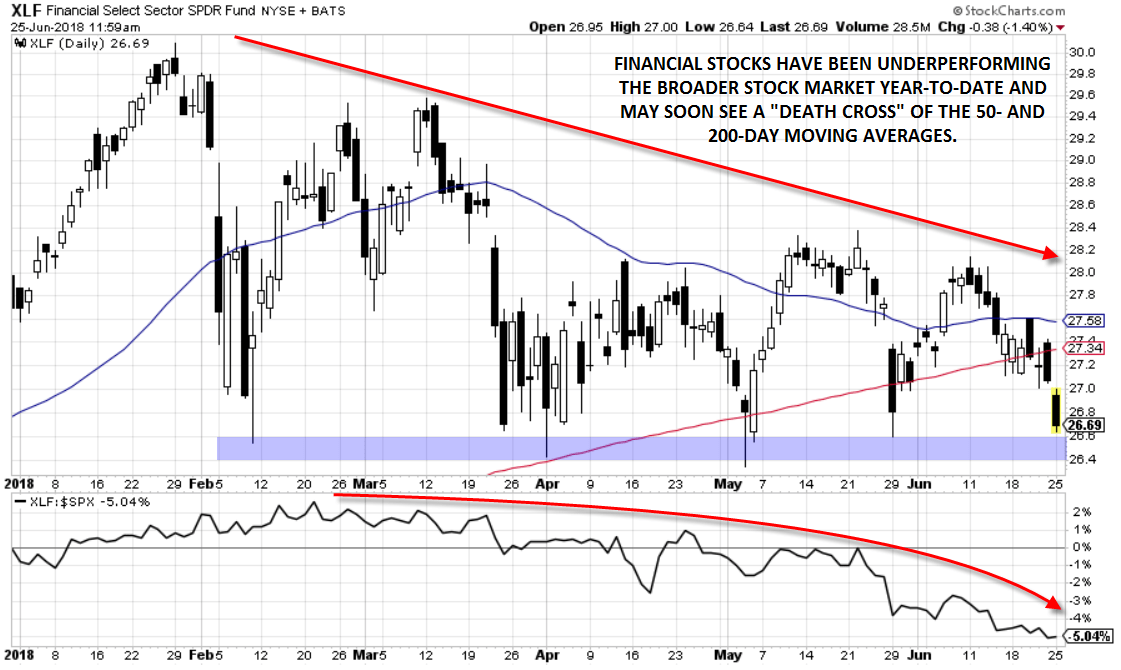
While today’s big drop in the market-leading technology sector is noteworthy, we wanted to take a close look at the second-largest US sector by market capitalization, financials. With interest rates generally rising through the first half of the year, a naïve analysis might suggest that financial stocks (which, after all, often make money by lending funds at the prevailing interest rate) should be big beneficiaries. In actuality, financials are among the worst-performing sectors year-to-date:
Source: Stockcharts.com, FOREX.com
The explanation for this counter-intuitive phenomenon lies with the yield curve, or the difference between short- and long-term interest rates. While it’s true that interest rates have risen across the curve in the US, short-term rates have risen far more dramatically as the market adjusts to a more hawkish Federal Reserve. By contrast, longer-term interest rates, which vary based on the market’s expectation for long-term growth and inflation, have been relatively stationary.
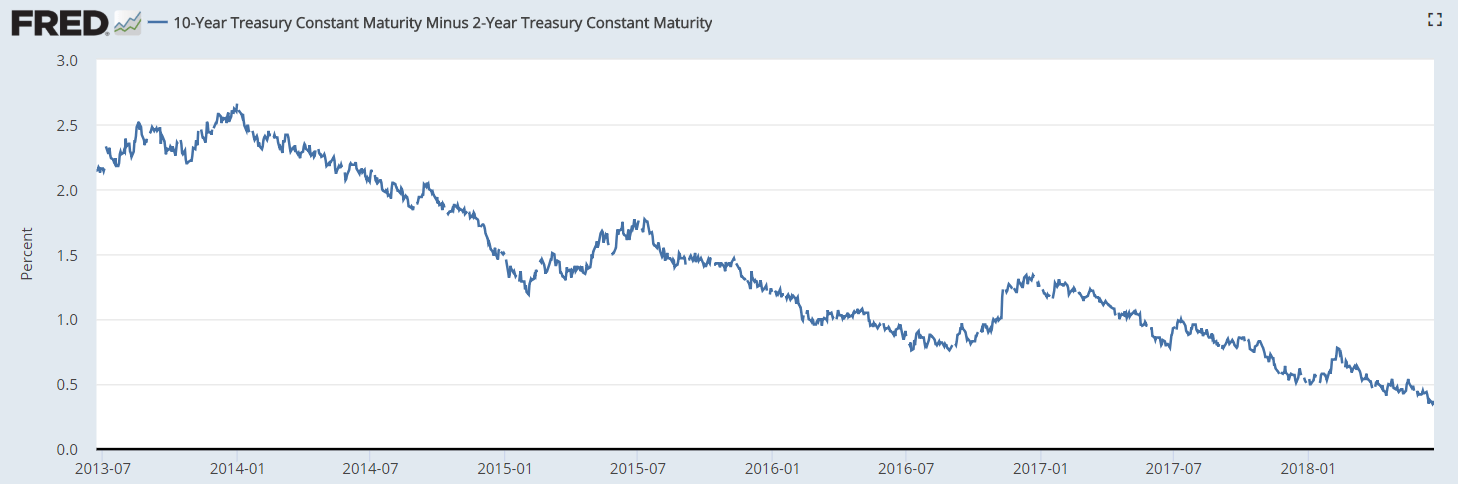
The upshot is that the yield curve has flattened dramatically over the last 18 months. For example, the 2yr-10yr spread has fallen from about 130bps at the beginning of 2017 to 54bps at the beginning of 2018 to 34bps (0.34%) now. Banks and other financial institutions that make profits borrowing short-term funds (through products like savings accounts and CDs) and lending out funds over a longer-term horizon (through business, auto, and mortgage loans) may now expect their profits to fall. As a result, financial stocks continue to underperform the broader market.
Source: FRED
Moving forward, investors should keep a close eye on the yield curve, both for its impact on financial stocks and its historic propensity to invert (when short-term rates rise above long-term rates) before economic recessions. With the widely-followed 2-10 spread now just a third of a percent away from that threshold, traders of all stripes are sitting on the edges of their seats.
Related tags:


Open an account in minutes
Experience award-winning platforms with fast and secure execution.
Economic calendar
Web Trader platform
Our sophisticated web-based platform is packed with features.
Related articles
China's steel slump leaves iron ore bulls under the pump
Iron ore has broken major support, threatening a return to the lows of 2022 as mounting evidence of weakness in China's steel sector reinforces the bearish outlook.

NZD/USD Forecast: Kiwi faces historic breakdown as RBNZ survey looms
NZD/USD is teetering above support that held through the pandemic and Liberation Day turmoil. With RBNZ hawks repeatedly disappointed, today's inflation expectations survey could open the door to a slide towards the GFC lows.

DXY, GBP/USD, AUD/USD, USD/CAD, USD/JPY, Gold Weekly Technical Outlook 11 16 2026
Sr. Technical Strategist Michael Boutros highlights the levels that matter on the USD Majors, commodities, and equity indices charts this week.

StoneX Financial Ltd (trading as "FOREX.com") is an execution-only service provider. This material, whether or not it states any opinions, is for general information purposes only and it does not take into account your personal circumstances or objectives. This material has been prepared using the thoughts and opinions of the author and these may change. However, FOREX.com does not plan to provide further updates to any material once published and it is not under any obligation to keep this material up to date.
This material is short term in nature and may only relate to facts and circumstances existing at a specific time or day. Nothing in this material is (or should be considered to be) financial, investment, legal, tax or other advice and no reliance should be placed on it. No opinion given in this material constitutes a recommendation by FOREX.com or the author that any particular investment, security, transaction or investment strategy is suitable for any specific person.
The material has not been prepared in accordance with legal requirements designed to promote the independence of investment research. Although FOREX.com is not specifically prevented from dealing before providing this material, FOREX.com does not seek to take advantage of the material prior to its dissemination. This material is not intended for distribution to, or use by, any person in any country or jurisdiction where such distribution or use would be contrary to local law or regulation. For further details see our full non-independent research disclaimer and quarterly summary.