



USD/CAD: Will Oil, inflation, and central bankers break the near-term range?
The pair is likely to see some significant volatility around fundamental data releases as we move through the latter half of the week...
Share this:

After an extremely active economic calendar last week, highlighted by major earnings reports, central bank meetings, and jobs reports, this week is decidedly quieter on the data front. Accordingly, it’s not surprising to see most major markets consolidating last week’s moves while traders await the next catalysts.
One market that is seeing some significant movement is oil. As my colleague Joe Perry noted earlier today, WTI crude oil is pulling back from 6-year highs today after hints of a de-escalation between Russia and Ukraine. It remains to be seen whether the ongoing geopolitical tensions in Eastern Europe will continue to recede, but as long as there isn’t an outbreak of military action, oil bulls may continue to take profits after a nearly 50% rally from the December low.
Of course, when FX traders hear oil, they immediately think of the Canadian dollar. Oil is Canada’s most important export, so the gyrations in the oil market have a big influence on the value of the loonie, and sure enough, the CAD is the weakest major currency so far today.
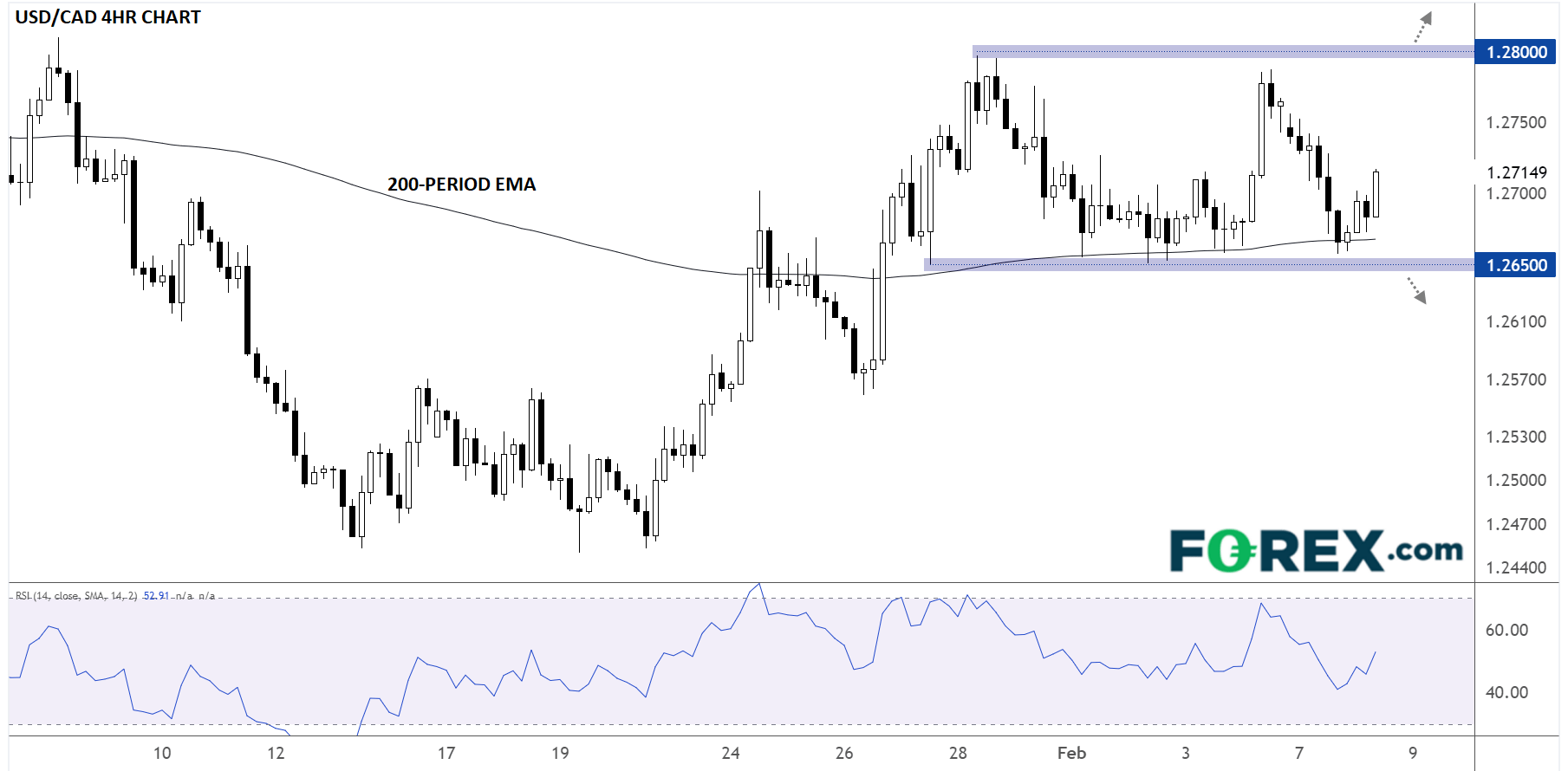
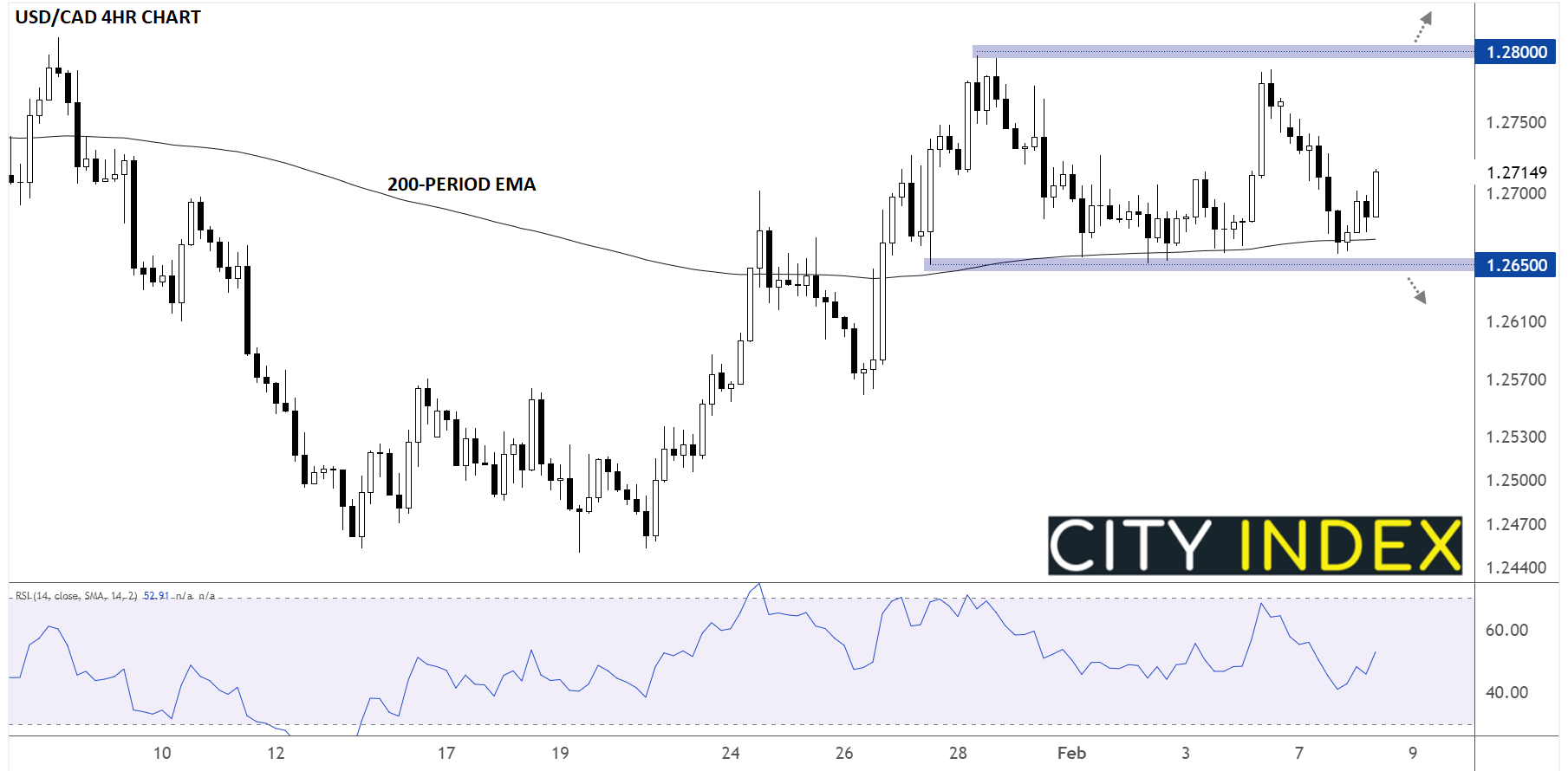
Technically speaking, USD/CAD is bouncing from the bottom of its 2-week range between 1.2650 and 1.2800 on the news. For short-term range traders, buying near support at 1.2650 and selling near resistance at 1.2800 has been an effective strategy in recent weeks; that range even held through Friday’s combination of a much-stronger-than-expected US jobs report and a much-weaker-than anticipated Canadian jobs report, a combination that would usually break any short-term technical structures:
Source: TradingView, StoneX
As it stands, USD/CAD is trading back near the middle of its range, leaving no immediate technical bias, but even putting aside any potential moves from its correlation with oil prices, the pair is likely to see some significant volatility around fundamental data releases as we move through the latter half of the week.
Tomorrow brings the US EIA crude oil inventories report, as well as speeches by BOC Governor Tiff Macklem and FOMC voter Loretta Mester, followed up by the highly-anticipated US CPI report on Thursday and the UofM Consumer Sentiment Survey on Friday. Of these, the US CPI report will be the most important release to watch: A hotter-than-expected reading could boost the US dollar against both the loonie and oil, whereas a soft print could take USD/CAD back to 1.2650 support or even below that key area to its lowest levels of the month.
In other words, USD/CAD traders who have grown accustomed to the pair regularly oscillating between 1.2650 and 1.2800 should remember that the past is not always prologue, and USD/CAD is set up for a potentially volatile end to the week.
After an extremely active economic calendar last week, highlighted by major earnings reports, central bank meetings, and jobs reports, this week is decidedly quieter on the data front. Accordingly, it’s not surprising to see most major markets consolidating last week’s moves while traders await the next catalysts.
One market that is seeing some significant movement is oil. As my colleague Joe Perry noted earlier today, WTI crude oil is pulling back from 6-year highs today after hints of a de-escalation between Russia and Ukraine. It remains to be seen whether the ongoing geopolitical tensions in Eastern Europe will continue to recede, but as long as there isn’t an outbreak of military action, oil bulls may continue to take profits after a nearly 50% rally from the December low.
Of course, when FX traders hear oil, they immediately think of the Canadian dollar. Oil is Canada’s most important export, so the gyrations in the oil market have a big influence on the value of the loonie, and sure enough, the CAD is the weakest major currency so far today.
Technically speaking, USD/CAD is bouncing from the bottom of its 2-week range between 1.2650 and 1.2800 on the news. For short-term range traders, buying near support at 1.2650 and selling near resistance at 1.2800 has been an effective strategy in recent weeks; that range even held through Friday’s combination of a much-stronger-than-expected US jobs report and a much-weaker-than anticipated Canadian jobs report, a combination that would usually break any short-term technical structures:
Source: TradingView, StoneX
As it stands, USD/CAD is trading back near the middle of its range, leaving no immediate technical bias, but even putting aside any potential moves from its correlation with oil prices, the pair is likely to see some significant volatility around fundamental data releases as we move through the latter half of the week.
Tomorrow brings the US EIA crude oil inventories report, as well as speeches by BOC Governor Tiff Macklem and FOMC voter Loretta Mester, followed up by the highly-anticipated US CPI report on Thursday and the UofM Consumer Sentiment Survey on Friday. Of these, the US CPI report will be the most important release to watch: A hotter-than-expected reading could boost the US dollar against both the loonie and oil, whereas a soft print could take USD/CAD back to 1.2650 support or even below that key area to its lowest levels of the month.
In other words, USD/CAD traders who have grown accustomed to the pair regularly oscillating between 1.2650 and 1.2800 should remember that the past is not always prologue, and USD/CAD is set up for a potentially volatile end to the week.
How to trade with City Index
You can trade with City Index by following these four easy steps:
- Open an account, or log in if you’re already a customer
• Open an account in the UK
• Open an account in Australia
• Open an account in Singapore
- Search for the company you want to trade in our award-winning platform
- Choose your position and size, and your stop and limit levels
- Place the trade

Open an account in minutes
Experience award-winning platforms with fast and secure execution.
Economic calendar
Web Trader platform
Our sophisticated web-based platform is packed with features.
Related articles

NZD/USD Forecast: Kiwi faces historic breakdown as RBNZ survey looms
NZD/USD is teetering above support that held through the pandemic and Liberation Day turmoil. With RBNZ hawks repeatedly disappointed, today's inflation expectations survey could open the door to a slide towards the GFC lows.

USD/JPY, AUD/JPY: Central Bank Divergence Creates Two-Way Risk
USD/JPY eyes a breakout above 160, while AUD/JPY faces further losses as Fed, RBA and BoJ interest rate expectations diverge.


DXY, GBP/USD, AUD/USD, USD/CAD, USD/JPY, Gold Weekly Technical Outlook 11 16 2026
Sr. Technical Strategist Michael Boutros highlights the levels that matter on the USD Majors, commodities, and equity indices charts this week.

StoneX Financial Ltd (trading as "FOREX.com") is an execution-only service provider. This material, whether or not it states any opinions, is for general information purposes only and it does not take into account your personal circumstances or objectives. This material has been prepared using the thoughts and opinions of the author and these may change. However, FOREX.com does not plan to provide further updates to any material once published and it is not under any obligation to keep this material up to date.
This material is short term in nature and may only relate to facts and circumstances existing at a specific time or day. Nothing in this material is (or should be considered to be) financial, investment, legal, tax or other advice and no reliance should be placed on it. No opinion given in this material constitutes a recommendation by FOREX.com or the author that any particular investment, security, transaction or investment strategy is suitable for any specific person.
The material has not been prepared in accordance with legal requirements designed to promote the independence of investment research. Although FOREX.com is not specifically prevented from dealing before providing this material, FOREX.com does not seek to take advantage of the material prior to its dissemination. This material is not intended for distribution to, or use by, any person in any country or jurisdiction where such distribution or use would be contrary to local law or regulation. For further details see our full non-independent research disclaimer and quarterly summary.