
- Australian employment plunged as unemployment hit multi-year highs
- RBA rate hike expectations slashed following disappointing jobs data
- AUD/USD yield spread relationships have flipped since quarter-end
- Improving risk appetite and bullish reversal offer recovery potential
AUD/USD was hammered on Thursday, underperforming against all major currencies despite broad-based weakness in the US dollar, undermined by another very soft Australian employment report that compounded the effects of widespread risk aversion earlier in the week.
The details in the jobs report were undeniably weak, prompting markets to pare expectations for further RBA tightening. But with broader risk appetite showing signs of recovery on Thursday, and the currency looking stretched on shorter-term timeframes, there's reason to question whether the selling pressure will persist heading into the weekend.
This content was created by an affiliate of FOREX.com and represents the views and opinions of the author/speakers, not the views and opinions of FOREX.com, StoneX Group Inc., or its subsidiaries. The content has not been independently reviewed by FOREX.com.
Australian labour market deteriorating faster than expected
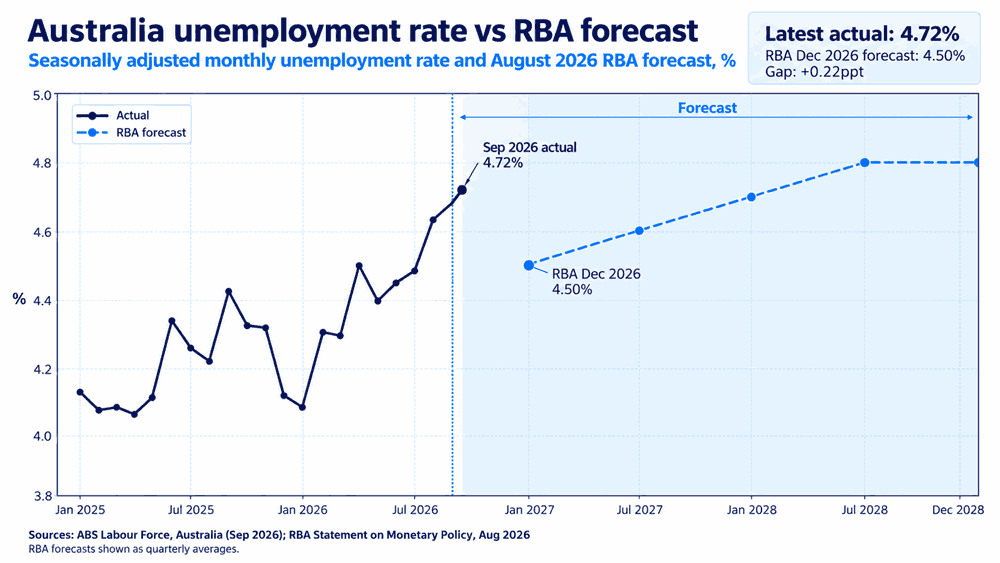
Australia's September employment report delivered another round of disappointing data, with employment falling by more than 39,000 and the unemployment rate rising to a fresh multi-year high of 4.72%, well above the 4.5% December quarter average forecast by the RBA only a couple of months ago.
Source: ABS, RBA
Clearly, evidence is accumulating that the labour market is deteriorating faster than the RBA was expecting, leading markets to pare expectations for further rate hikes following the move delivered in September.
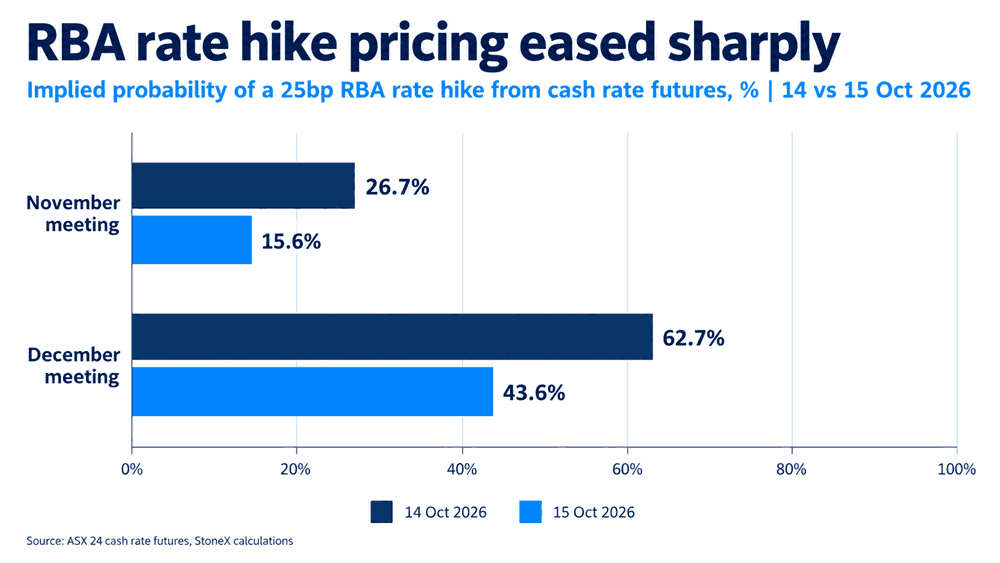
The implied probability of a 25 basis point hike on November 3 now sits at just 15.6%, nearly halving relative to a session earlier, while the probability of a move by December is now under 50% at 43.6%. Looking further out, markets are no longer fully priced for another 25 basis point rate hike this cycle, contributing to the Aussie's underperformance against the G10 FX universe on Thursday.
Source: TradingView
AUD/USD relationships become confused since quarter-end
While that weighed on the Aussie yesterday, what's clear so far in October is that its relationship with interest rate differentials, evident over longer periods, has become confused and broadly unreliable.
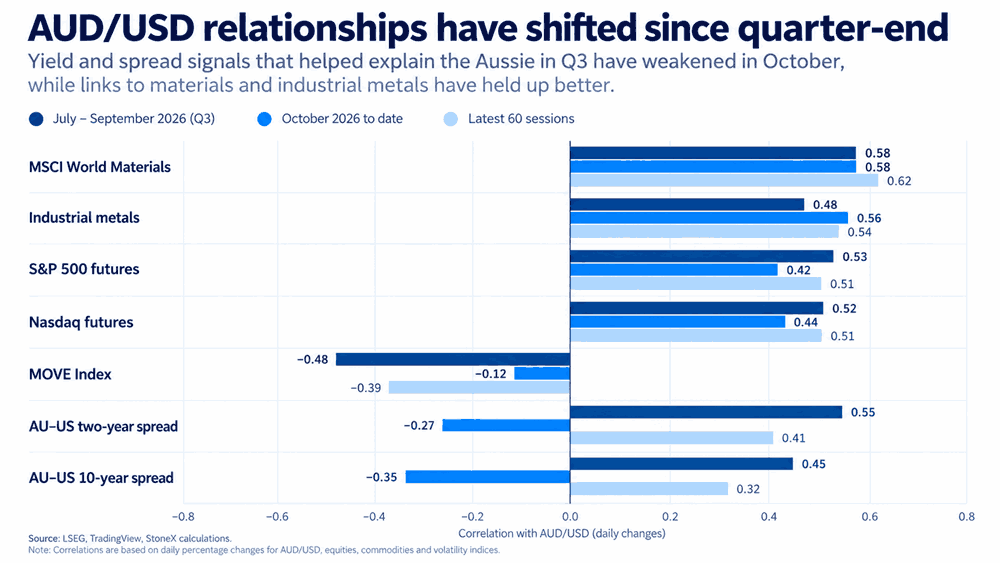
As the graphic below shows, AUD/USD maintained a reasonably strong positive correlation with short and longer-dated yield spreads between Australia and the US during the September quarter, at +0.55 and +0.45 respectively. But so far in October, both relationships have flipped on their head, sitting in mildly negative territory. There's also been no consistent relationship with outright US Treasury yields, suggesting interest rate movements may not be a particularly useful steer for directional risk in the Aussie right now.
Source: LSEG
In contrast, its relationship with cyclical assets, such as global materials equities and industrial metals, has been far more consistent, including in October. That's evident in the correlation coefficients with the MSCI World Materials Index and Bloomberg Industrial Metals Index of +0.58 and +0.56 respectively this month, broadly consistent with what we saw over the September quarter.
AUD/USD has also maintained a mildly positive relationship with US equity futures, indicating the Aussie still clings to its historical standing as a cyclical risk-on barometer.
While these relationships are not definitive by any stretch, just because the Aussie was undermined by an unwind in hawkish RBA pricing yesterday doesn't mean that weakness will necessarily continue beyond the move already seen.
Risk appetite offers the Aussie a potential lifeline
Precious metals rallied sharply on Thursday, with gold and silver posting large gains after being hit hard earlier in the week, while US equities pared earlier losses to finish flat to higher, led by cyclical sectors.
With the Aussie maintaining a persistent positive relationship with cyclical assets, the recovery in broader risk appetite hints that Thursday's weakness may not last heading into the weekend.
AUD/USD: Bulls look to build on morning star reversal
Source: TradingView
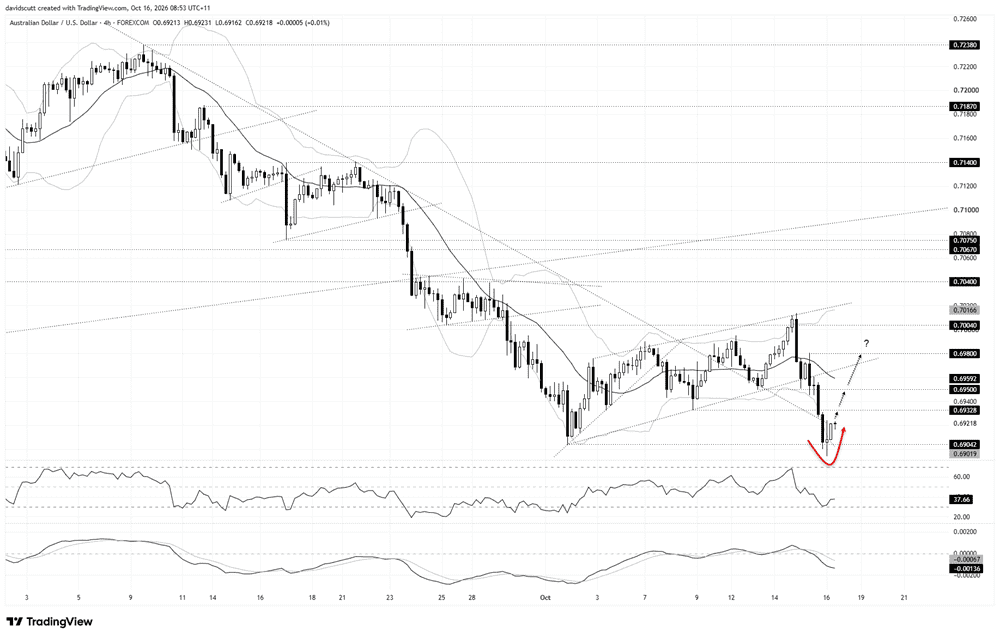
AUD/USD traded and closed beneath its lower Bollinger Band on the four-hourly timeframe following the jobs report, prompting me to undertake a historical backtest of similar episodes to see how the Aussie tended to perform in the period following.
However, the results revealed no strong tendency in either direction, suggesting there may be more signal from price action than stretched conditions in the short term.
Having traded to fresh multi-month lows beneath 0.69042 during Thursday's Asian session, bids managed to push AUD/USD back above the level, with the following candle extending the rebound and closing more than halfway up the preceding bearish candle, completing a bullish morning star reversal pattern in the process.
The key now is whether we see follow-through buying into early Asian trade. If the price holds up heading towards the opening of Asian equity markets, longs could be considered with a tight stop beneath entry for protection, targeting initially 0.69328, the October 8 low. Above that, 0.6950 and 0.6980 are other levels that screen as potential targets, with a tougher resistance zone looming above 0.7000.
On the downside, a reversal back towards 0.69042 would question the merits of long setups, putting greater emphasis on price action around that level when assessing directional risk. A move beneath 0.69042 that sticks on a closing basis would shift directional risk back to the downside in the near term, especially with RSI (14) and MACD continuing to favour short setups over longs.