
- Trump comments accelerate USD unwind
- AUD/USD gains underpinned by widening rate differentials
- Australia Q4 inflation report looms
- Upside inflation risk supports AUD, downside risks a flush
Summary
The U.S. dollar slid sharply on Tuesday after explicit political signals from Donald Trump removed resistance to further weakness, overwhelming an otherwise supportive macro backdrop. That unwind has set the tone for FX markets and pushed AUD/USD sharply higher ahead of key inflation data.
Trump Accelerates Dollar Dump
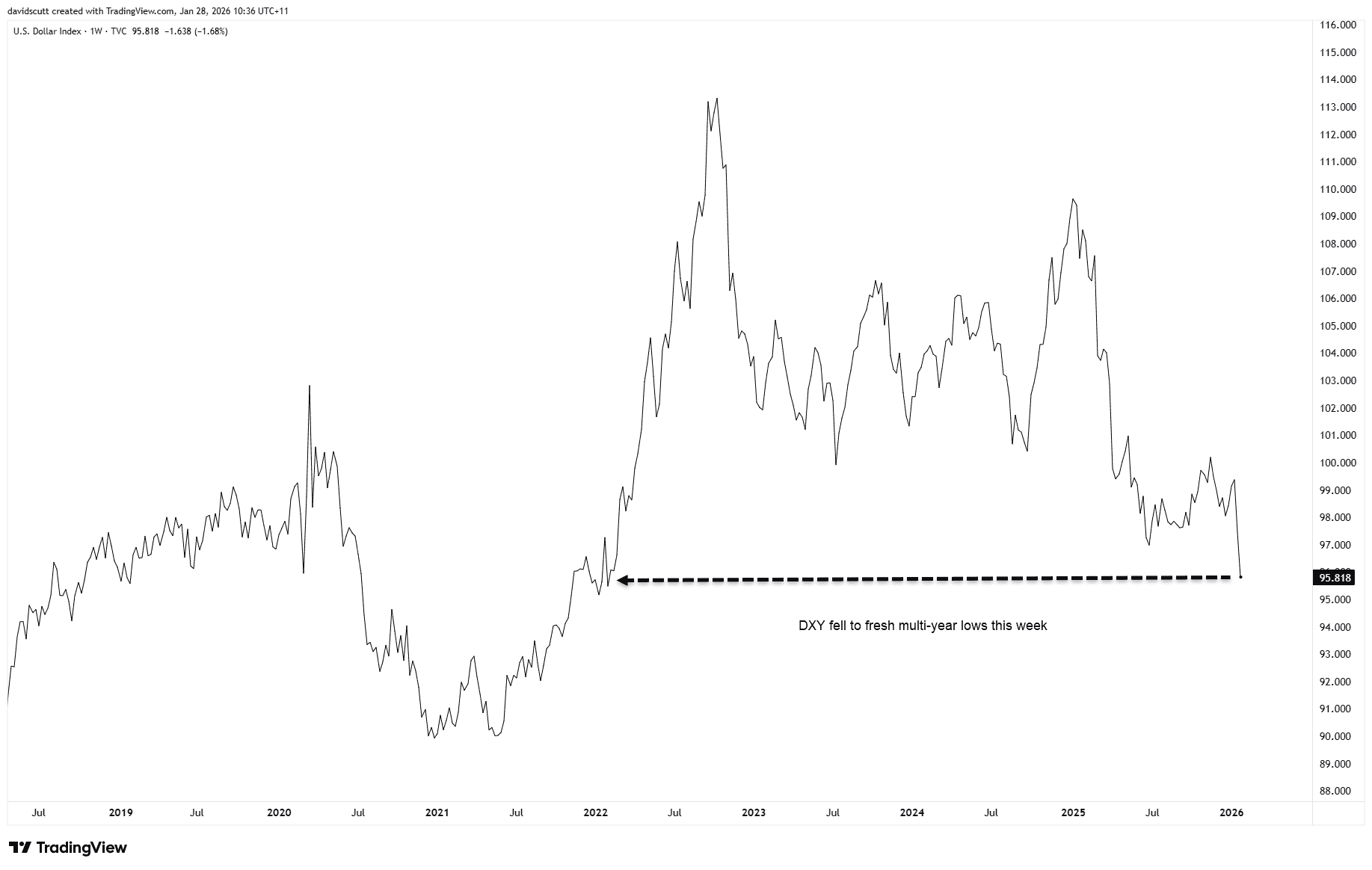
The latest leg lower in the U.S. dollar was triggered by President Trump himself. His remarks on Tuesday that the currency had not weakened “excessively”, that the move was “great”, and that the dollar should be allowed to “seek its own level” removed any remaining ambiguity around the administration’s tolerance for depreciation. Markets treated the comments as confirmation rather than an off-the-cuff remark, accelerating a sell-off that was already underway, dragging the dollar index to its weakest levels in years.
Source: TradingView
That reaction was the culmination of a sequence of policy signals. Earlier in the month, Treasury Secretary Scott Bessent openly questioned the extent of dollar strength against several Asian currencies, including the yen and the won, implying FX levels had drifted away from fundamentals. Days later, reports of the New York Fed conducting rate checks in USD/JPY reinforced suspicions US authorities were actively leaning against further dollar appreciation, particularly in Asia.
Those developments helped spark a sharp reversal in USD/JPY as traders positioned for potential Japanese intervention, but the implications quickly extended beyond the region. The perception of an emerging softer-dollar bias encouraged USD selling across G10, especially with positioning already stretched after a prolonged period of U.S. exceptionalism and dollar resilience.
Renewed tariff brinkmanship and erratic geopolitical manoeuvring from Washington have only added to the pressure. Fresh threats against allies, selective targeting, and abrupt reversals have reignited concerns around policy unpredictability, reinforcing the broader ‘sell America’ narrative.
What stands out is that the dollar’s unwind has unfolded despite continued U.S. economic outperformance. Growth momentum remains firm, data continues to surprise on the upside, and rate cut pricing has been scaled back. Ordinarily, that combination would be supportive. Instead, policy signalling, political risk, and FX-specific intervention fears have overwhelmed the macro positives, leaving the dollar vulnerable to continued downside.
Rates Repricing Boosts AUD
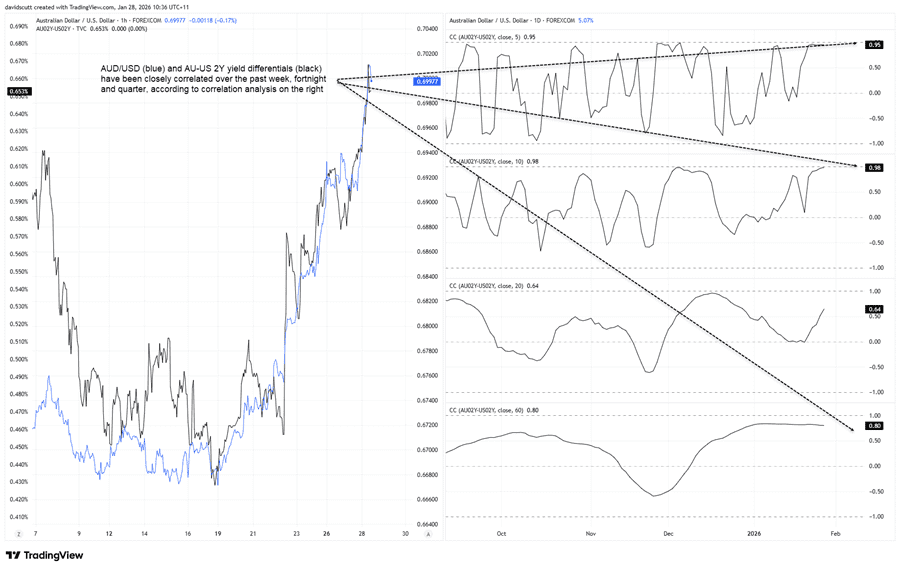
That dollar unwind has fed directly into the surge in AUD/USD, amplifying what has already been a powerful move driven by domestic factors. The Aussie has clearly benefited from the broader USD dump, but the rally has not been indiscriminate. Stronger commodity prices and a firmer yuan against the dollar have provided important external support, reinforcing demand for pro-cyclical and China-levered FX.
Source: TradingView
More importantly, the shift in the domestic rates outlook has become a decisive tailwind. Australian yields have repriced sharply higher relative to the US, and that widening rate differential has reasserted itself as a dominant driver of AUD/USD. The rolling 5, 10 and 60-day correlations between AUD/USD and Australia–U.S. two-year yield differentials, sitting at 0.95, 0.98 and 0.8 respectively, underline just how tightly price action has tracked relative rate expectations.
That strength is not coincidental. It reflects a market increasingly comfortable expressing AUD upside through rates rather than purely through risk sentiment or commodities. In that context, the Aussie’s recent outperformance across the G10 complex looks less like a speculative squeeze and more like a re-alignment with a rates backdrop that has shifted decisively in its favour.
Market Primed for Hot Inflation Print
That makes today’s Australian inflation report pivotal for AUD/USD, particularly with rate differentials now dominating price action over both the short and medium term. With the currency tightly aligned to Australia–US two-year yield spreads, even a modest CPI surprise has the potential to drive an outsized FX response.
The RBA is assuming trimmed mean inflation of 0.8 percent quarter-on-quarter, or around 3.2 percent annually, broadly in line with the median economist forecast. However, the skew of individual forecasts leans toward a hotter outcome, not a cooler one, a bias reinforced by the heavy tone in Australian three-year bond futures into the release.
With more than two full rate hikes now priced into the OIS curve for this year, the market is clearly positioned for inflation to remain firm with risks skewed to the upside. That leaves little room for disappointment for bulls. Any meaningful undershoot relative to expectations risks triggering a sharp near-term downside flush in AUD/USD as rate support is quickly unwound.
Aussie Overload?
Source: TradingView
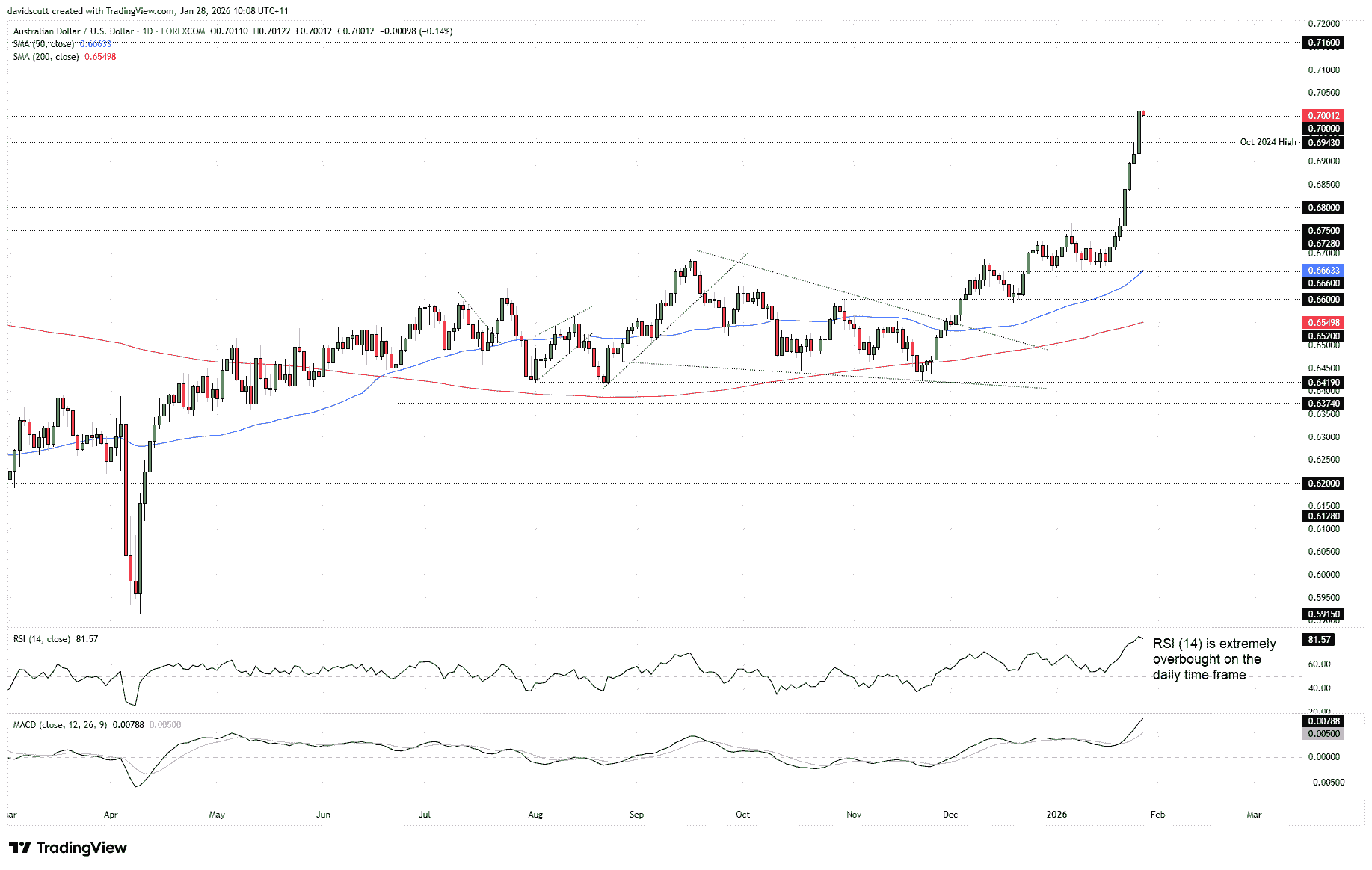
Before looking at the broader technical picture, it’s worth noting that RSI (14) hit its most overbought level in around 20 years on Wednesday. That adds to the sense AUD/USD is stretched and therefore vulnerable to an inflation undershoot, even though the broader signal from momentum oscillators remains firmly bullish.
Wednesday’s surge saw AUD/USD hit its highest level since Valentine’s Day 2023, breaking above the psychologically important .7000 level. When the pair last traded around this area, it was probed and prodded for extended periods, with very few breaks above managing to stick. That history suggests near-term price action around .7000 will be instructive in determining where medium to longer-term directional risks lie.
If the pair can establish a foothold above .7000, the January 2023 swing high at .7160 comes into view for bulls. However, a reversal back below the figure that persists would raise the risk of a bearish unwind, potentially bringing the October 2024 high at .6943 into play. A clean break of that level would open the path for a deeper pullback towards .6800.
My overall assessment is that AUD/USD remains a buy-on-dips and bullish-breakout play, but risk management should be front of mind given the growing risk of a near-term pullback.