- RBA expected to hold cash rate at 3.60%, focus on statement tone
- Strong CPI, spending and labour data create hike risk for H1 2026
- AUD/USD trades near 0.6625, technical bias remains bullish
Summary
The data flow points to the risk that the RBA may signal an end to the easing cycle, reinforcing its hawkish tone from November. Inflation remains sticky, demand is firm and labour market slack is waning, all of which argue against further cuts. However, markets have already priced that shift aggressively. If the Bank stops short of going that far, it could set up a classic ‘buy the rumour, sell the fact’ outcome, leaving AUD vulnerable to a knee-jerk pullback before the broader bullish trend reasserts itself.
Hawkish Tone Already Set in November
The Reserve Bank of Australia enters its final meeting of the year with a distinctly hawkish tone already established in November, when the Board warned that “inflation has recently picked up.” That phrase will be the one traders focus on today, as it signals the RBA’s growing discomfort with price pressures that were “materially higher than expected” in the September quarter. At the same time, the Bank acknowledged uncertainty about whether policy remains restrictive, a subtle but important admission that the easing cycle may have run its course.
Source: ABS
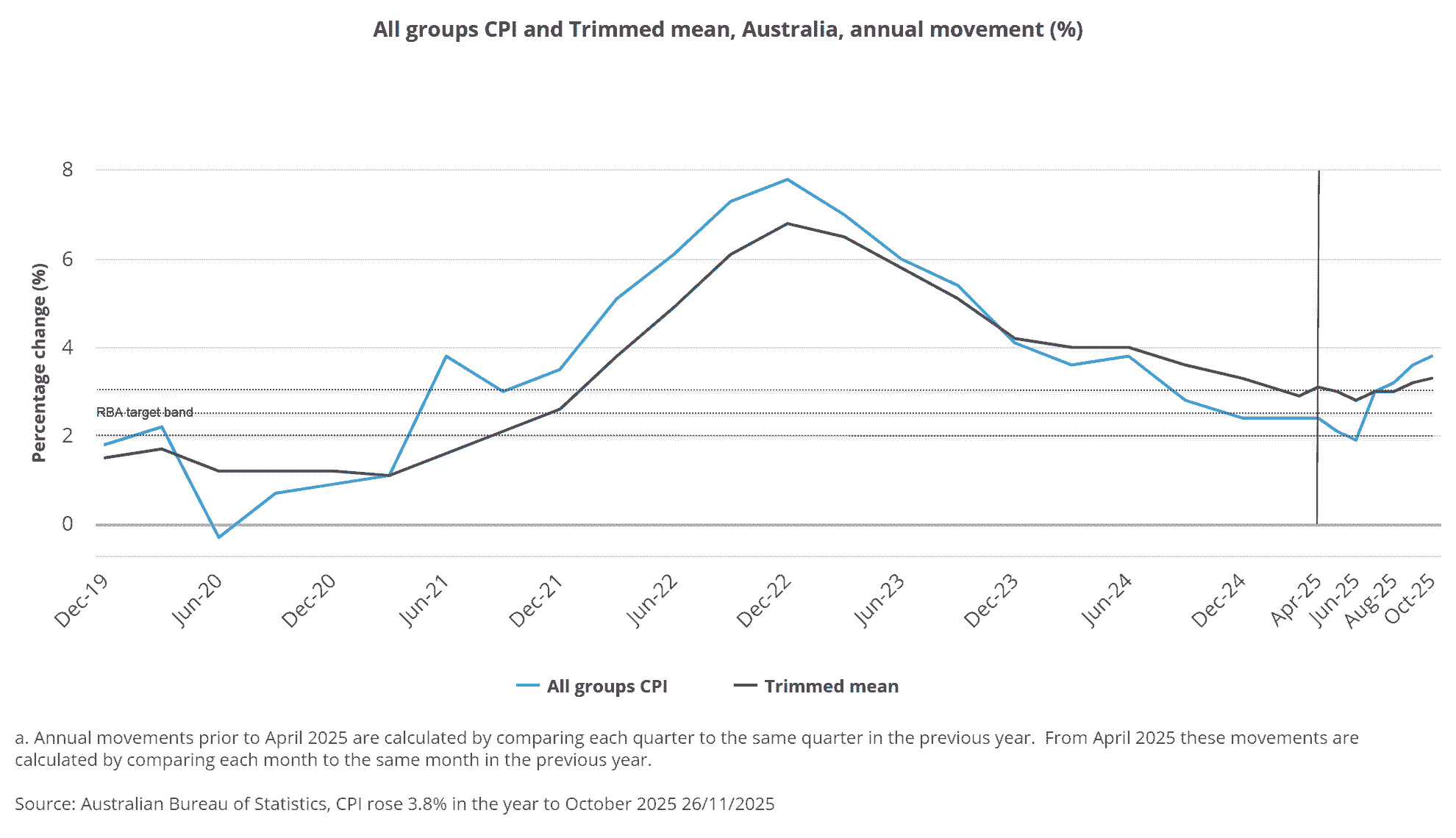
Since then, the data has only reinforced those concerns. October’s CPI report showed headline and trimmed mean inflation accelerating further, both above the top of the 2–3% target band, while household spending surged 1.3%, the strongest monthly gain since January 2024. Discretionary categories led the improvement, suggesting demand is not just holding up but strengthening, a dynamic that risks amplifying underlying price pressures.
Labour market conditions have also tightened. Unemployment tumbled to 4.3% from 4.5% as employment surged by 42,200, while underemployment and underutilisation fell alongside youth unemployment. These shifts hint that slack in the economy is being eaten into, raising the risk that wage pressures could reaccelerate, particularly with productivity growth weak and unit labour costs still high.
Policy Options Narrow: Hold or Hike
Against this backdrop, it is highly likely that if the RBA discusses two policy options today, they will be to hold or hike, not hold or cut. It’s likely this will be the first question RBA Governor Michele Bullock is asked at her post-meeting press conference, scheduled to begin an hour after the rates decision drops at 2.30pm AEDT.
Source: Bloomberg
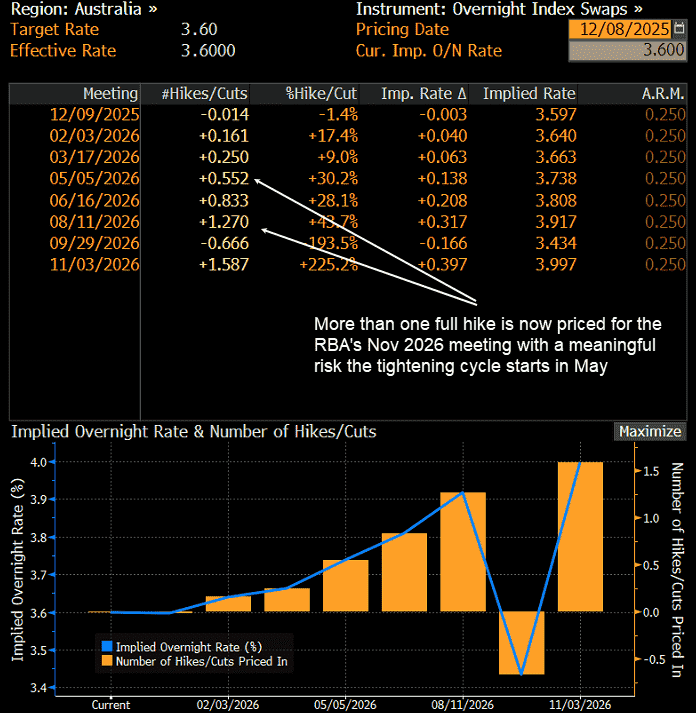
Heading into the December meeting, swaps are fully priced for the RBA’s next hiking cycle to begin by November next year, with around a one-in-four chance of a second 25-point increase also baked in for that meeting. The first move may arrive even sooner, with pricing for a hike at the RBA’s May meeting sitting at 55%, indicating traders marginally favour a move within six months.

What to Watch in the Statement
For traders, the real test will come from the language the RBA uses to describe the labour market, inflation, wage pressures and cyclical areas such as housing and consumer spending. Pay particular attention to the final paragraph of the statement, as this is where the Bank often delivers explicit guidance on the rate outlook. While it’s unlikely to appear today, if there is a tweak, it’s far more likely to be hawkish than dovish.
For those new to trading around the RBA decision, the subheadings in the statement provide an excellent and near-instant read on the Bank’s thinking, allowing for quick assessment of how markets may react. Keep in mind that Michele Bullock often comes across as more hawkish than the tone of the statement, which is crafted by the entire Board, so the period between the statement and her press conference could be volatile.
Trading Risks: Buy the Rumour, Sell the Fact?
My concern heading into the meeting is that hawkish pricing has advanced far beyond what the RBA will be willing to signal publicly. That raises the risk of a ‘buy the rumour, sell the fact’ outcome unless the Bank turns truly hawkish. This points to the potential for knee-jerk weakness in AUD, although it’s debatable how long it would last.
AUD/USD Technical Picture
Source: AUD/USD
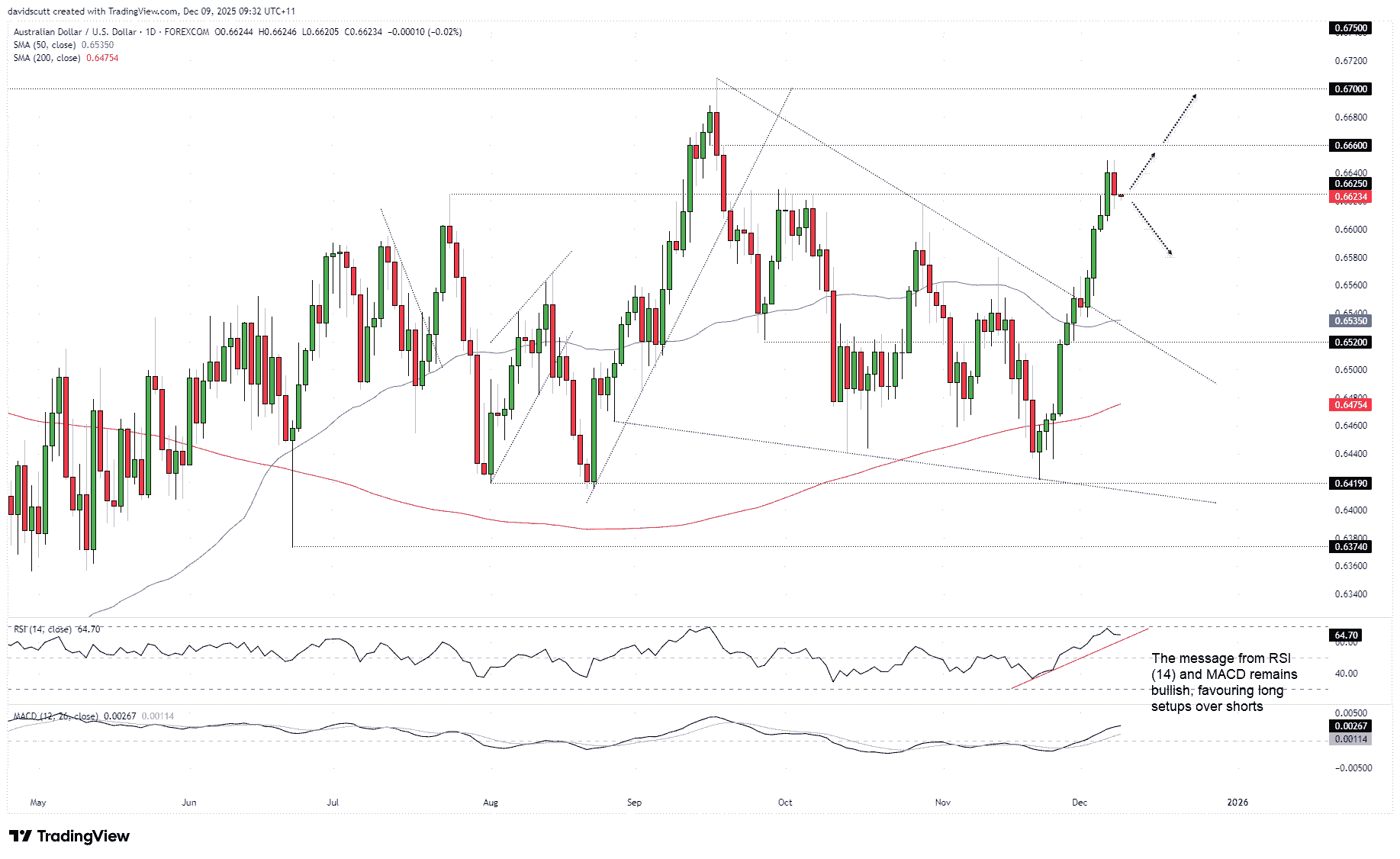
Looking at AUD/USD on the charts, the breakout risk flagged from the falling wedge it had been trading in has played out nicely, with the price surging to multi-month highs last week. However, with not only the RBA but also Fed rate decisions looming large, it’s not surprising that we’ve seen some profit-taking in the Aussie to start the week, resulting in AUD/USD slipping back to former resistance at 0.6625. That’s the key level for traders to watch today, providing a level to build trades around depending on how the price reacts.
Should AUD/USD hold above 0.6625, longs could be set with a stop beneath for protection, targeting 0.6650 or 0.6660 initially, with 0.6700 a far tougher test overhead. Conversely, if the pair slips below 0.6625 and holds there, it would allow for shorts to be set with a stop above, targeting the November high of 0.6580 initially.
The message from RSI (14) and MACD is entirely bullish, favouring long setups over shorts. Neither indicator suggests AUD/USD is particularly stretched either, so downside could be limited unless we receive a shock and highly unlikely dovish tone from the RBA later today.