
The Australian dollar has started the week with a slight short-term weakness, as AUD/USD posted a decline of around 0.5% in the first session. However, this move does not change the broader picture, as the pair remains in a predominantly bullish trend, with market focus now centered on today’s Reserve Bank of Australia decision, which could be key in shaping AUD strength in the near term.
In this context, if the central bank maintains or reinforces a more aggressive monetary policy stance, it could help sustain more stable buying pressure in AUD/USD, particularly against other central banks that remain on hold.

RBA decision day arrives
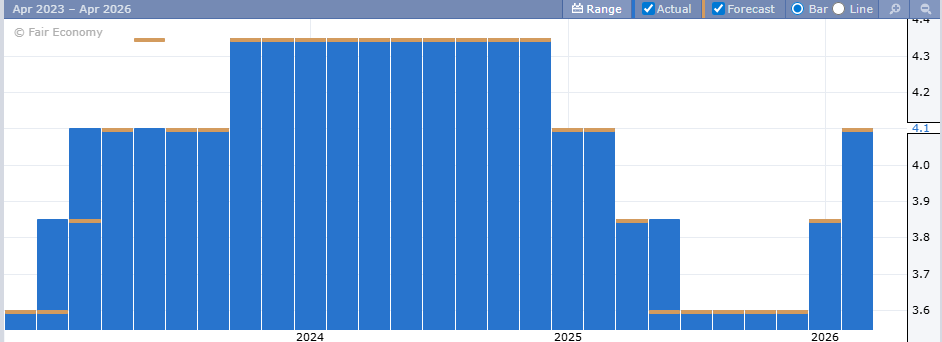
The Reserve Bank of Australia is set to announce its interest rate decision today, and market consensus suggests it could be one of the few central banks continuing to raise rates. Specifically, rates are expected to increase from 4.10% to 4.35%, in line with the tightening cycle seen in recent months.
This scenario is largely priced in, as previous decisions have aligned closely with market expectations. However, the key focus will be on the forward guidance, where the central bank may signal whether further hikes remain on the table.
Source: ForexFactory
If the central bank emphasizes the need to continue tightening, this could reinforce the relative strength of the Australian dollar against the US dollar, especially considering that the expected 4.35% rate would remain well above the Federal Reserve’s 3.75% benchmark.
This rate differential has been a key driver behind AUD strength in recent months and could remain so if Australia continues to adopt a more aggressive stance than the US.
At the same time, this policy stance is supported by inflation data. The RBA’s upper target is 3.00%, yet inflation remains elevated, standing around 4.6% in March—well above the 1.9% low recorded in June 2025.
This indicates that inflation has not shown a consistent slowdown, justifying a more prolonged restrictive stance.

Source: TradingEconomics
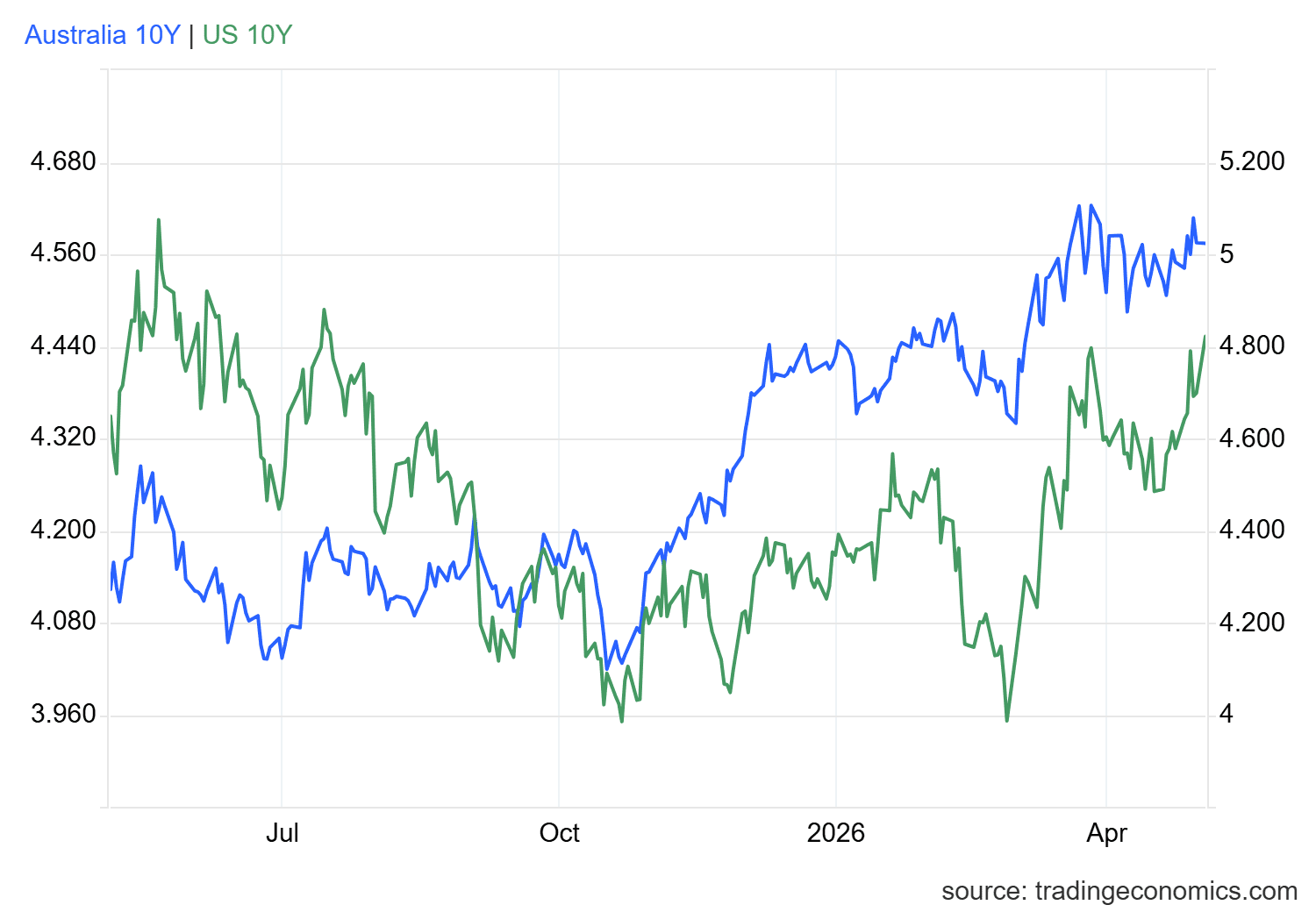
This dynamic is also reflected in the bond market, where Australian 10-year yields remain above 5.00%, clearly outperforming US Treasuries, which are currently around 4.45%.
This gap continues to favor AUD-denominated assets, as they offer higher relative returns, supporting the currency’s structural strength in recent months.
Source: TradingEconomics
Taking all of this into account, the market logic remains consistent: a central bank in an active tightening cycle versus a Federal Reserve on pause keeps AUD attractive. If the RBA confirms that further hikes are likely, this could support continued demand for the Australian dollar and help stabilize bullish pressure in AUD/USD in the short to medium term.
Technical outlook for AUD/USD
Source: StoneX, Tradingview
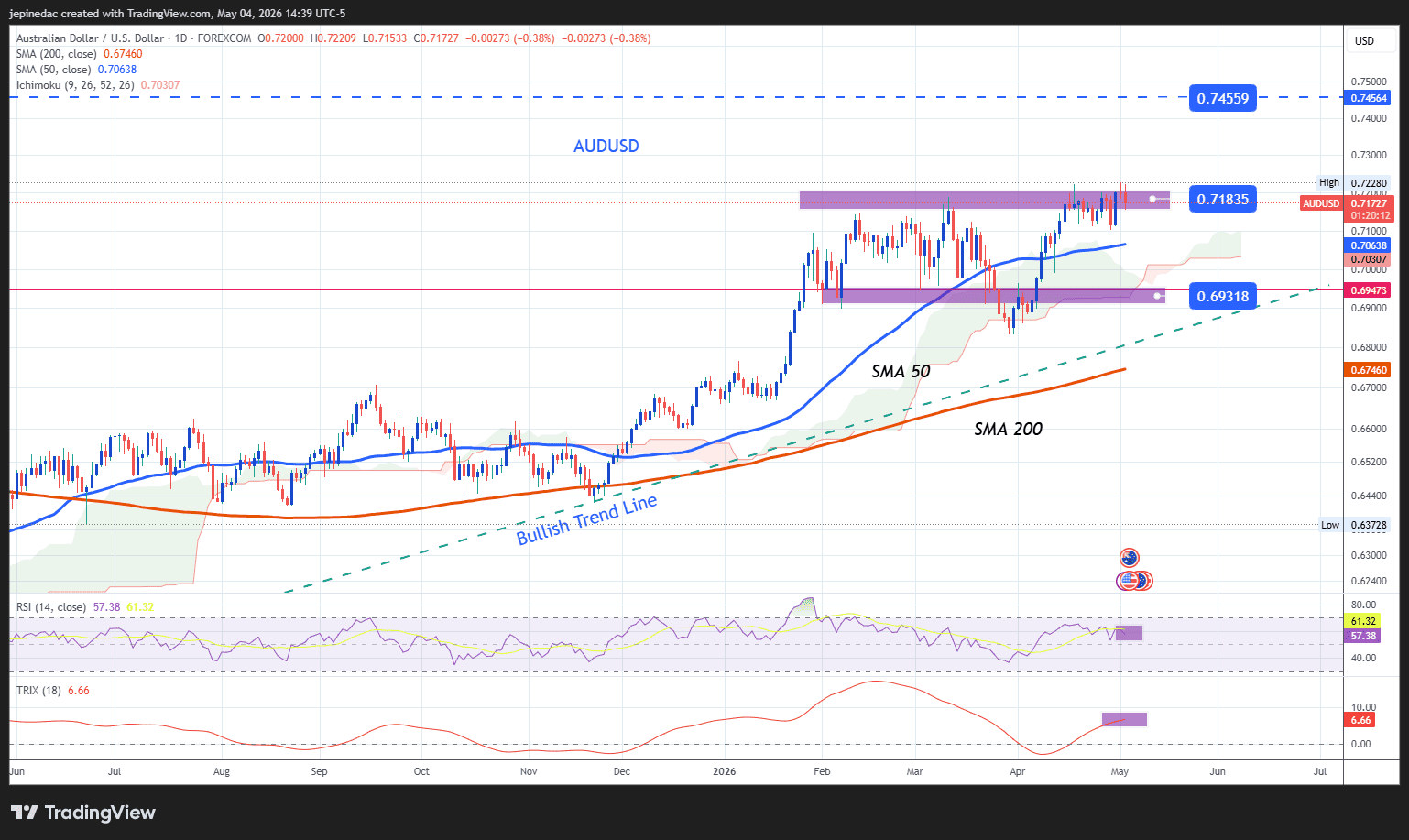
- Uptrend remains relevant: For several months, AUD/USD has maintained a long-term upward trendline, which continues to be the dominant technical structure. So far, no significant corrections have been strong enough to challenge this trend, suggesting that the bullish bias remains intact. As long as buying pressure holds, this structure is likely to continue guiding price action in the coming weeks.
- RSI: The RSI remains slightly above the 50 level, indicating that buying pressure remains relevant in the short term. If the indicator continues to recover, it could reinforce a clearer bullish bias in price behavior.
- TRIX: Similarly, the TRIX indicator remains above the zero level, reflecting that the underlying trend momentum remains in positive territory. This supports the view that the broader structure continues to favor the upside.
Key levels:
- 0.74559 – Key resistance: A level of highs not seen since April 2022. Moves toward this zone could reinforce the dominant bullish bias and open the door to further upside extension in the coming weeks.
- 0.71835 – Near-term barrier: A key reference zone where consistent pullbacks have been observed. A sustained move above this level could trigger a stronger short-term bullish move.
- 0.69318 – Key support: A level located below the 50-period moving average. A move toward this area could weaken the current structure and lead to a more defined phase of indecision or consolidation in the coming weeks.
Written by Julian Pineda, CFA, CMT – Market Analyst
Follow him on: @julianpineda25