
AUD/USD closed lower for a fourth week as the Australian dollar continued to retreat against the FX majors. Yet softer US payrolls, falling Fed hike expectations and increasingly stretched bearish positioning suggest the decline could lose momentum over the near term. With little top-tier Australian data scheduled, the US dollar and FOMC minutes could provide the main directional cues.
View related analysis:
- AUD/USD Q4 Outlook: RBA and Fed Hikes Set the Tone
- USD/CHF Reverses as Swiss Franc Surges amid Bond Carnage
- Tankan Backs BOJ Tightening, but Yen Rate Expectations Ease
-
AU Consumer and Business Confidence Feels the Heat of RBA Hike Bets
AUD/USD Bears Face Signs of Near-Term Exhaustion
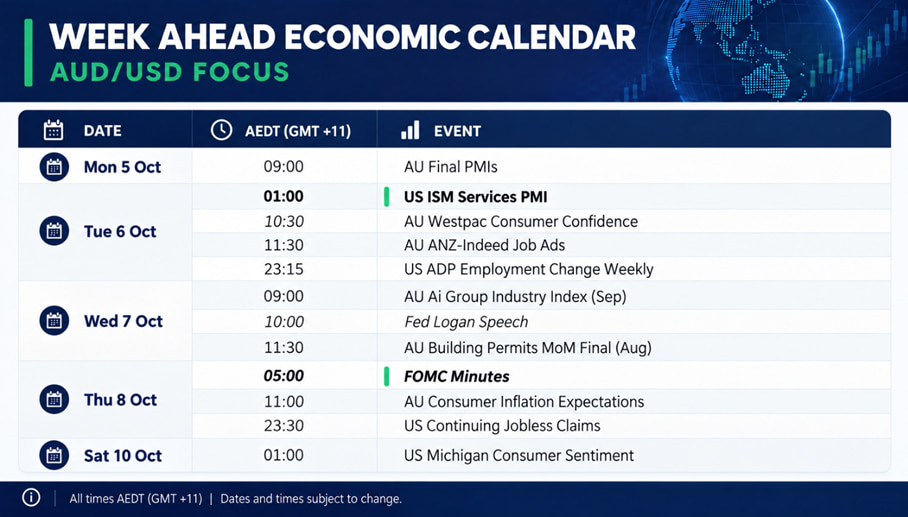
A softer-than-expected NFP report saw the odds of an October Fed hike fall to 22% from 70% earlier in the week, following a run of more dovish comments from Fed officials. Attention now shifts to the FOMC minutes, which could reveal how strongly policymakers favour further hikes after September’s 25bp increase. ISM services PMI will also provide a read on underlying growth, inflation and employment trends to help fine-tune Fed expectations.
There is no top-tier Australian economic data this week, although Westpac consumer confidence warrants a look. Its August report showed rising concerns over unemployment and interest-rate hikes, while the headline sentiment index and all of its components declined.
AUD/USD economic calendar for 5-10 Oct, highlighting Australian dollar and US dollar events, including ISM Services PMI and FOMC minutes.
Australia This Week: Economic Data and Events for AUD/USD Traders
AUD/USD Technical Analysis: Australian Dollar vs US Dollar
Two themes immediately jump out when I step back for a broader look at the Aussie dollar’s performance against FX majors. AUD is retracing against all FX majors, though the degree to which it is softening varies widely. This is in stark contrast to the year between April 2025 and 2026, when it was top dog and rising smoothly against the pack. This means traders may want to be more selective about what they pair AUD with and refer to lower timeframes.
- AUD/USD closed lower for a fourth week, though last week’s downside spike and shake-up in the US dollar mean its decline could slow over the near term – or even produce a small bounce.
- AUD/CAD has tested parity and is now amid a minor pullback, though its trend remains firmly bullish – so perhaps a break above parity could be on the cards.
- AUD/CHF also remains within a healthy correction against an established uptrend, making it another AUD pair for dip buyers to keep an eye on.
- AUD/EUR has met resistance around 0.62, though its series of higher lows suggests an ascending triangle – and therefore a potential bullish breakout – could be lining up.
- AUD/GBP seems to be forming a potential head and shoulders top, though for now we can simply focus on its ability to head for the March low.
- AUD/JPY has made a minor attempt at breaking the 2024 high, though its lacklustre effort leaves it vulnerable to a deeper pullback.
- AUD/NZD has formed a two-week pullback against an otherwise solid trend, making it another pair for dip buyers to keep an eye on.
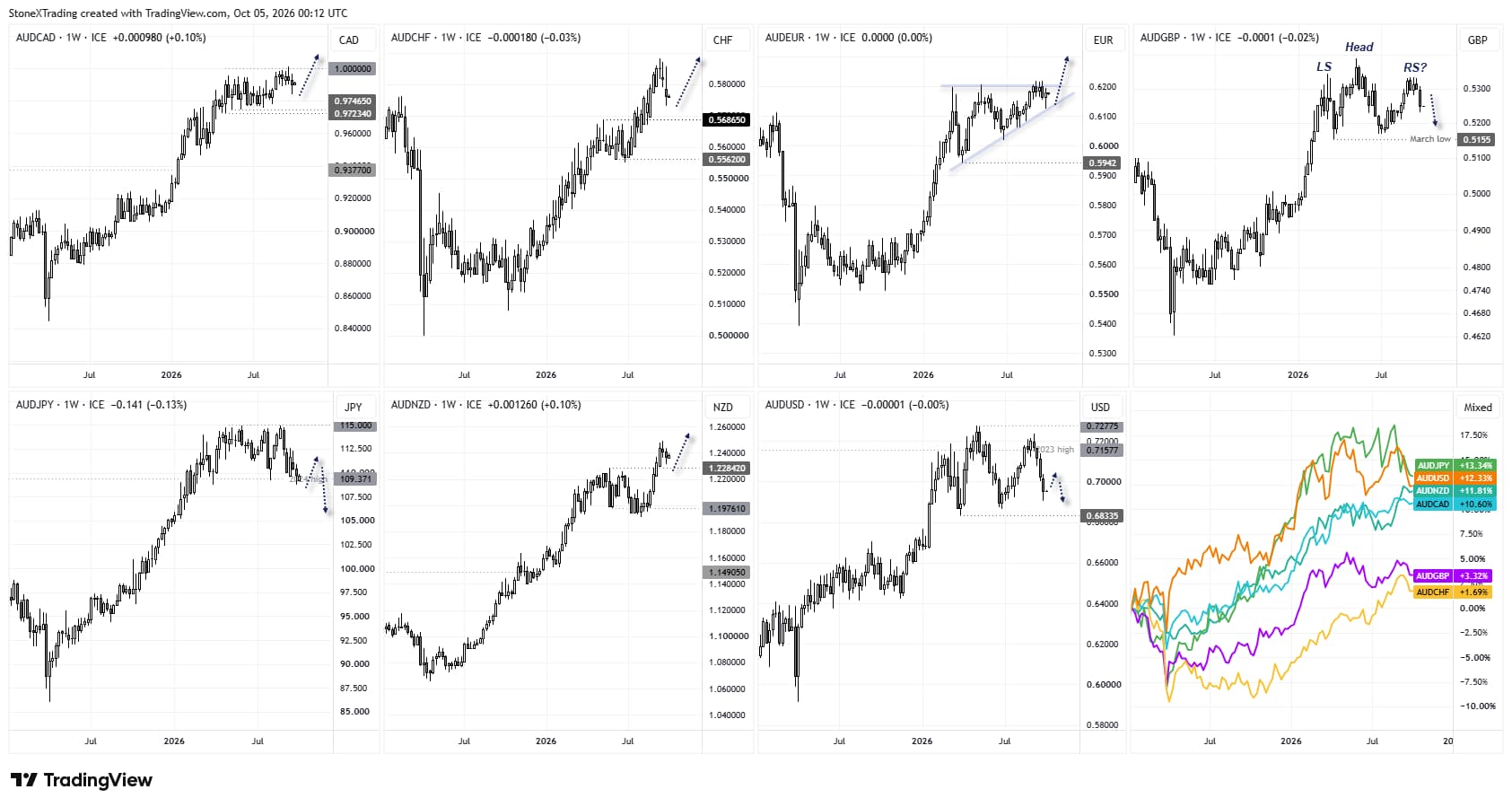
Chart prepared by Matt Simpson - Source: LSEG

AUD/USD Correlations
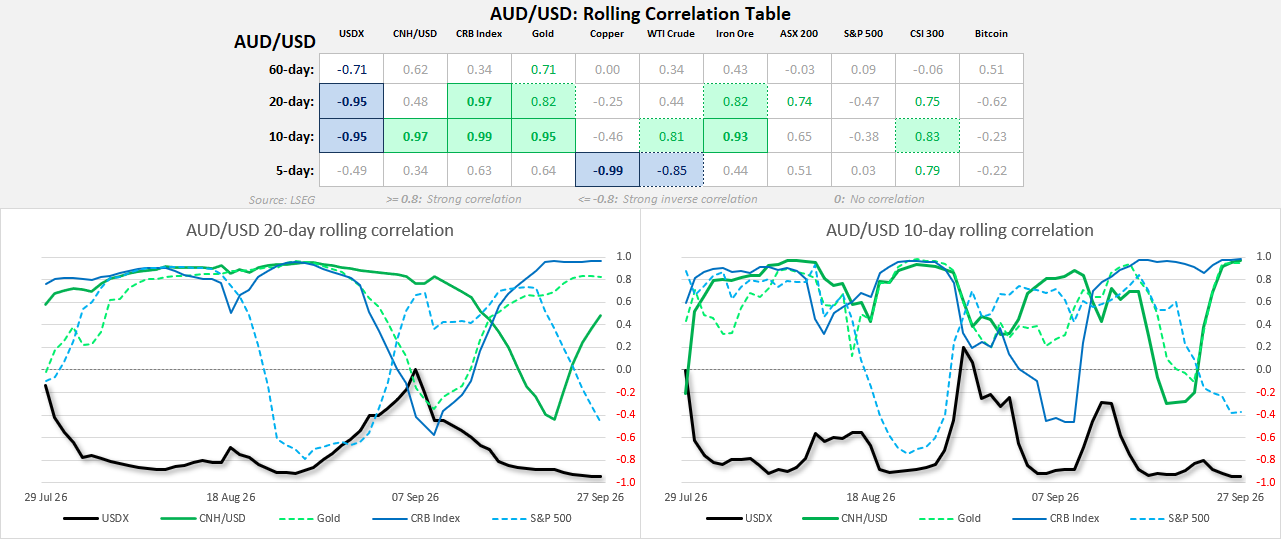
- US dollar remains the dominant driver: AUD/USD holds a very strong inverse correlation with DXY at -0.95 across both 10- and 20-day windows. Dollar weakness remains the cleanest bullish cue for AUD/USD.
- Commodities are strongly supportive: Correlations with the CRB Index are exceptionally high at 0.99 (10-day) and 0.97 (20-day), while gold and iron ore are also strongly positive.
- China-sensitive assets matter again: The yuan correlation has strengthened to 0.97 over 10 days, while the CSI 300 sits at 0.83, reinforcing China as an important confirmation signal for AUD/USD.
- Equities are giving mixed signals: AUD/USD remains positively linked with the ASX 200, but correlations with the S&P 500 are negative over 10 and 20 days, so broad “risk-on/risk-off” signals are less reliable.
- Very short-term commodity signals are distorted: Copper and WTI correlations have flipped sharply negative over five days, suggesting traders should favour the more stable 10- and 20-day relationships for directional confirmation.
Source: LSEG
AUD/USD Futures Positioning | COT Report
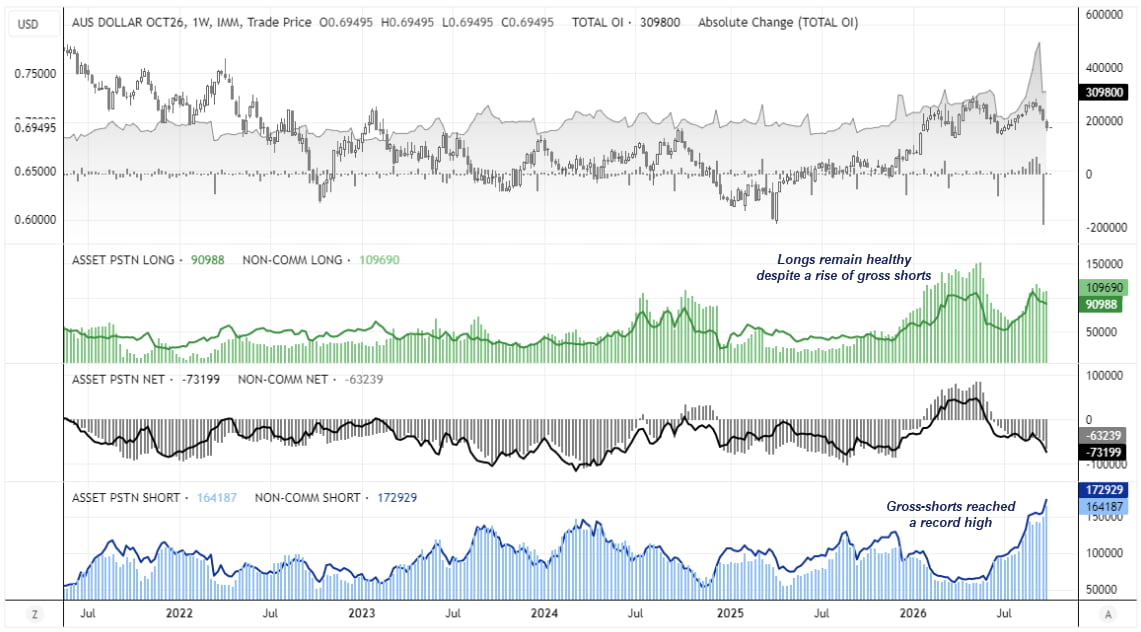
Bears have been piling into short AUD/USD futures, with large speculator and asset manager short exposure reaching record highs. However, there is still a healthy level of gross longs, so this is not an outright rout. That makes sense given Australia’s relatively high cash rate compared with other FX majors.
Total open interest has stabilised around 309k after plunging from its own record high the prior week. Again, this points to underlying support, even though record gross shorts may be signalling a near-term sentiment extreme.
Source: CFTC (COT) CME, LSEG
For traders wanting a deeper understanding of futures positioning, I’ve also published a guide on how to read and interpret weekly COT data in forex markets.
AUD/USD Options and Volatility Analysis (Risk Reversals, HVN Levels)
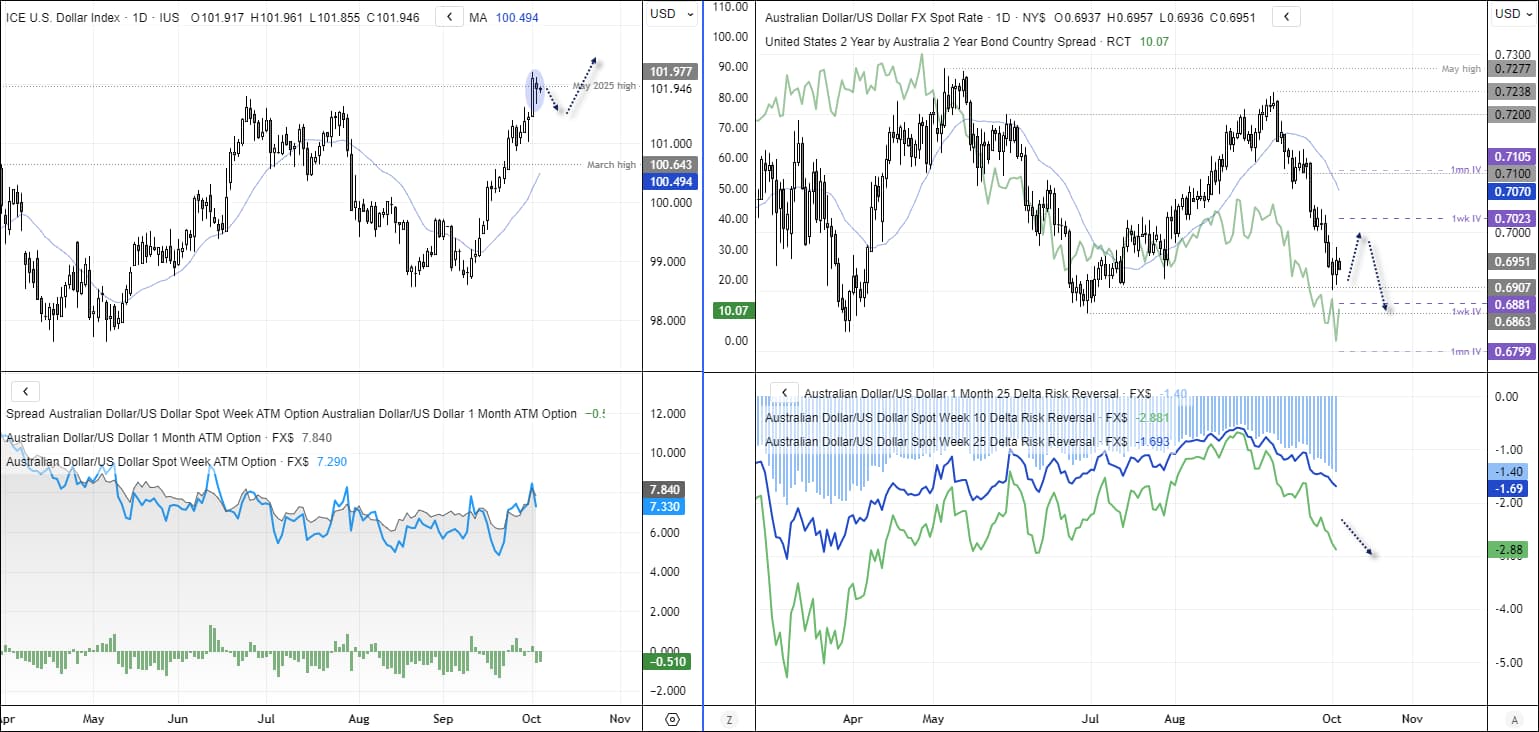
The US dollar remains firm overall, but Friday’s hammer and inside candle warn of near-term trend exhaustion. This could allow AUD/USD to catch its breath and perhaps form a minor bounce. We can see that it rebounded from Thursday’s low on Friday after finding support at the 0.6907 swing low.
With prices stretched below the 20-day SMA, perhaps some bullish mean reversion is due over the near term.
However, the AU-US 2-year yield spread remains relatively low, while risk reversals continue to trend lower, meaning options traders have increased their demand for puts relative to calls. The 1-week implied volatility band has narrowed slightly from last week and now sits at 0.6881–0.7023. The 1-month band sits roughly between 0.68–0.71.
Source: ICE, TradingView