
AUD/USD enters the week with bulls retaining a slight edge, despite mixed signals across the charts and increasingly bearish futures positioning. Australia's employment report is the standout event on an otherwise quiet calendar, with traders watching to see whether it can provide the catalyst for the pair's next move.
View related analysis:
- Nasdaq 100 Signals Deeper Pullback, Chipmakers Lead Selloff into Earnings
- Gold Outlook: XAU/USD Closes Below 4,000 for the First Time Since October
- Australian Dollar Outlook: AUD/USD Bounce Losing Steam Ahead of US CPI
- Yen Bears Capitulate, US Dollar Nearing Sentiment Extreme? | COT report
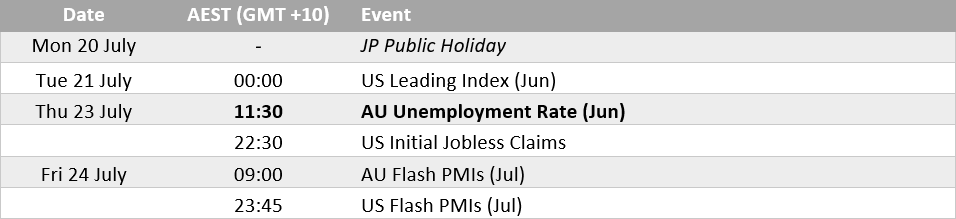
Australia This Week: Economic Data and Events for AUD/USD Traders
It is a good job we have the employment report on Thursday, otherwise the domestic calendar would officially be dead. Though it runs the risk of being a non-event if it continues to chug along with decent-ish figures.
Any concerns that Australia's labour market was beginning to roll over were put on the backburner after May's figures. Unemployment edged down to 4.4% from the 4½-year high of 4.5%, while employment rose by 40.3k, even if most of the gains came from part-time jobs. The figures should allow the RBA to retain a mildly hawkish bias, although they are unlikely to strengthen the case for another rate hike in the near term.
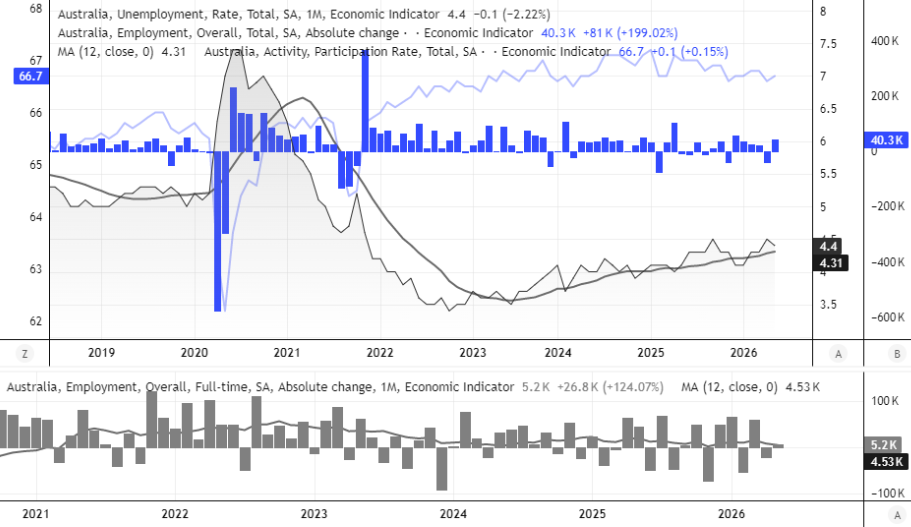
Source: ABS, LSEG
Unless the US flash PMIs deliver a meaningful surprise in either direction on Friday, or an unexpected catalyst emerges, it could prove to be another relatively quiet week for AUD/USD volatility from the economic calendar.
Appetite for risk may weigh on AUD/USD sentiment slightly should Wall Street earnings surprise to the downside, and traders will also keep an ear out for the latest saga of the US-Iran war.
Australian Dollar Performance Against Major Currencies
Another mixed performance from the Aussie dollar last week, rising against safe-havens Japanese yen and Swiss franc, the US dollar and euro. AUD was effectively flat against the British pound, and lost ground to the Canadian dollar and New Zealand dollar.
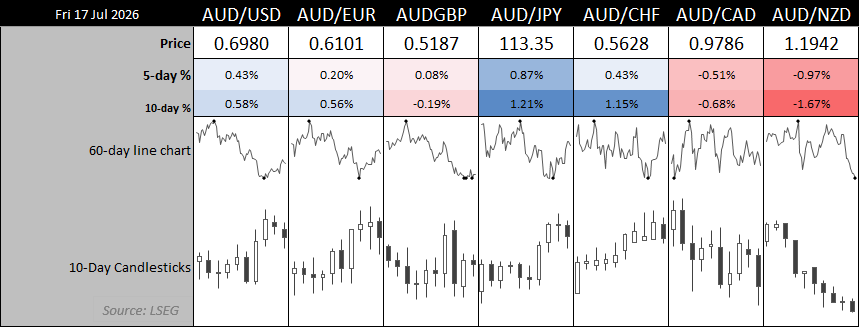
Source: LSEG
- AUD/USD rose for a third week, though only just managed to recoup its losses sustained during the week it fell below 70c
- AUD/CAD remains within its choppy sideways range, holding above the April high and 20-week EMA for now
- AUD/CHF increased for a second week, though handed back gains on Friday around the 2015 SNB-spike low
- AUD/EUR tracked AUD/USD higher for a third week, though last week’s doji warns of weakness to the underlying move
- AUD/GBP snapped a 3-week losing streak with a marginal gain of 0.04%, showing neither bulls or bears are in control for now
- AUD/JPY enjoyed its best week in 8 with its 0.9% gain, with bulls potentially eyeing another attempt at breaking above 115 should sentiment allow
- AUD/NZD suffered its worst 3-week run in 15 months and closed below 1.20

AUD/USD Technical Analysis: Australian Dollar vs US Dollar
AUD/USD Correlations
The inverse relationship between AUD/USD and the US dollar index remains consistently strong across the 10, 20 and 60-day timeframes. Positive correlations with the offshore yuan and NZD also remain firm, while links with equities are generally weak, suggesting broader risk sentiment is playing a smaller role in driving the Australian dollar.
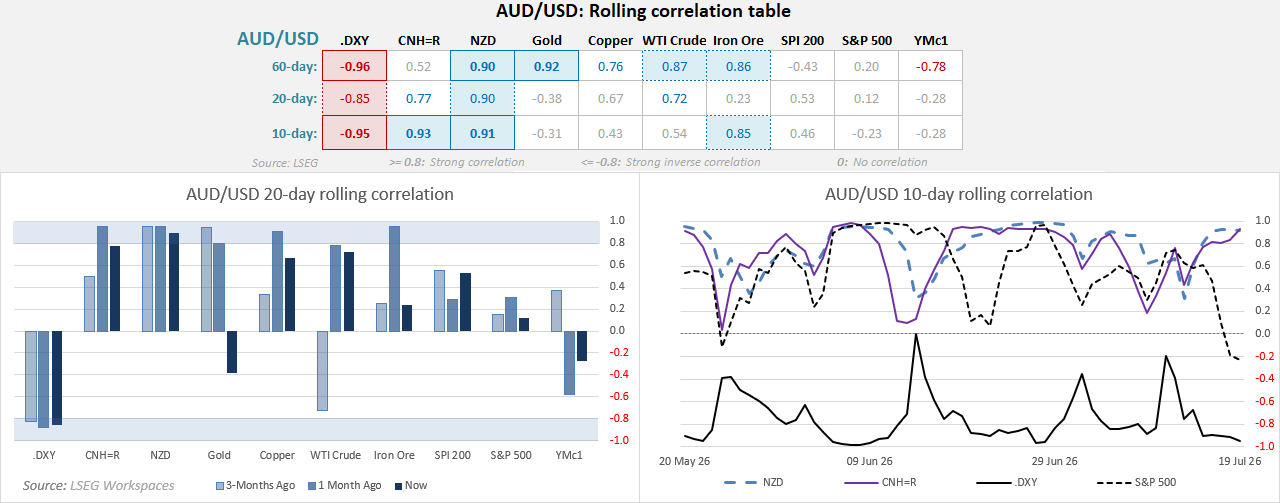
Source: LSEG
AUD/USD Futures Positioning | COT Report
Futures traders continued to turn more bearish on the Australian dollar last week, with gross longs declining and short positions increasing. Large speculators lifted net-short exposure for a fifth consecutive week to a 31-week high of 30.4k contracts. Asset managers were more measured, increasing net-short exposure by 3.2k contracts after adding 5.2k shorts while also increasing long positions by 1.9k contracts.
There is little in this dataset to suggest anything beyond a modest deterioration in sentiment towards the Australian dollar, with positioning still well short of bearish extremes. If anything, it suggests AUD/USD could remain rangebound, with rallies likely to be capped unless a fresh catalyst emerges.
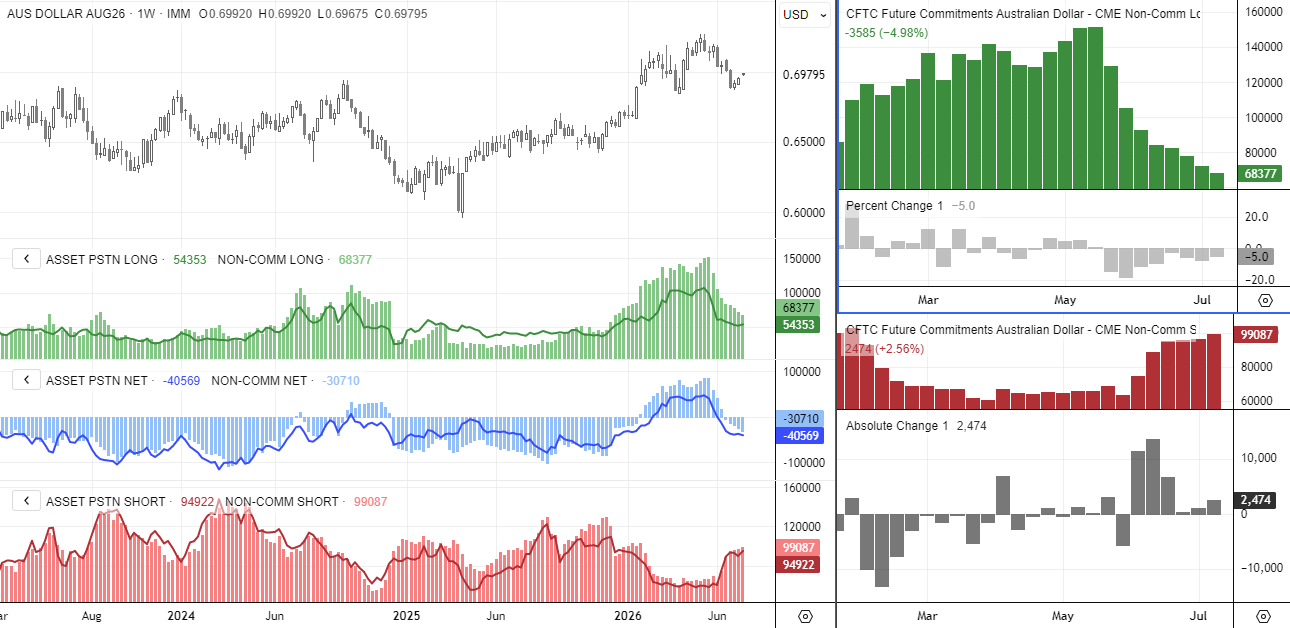
Source: CFTC (COT) CME, LSEG
For traders wanting a deeper understanding of futures positioning, I’ve also published a guide on how to read and interpret weekly COT data in forex markets.
AUD/USD Technical Analysis
There are a few mixed signals, although the bias may be tilted slightly to the upside this week. While AUD/USD advanced for a third consecutive week, it formed a wide-bodied, long-legged doji, highlighting indecision. Looking beyond the five-week rally at the end of February, the Australian dollar has generally seen winning streaks end after the third week over the past 15 months.
The daily chart, however, remains constructively bullish. A higher low and bullish engulfing candle formed above the 200-day EMA last week. While resistance emerged at the 50-day EMA, the narrow two-day pullback suggests bears lack conviction. With the AU–US two-year yield spread rebounding from multi-month lows, bulls may instead look to buy dips this week, even as implied volatility trends lower.
Volatility remains below its 20-week average, although it has begun to edge higher, as shown by the high-to-low percentage range indicator in the lower-right panel.
The 70c level remains the main hurdle for bulls. A sustained break above it would bring the one-week implied volatility range into focus, with the upper band pointing towards 0.7050. Beyond that, I suspect bears may still be seeking another crack at the March low.
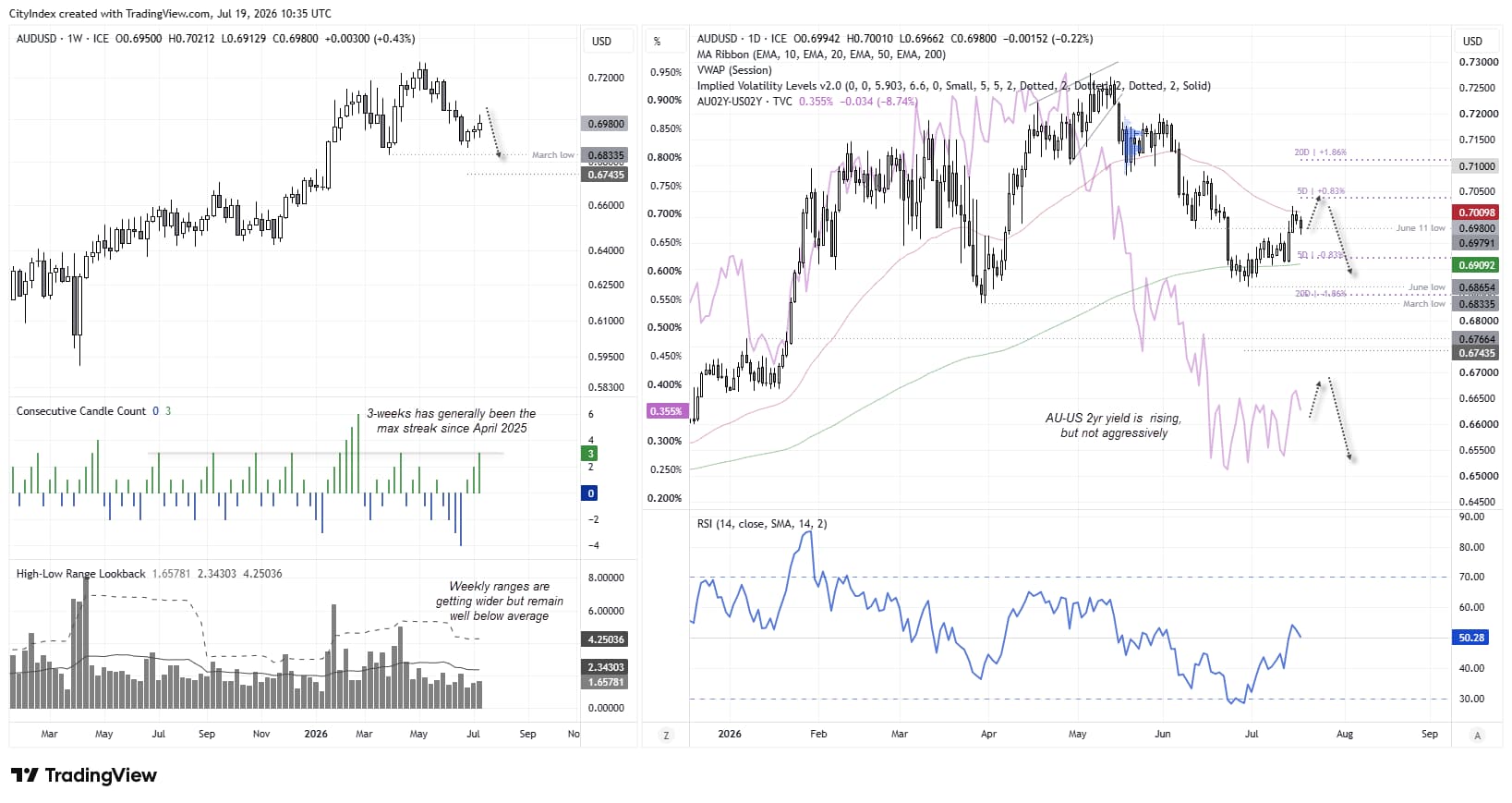
Source: ICE, TradingView
View the full economic calendar
-- Written by Matt Simpson
Follow Matt on Twitter @cLeverEdge