
Australia’s labour market continued to soften in July, with unemployment rising to 4.5%, employment contracting and participation falling. The data is unlikely to trigger an RBA policy shift, but it further reduces the case for another hike. The Australian dollar reaction was muted overall, although AUD/JPY and AUD/NZD are showing more interesting signs of bearish momentum.
View related analysis:
- US Dollar Slammed, USD/JPY Sinks on Treasury Buybacks
- Nasdaq 100 Outlook: Bond Yields Stoke Wall Street Risk
- Australian Dollar Outlook: Sentiment Rebounds, AUD/USD Nears Resistance
- Australian Dollar Outlook: AUD/USD Grinds into Jobs, DXY Holds Support
Australian Jobs Cool as AUD/JPY and AUD/NZD Signal Downside
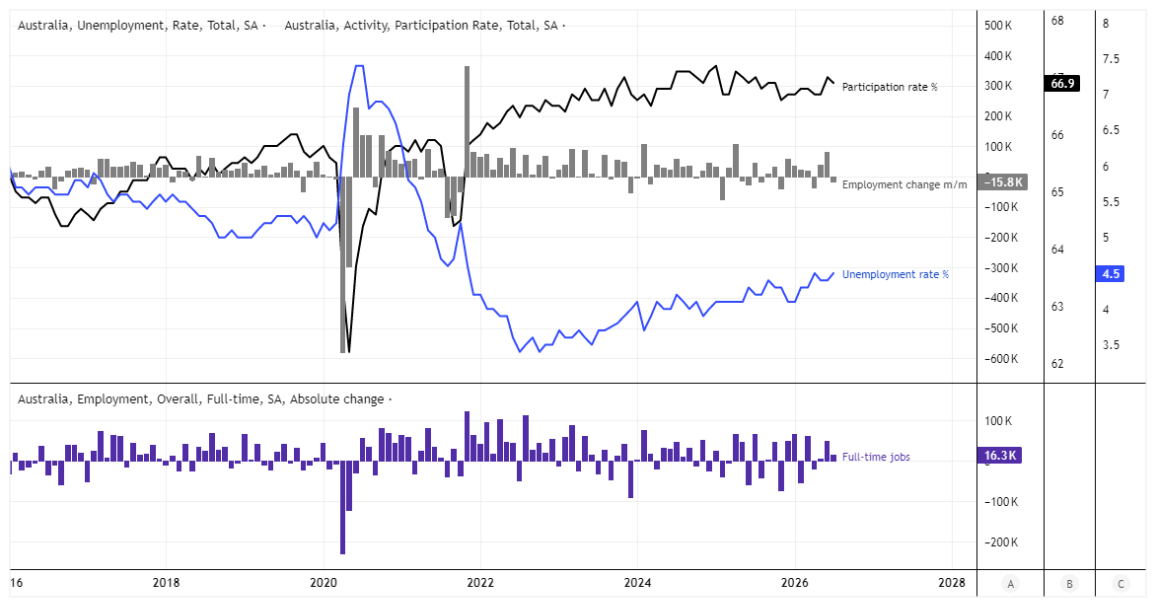
Australia’s employment figures are unlikely to move the needly much for the RBA, though it tils more towards an indefinite hold than it does lean into a hike. RBA cash rate futures were a 50/50 of a hike by December, and only marginally better for a hike by March. And with unemployment rising, participation and job growth low, those narrow odds are diminishing further.
None of these numbers scream impending recession, but it is showing gradual deterioration and not a jobs crisis. This suggests rate hikes are working, and trims already slight concerns for a hike. But at the same time, nowhere near bad enough to warrant a cut.
Source: ABS, LSEG
Australian Jobs Data Points to a Softer Labour Market
- Unemployment rose to 4.5%, matching its 4.5-year high set in April
- Job growth contracted by -15.8k, with a -32.2k part-time culling wiping out the 16.3k full-time jobs added
- The participation rate retreated by -0.16 percentage points to 66.9%, showing that June’s influx of new workers was a blip
- Underemployment edged lower to 6.4%, underutilisation was also lower to 10.9% - though still near its 2.5-year high
- Monthly hours worked was also softer at -0.6% in July, or down -1.4% from its May peak
- The 3-month % return for hours worked was its slowest since October 2011 and the annual return was effectively flat at 0.18%
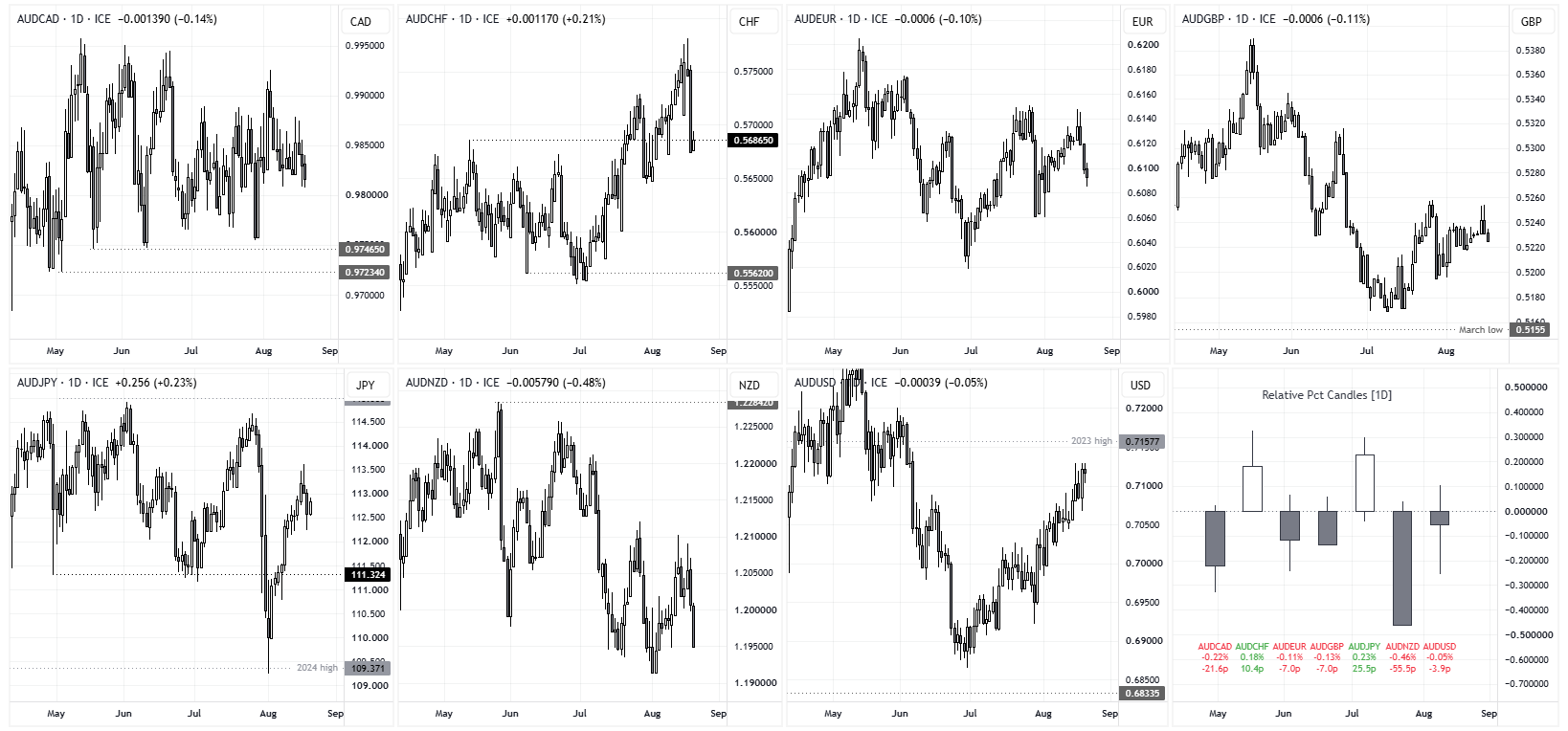
Australian Dollar Crosses Flash Bigger Moves Than AUD/USD
It has been a low-volatility and mixed reaction from the Australian dollar. AUD/USD was effectively flat once the initial reaction – which was small – settled, and was around 0.1% lower at the time of writing. The Aussie edged lower against the Euro and shows the potential to break lower against the British pound. But looking across Australian dollar pairs, AUD/JPY and AUD/NZD stand out as the most interesting, from a price action perspective.
Source: ICE, LSEG
AUD/JPY Technical Analysis: Australian Dollar vs Japanese Yen
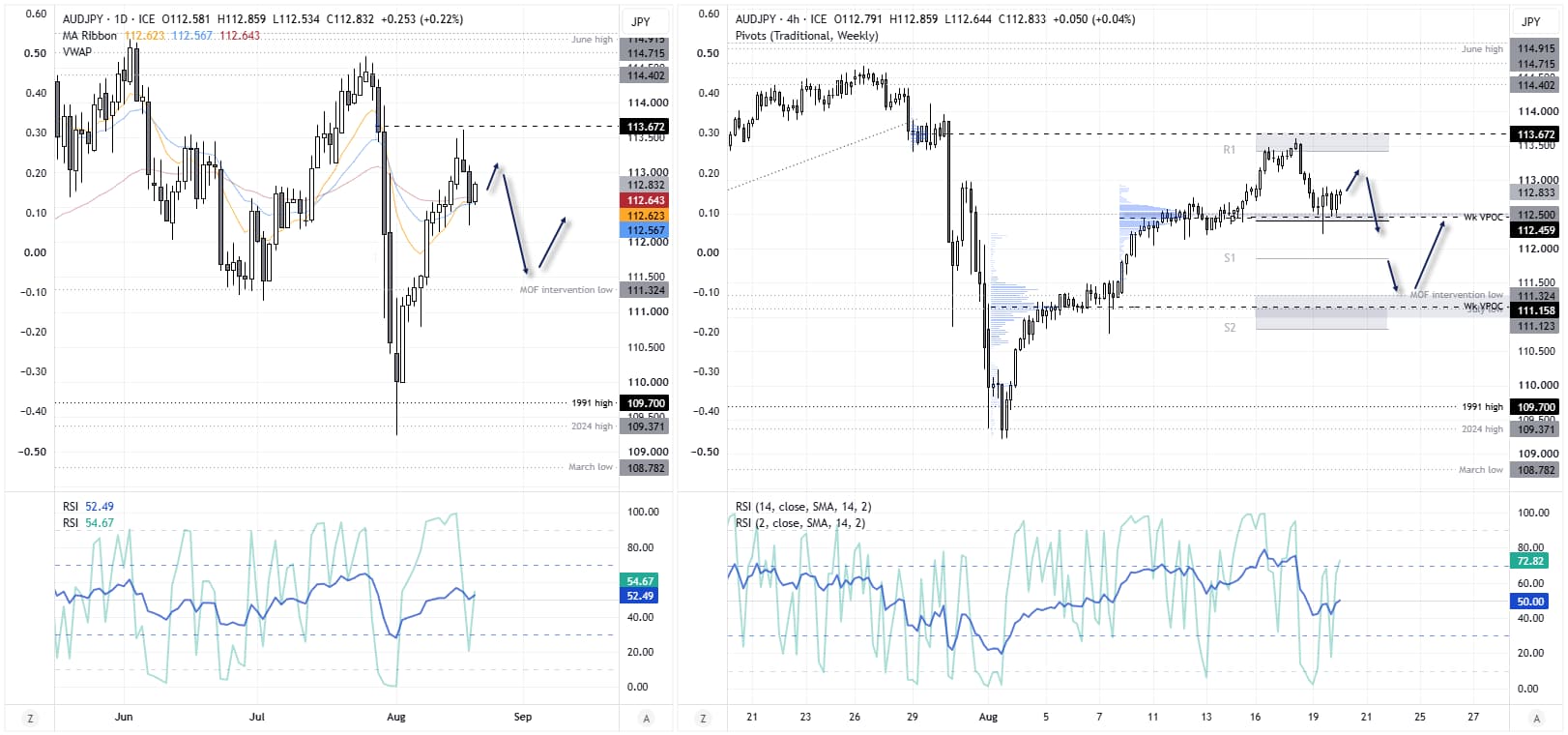
The Australian dollar benefited the most from recent Japanese yen weakness compared with its FX major peers. AUD/JPY rose 4% from the post-intervention low to Tuesday’s high, though momentum has clearly turned against the bulls. Tuesday’s shooting star reversal snapped a nine-day winning streak for AUD/JPY, before bearish momentum accelerated on Wednesday. The question now is whether there is more to this bearish move.
I outlined in other reports that I strongly suspect USD/JPY has topped for the year, and yesterday’s price action suggests it is ready for its next leg lower. However, with AUD/USD continuing to grind higher, I am not so confident that AUD/JPY will simply roll over. But there could be further downside over the near term while prices remain beneath Tuesday’s high.
AUD/JPY Bears Eye 113 for Fresh Short Opportunities
For now, AUD/JPY is holding above a cluster of support around 112.60 on the daily chart, including several moving averages, last week’s VPOC and the weekly pivot point. The higher low on the 4-hour chart also hints at a bounce, though bears may simply be waiting for prices to head towards 113 or the weekly R1 pivot point to seek fresh short opportunities.
Source: ICE, TradingView
AUD/NZD Technical Analysis: Australian Dollar vs New Zealand Dollar
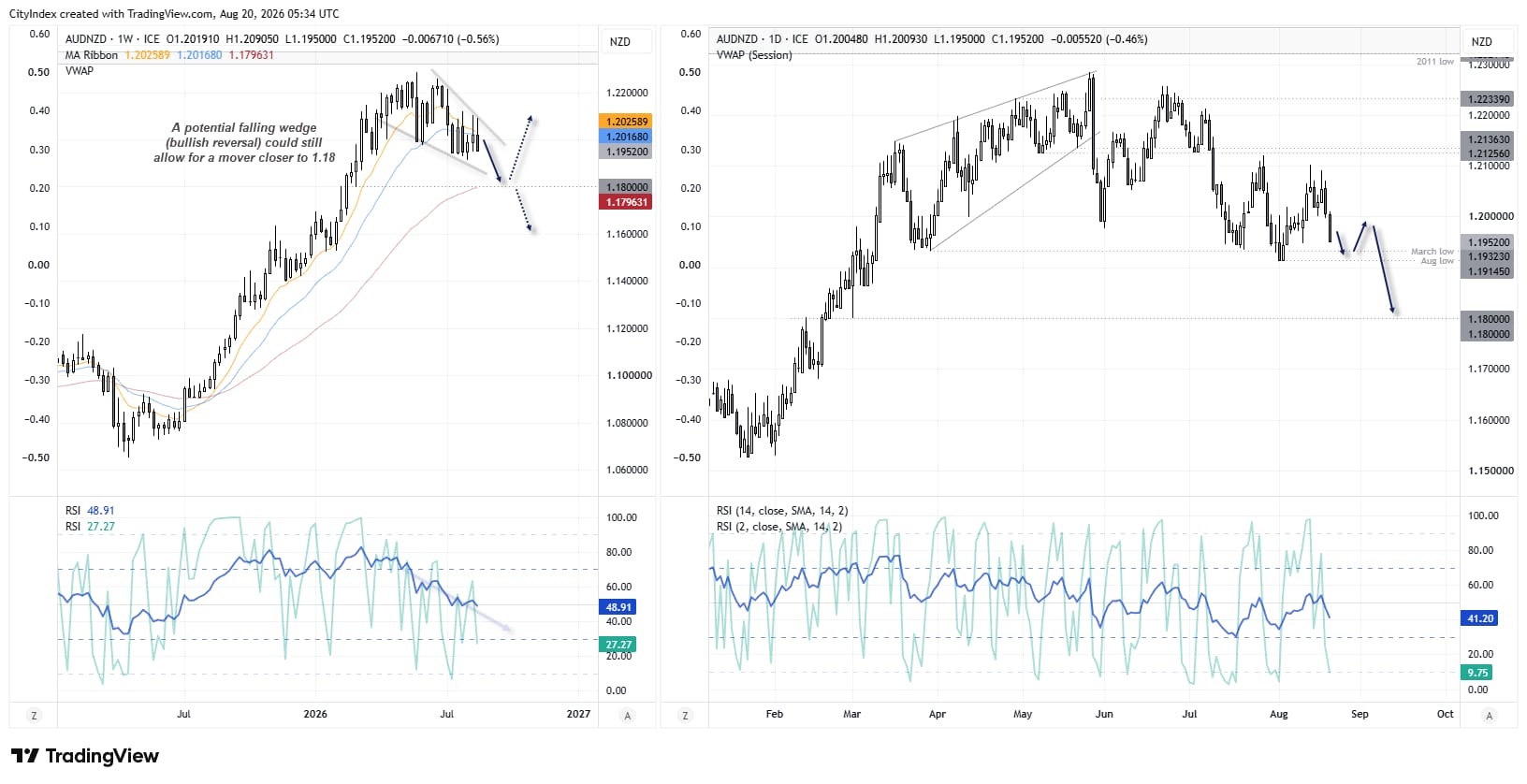
The Aussie rose an impressive 15% in six weeks, though momentum has turned against that bullish trend. It is too early to tell whether this is more likely to be a minor pullback on the weekly chart that morphs into a bullish wedge breakout, or simply the slow start to a deeper pullback. Either way, I suspect AUD/NZD has the potential to retrace towards 1.18 near its 50-day EMA.
The weekly RSI (14) is trending lower with prices without being oversold, while bearish momentum has clearly accelerated on the daily chart. I suspect AUD/NZD may initially hold above the August and March lows, but an eventual break beneath them could bring the 1.18 handle into focus.
Source: ICE, TradingView
View the full economic calendar
-- Written by Matt Simpson
Follow Matt on Twitter @cLeverEdge