

Despite the gradual recovery Bitcoin has attempted to sustain over recent weeks, the bullish move has not been enough to break the long-term structural downtrend that continues to dominate the market. In this moment, a renewed phase of consistent depreciation is evident, as Bitcoin has accumulated losses of more than 2% over the past three trading sessions, highlighting persistent weakness heading into the final days of 2025. For now, selling pressure remains firmly in place, supported by data reflecting weak Bitcoin demand in recent sessions and the absence of a sustained rebound in market confidence. As long as both factors persist, Bitcoin may continue to face steady selling pressure over the coming trading sessions.

Is Appetite for BTC Fading?
As we approach the final weeks of 2025, current macroeconomic conditions do not appear to be supporting confidence in Bitcoin. Recent weeks have been marked by mixed signals from central banks, with institutions such as the Federal Reserve showing a high degree of indecision. In addition, the final weeks of the year are typically characterized by reduced market activity, leading to lower liquidity across major asset classes, including the cryptocurrency market.
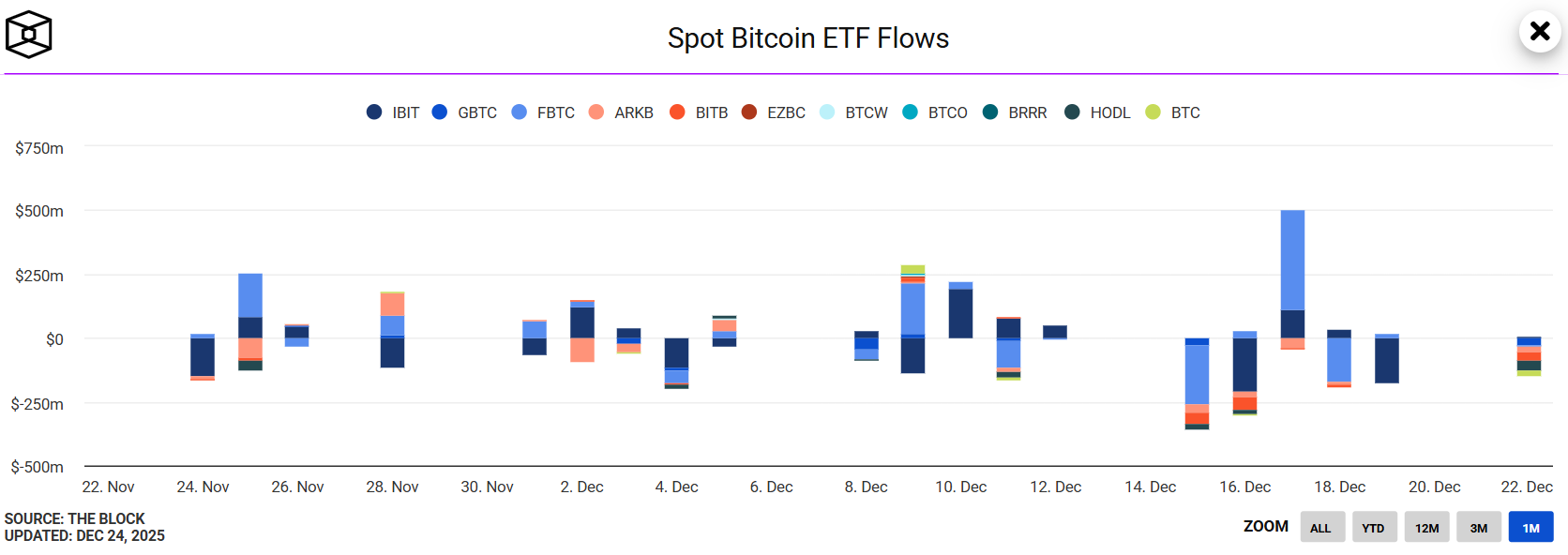
This environment has caused confidence in solid Bitcoin demand to deteriorate. Recent data point to a loss of market appeal toward year-end, a trend reflected in net capital flows from BTC ETFs. According to the latest data published on December 22, net outflows exceeding $140 million remain in place, confirming that capital outflows continue to be a defining feature of Bitcoin’s behavior as 2025 draws to a close.
Source: Theblock
On the other hand, when analyzing Open Interest, an indicator that measures total open long and short positions in Bitcoin’s institutional market, a modest increase toward levels above $28 billion can be observed. However, when this rise is combined with Bitcoin’s recent price decline, it suggests that incoming capital is not driven by new long positions, but rather by an accumulation of short positions. This reinforces the perception of institutional caution toward Bitcoin as the year comes to an end.

Source: Cryptoquant
Considering all of the above, institutional behavior indicators continue to show a lack of sustained appetite for Bitcoin, a factor that has become increasingly embedded in the asset’s short-term structural weakness. As long as capital outflows persist and short positions continue to build, this dynamic is likely to remain a key pillar supporting ongoing selling pressure in Bitcoin during the final trading sessions of the year.
Confidence Fails to Return to Positive Territory
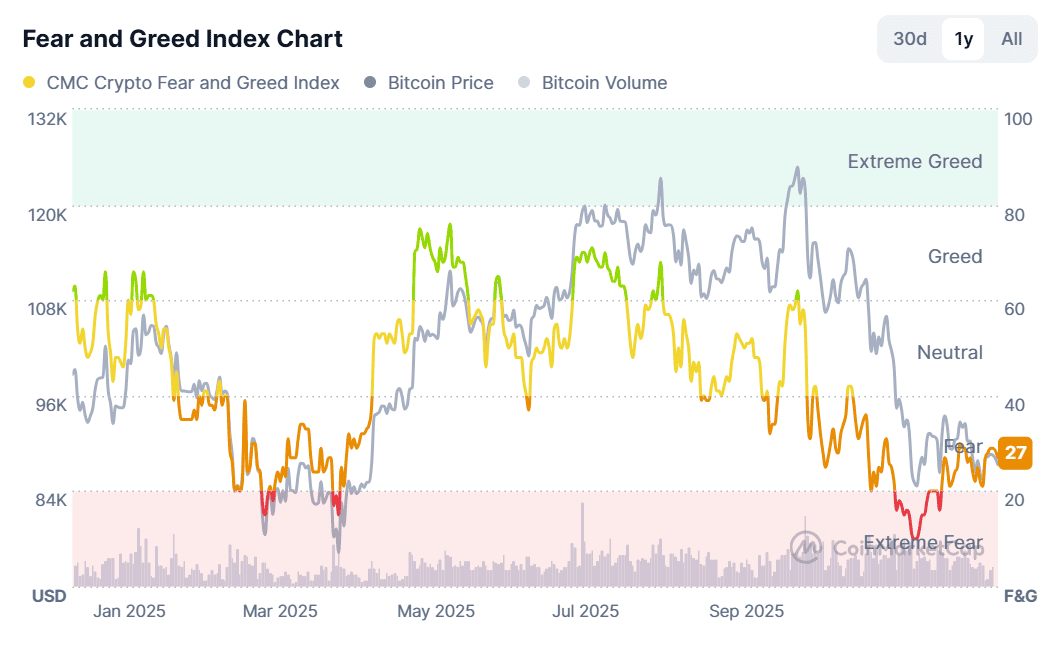
Market sentiment also remains fragile. The Crypto Fear & Greed Index continues to hover around 27 points, remaining firmly within the “fear” zone, without showing a meaningful short-term recovery.
Source: Coinmarketcap
This persistent indecision in sentiment suggests that conditions are not yet in place for a sustained recovery in Bitcoin demand. As long as the index fails to move at least back into neutral territory, the lack of confidence may continue to limit any rebound in demand, keeping selling pressure elevated in BTC price action over the coming sessions.
Bitcoin Technical Outlook
Source: StoneX, Tradingview
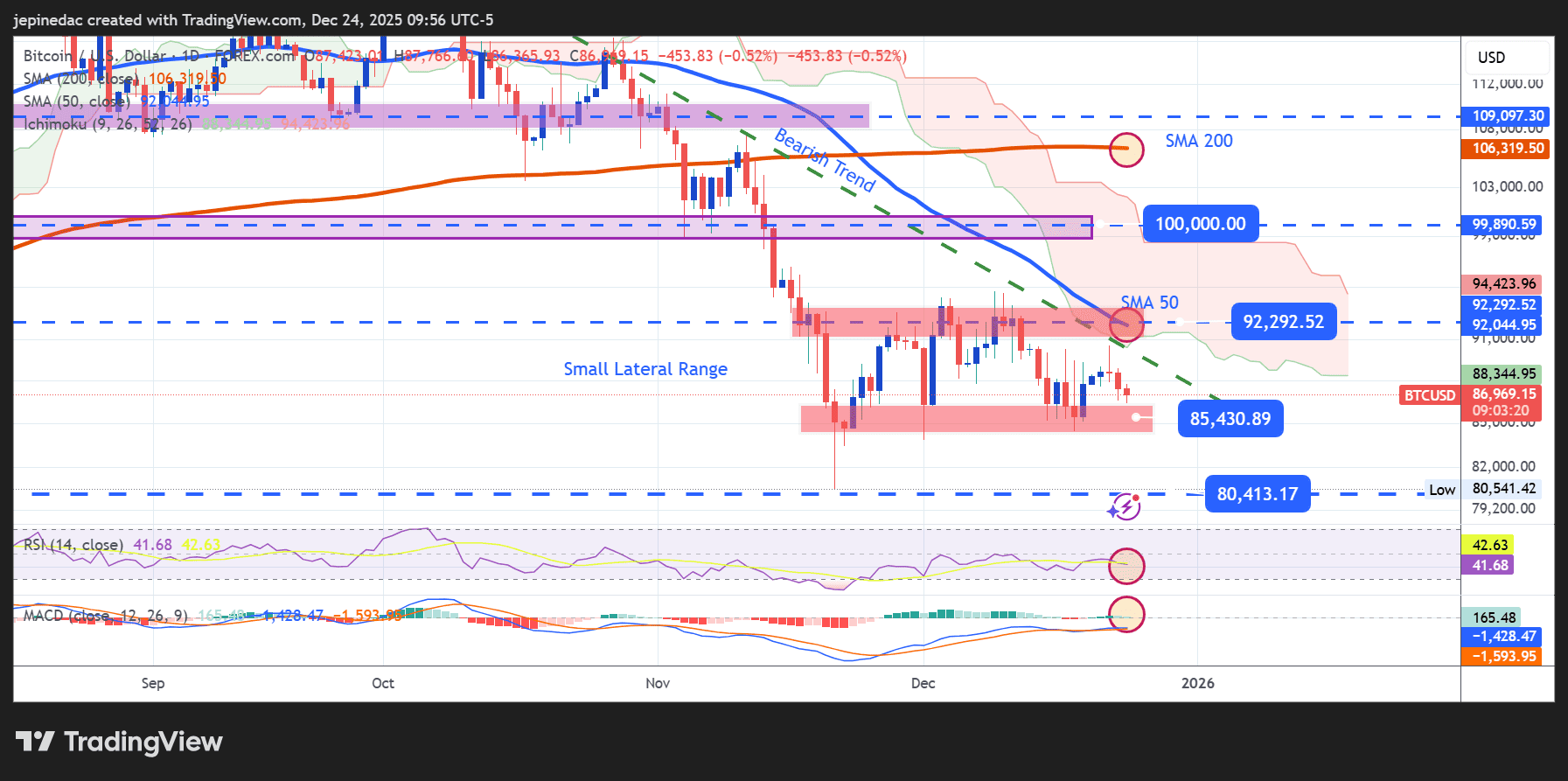
- The bearish trend dominates the market: Despite repeated short-term recovery attempts, the most relevant technical structure continuing to dominate Bitcoin’s price behavior is the long-standing bearish trendline in place since the all-time highs. Recent bullish corrections have not been sufficient to break this technical formation, leaving it as the dominant reference on the chart. As long as selling pressure persists, Bitcoin is likely to continue extending this bearish trend toward the close of 2025.
- RSI: The RSI maintains a downward slope, with readings below the neutral 50 level, indicating that average momentum over the past 14 sessions continues to favor sellers. If this behavior persists, it may continue to reinforce short-term selling pressure.
- MACD: The MACD histogram is progressively approaching the neutral zero line. Should a consistent crossover into negative territory occur, it would signal increased dominance of selling momentum in short-term moving averages, reinforcing the outlook for additional weakness in Bitcoin over the short term.
Key Levels:
- 92,292 – Key resistance: A level aligned with the long-term bearish trendline and the 50-period simple moving average. A sustained breakout above this zone could put the bearish structure at risk and open the door to a more meaningful bullish bias toward the end of 2025.
- 85,430 – Nearby barrier: A support zone associated with the recent weekly lows. As long as price holds above this level, a short-term consolidation range may develop.
- 80,413 – Major support: A level that coincides with the 2025 lows and sits near a key psychological area. A break below this zone could trigger a much more dominant bearish bias, keeping the downtrend as the primary structure into year-end.
Written by Julian Pineda, CFA, CMT – Market Analyst
Follow him on: @julianpineda25