

Over the last two trading sessions, USD/CAD has declined by around 0.4% in favor of the Canadian dollar, as the US dollar begins to experience a new wave of weakness in the market. At the start of the week, selling pressure remains strong, with investors focused on upcoming monetary policy decisions from both central banks and lingering political uncertainty in the United States. These factors have contributed to a sustained bearish bias in USD/CAD movements over the short term.

What to Expect from the Central Banks?
Interest rate decisions from both the Federal Reserve and the Bank of Canada are scheduled for July 30. For now, both are expected to maintain a neutral stance, with no changes to current rates. According to recent statements from the Bank of Canada, there is no urgency to accelerate rate cuts, which would leave the benchmark rate at 2.75%. Meanwhile, data from the CME Group shows a 95.3% probability that the Federal Reserve will keep its rate unchanged at 4.5%.
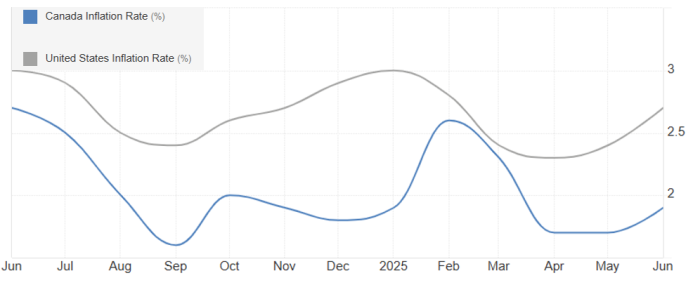
In this context, recent inflation data is key. As of June, US inflation stands at 2.7%, while Canada reports 1.9%. Both countries have seen a slight increase in their most recent figures, but only Canada is currently below the 2% target. This gives the Bank of Canada more room to maintain a low-rate stance, while the Federal Reserve may be required to hold rates higher for longer due to the persistent inflation gap.
Source: Tradingeconomics
This environment suggests that the Bank of Canada has more flexibility to remain dovish, while the Federal Reserve may need to stick to a more hawkish policy. The rate divergence means that US dollar–denominated assets offer higher yields than their Canadian counterparts, which could eventually renew demand for the US dollar. If this scenario persists, the recent strength of the Canadian dollar could be temporary, and USD/CAD might resume a sustained bullish phase in the future.
US Dollar Weakness
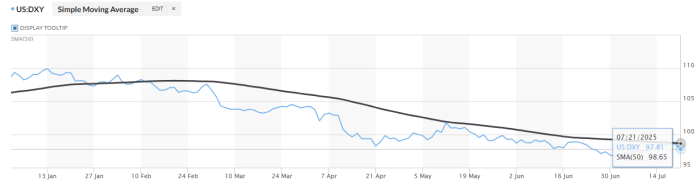
Ongoing tariff threats and even speculation about the dismissal of the Federal Reserve chair have weighed on US dollar confidence. The DXY index, which tracks the dollar’s strength against a basket of currencies, has started the week with a steady drop below 98 points, reinforcing a new bearish tone in its average behavior.
Source: Marketwatch
This loss of strength has allowed currencies like the Canadian dollar to gain ground. If the DXY continues to weaken, selling pressure on USD/CAD may intensify in the short term, at least until the upcoming rate decisions from both central banks.
USD/CAD Technical Outlook

Source: StoneX, Tradingview
- New Sideways Range: After breaking out of a previous bearish channel, USD/CAD has begun forming a defined sideways range, with a ceiling at 1.37807 and a floor at 1.35435. So far, price action has failed to break either boundary, leaving this range as the key technical formation to monitor in the coming sessions. The pair will likely continue oscillating within this range in the near term.
- RSI: The Relative Strength Index remains close to the neutral 50 zone, reflecting a balance between buyers and sellers. This suggests a lack of clear market direction at this stage.
- MACD: Similarly, the MACD histogram is moving around the zero line, indicating a neutral momentum profile based on the moving averages. As long as this condition persists, the sideways range is likely to continue dominating price action.
Key Levels:
- 1.35435 – Key Support: This level represents the most recent low, serving as the primary floor for bearish momentum. If price breaks below this area, it may reactivate a previously dormant downtrend.
- 1.37807 – Nearby Resistance: This is the upper boundary of the current range and aligns with the 50-period simple moving average and the 23.6% Fibonacci retracement level. A breakout above this point could trigger a meaningful bullish bias for USD/CAD.
- 1.39332 – Distant Resistance: This level aligns with the 38.2% Fibonacci retracement. If price action rises above this threshold, it could signal the start of a new uptrend for the pair.
Written by Julian Pineda, CFA – Market Analyst
Follow him on: @julianpineda25