
Key Events
- OPEC Supply Strategy: A steeper production hike of 548,000 bpd begins in August, reflecting confidence in global demand recovery.
- Inventory Support: Global crude inventories remain below the 5-year average, strengthening the case for an upside in WTI prices should prices hold above the 3-year resistance
- Tariff-Inflation Dynamic: Soft oil prices may help counterbalance the inflationary effects of tariffs, supporting macroeconomic stability as global inflation cools.
- Market Outlook: Key bullish and bearish drivers are emerging alongside critical technical levels that may define crude oil’s next move.
Crude oil prices held steady within a neutral-to-bullish range despite OPEC+’s recent announcement of a 548,000-bpd production hike. The move signals the group’s confidence in resilient global demand and its strategic intent to reclaim market share. Additional supply increases are expected throughout H2 2025. Extreme seasonal factors—ranging from intense summer heat to the anticipated winter surge—alongside optimism around trade deals, are likely to keep demand elevated. Should oversupply pressures emerge, they may help temper tariff-related inflation in the short term and strengthen U.S.-OPEC strategic ties over the longer run.
Extreme Weathers and Oil Demand Potential
With mounting summer heat, forecasts suggest a harsher winter ahead, potentially driving increased demand for heating oil, diesel, and electricity generation fuels. In Q4 2025 and Q1 2026, consumption of heating oil and diesel is expected to surge, particularly in colder regions where diesel serves dual roles in transportation and heating. Meanwhile, natural gas demand is projected to rise across both residential and industrial sectors. As of early 2025, global oil inventories remain below the five-year average, prompting OPEC+ to adjust output monthly while monitoring consumption patterns.
Crude Oil’s Role in Mediating Tariff Risks
As tariff tensions continue to rise, OPEC’s decision to increase supply may reflect more than just a market move—it hints at a quiet strategic alignment with U.S. interests. By keeping oil prices subdued, OPEC helps ease inflationary pressures that tariffs might otherwise intensify, creating a scenario where both sides stand to benefit. The group is gradually bringing barrels back to the market, betting that long-term economic recovery and stronger demand will support its revenue goals. At the same time, OPEC maintains the flexibility to reverse course if conditions sour, preserving its ability to stabilize prices when needed. In many ways, the current environment offers a rare opportunity: OPEC can reclaim market share while playing a subtle but significant role in cushioning the global economy from trade-related shocks.
China’s Economic Outlook: Petrochemicals, Trade Tensions, and Iranian Oil
China’s appetite for oil—especially for petrochemical production—remains tightly linked to the evolving landscape of U.S. trade tensions. By continuing to import oil from sanctioned producers at discounted rates, China maintains a competitive edge in industrial output. Yet, a strategic shift toward alignment with U.S. trade policies could ease sanctions and dial down tariff-related frictions, potentially reshaping the demand equation.
The ripple effects of trade actions are already being felt. The April 2025 tariffs dampened market sentiment and stalled key petrochemical projects, creating delays across supply chains. With these pressures still unfolding, China’s economic trajectory—and how it navigates trade relations—will remain a critical force shaping oil market dynamics through the second half of the year.
Can OPEC Lead a Positive Outlook into H2 2025?
With interest rate cut forecasts surfacing and U.S. equity indices reaching record highs, questions arise about whether OPEC can lead the next positive leg in global economic sentiment.
Key Bullish Drivers
- Inventories remain below the 5-year average, supporting prices amid rising seasonal demand.
- Geopolitical tensions add upward pressure to oil markets.
- A breakout above the 3-year downtrend (~$72) may unlock technical upside momentum.
- OPEC’s supply strategy aligns with a critical turning point in sentiment and structure.
- Improving macro data and potential trade agreements could revive global oil demand.
- Fed rate cuts, dollar softness, and emerging market demand strengthen the bullish case.
Key Bearish Drivers
- WTI still trades within a 3-year downtrend, limiting upward conviction.
- China’s economic slowdown and tariff-related deflation risks weigh on demand.
- Rising supply may overshoot expectations if demand fails to materialize.
- Ongoing global trade disputes may suppress confidence and cap demand recovery.
Crude Oil H2 Outlook: Weekly Time Frame – Log Scale
Source: Tradingview
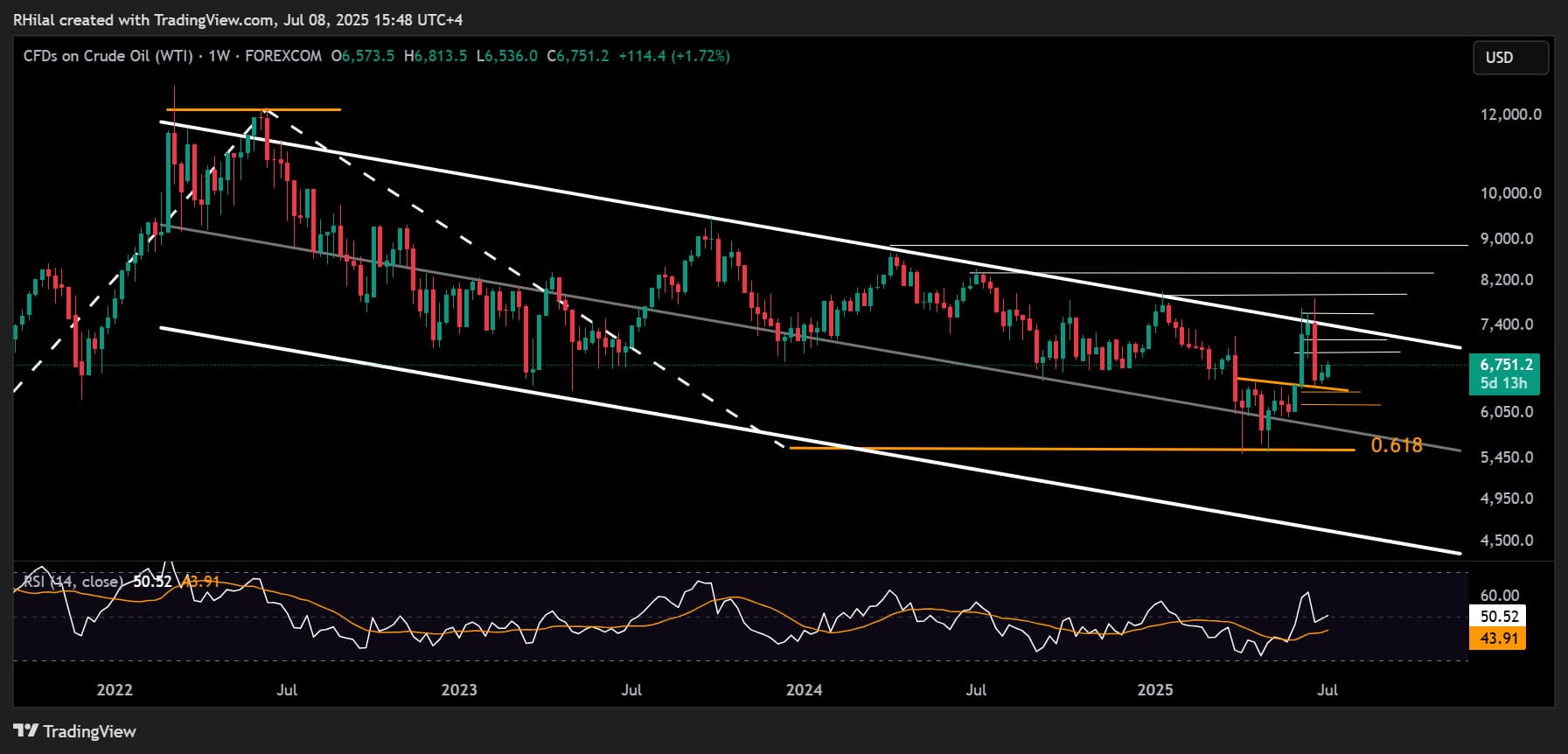
WTI has rebounded cleanly from the neckline of an inverted head-and-shoulders pattern—formed ahead of the June Middle East conflict—establishing a strong support zone above $63.40. Prices are currently trading above $67. A sustained hold above this level could target $69 and $72, aligning with the upper edge of the 3-year declining channel. A confirmed breakout above $72 may extend gains toward $78, $80, $84, and $88 respectively. On the downside, a close below $63.80 may trigger renewed selling pressure toward $60, $58, and $56—within the mid-zone of the broader trend channel.
Crude Oil H2 Outlook: Monthly Time Frame – Log Scale
Source: Tradingview
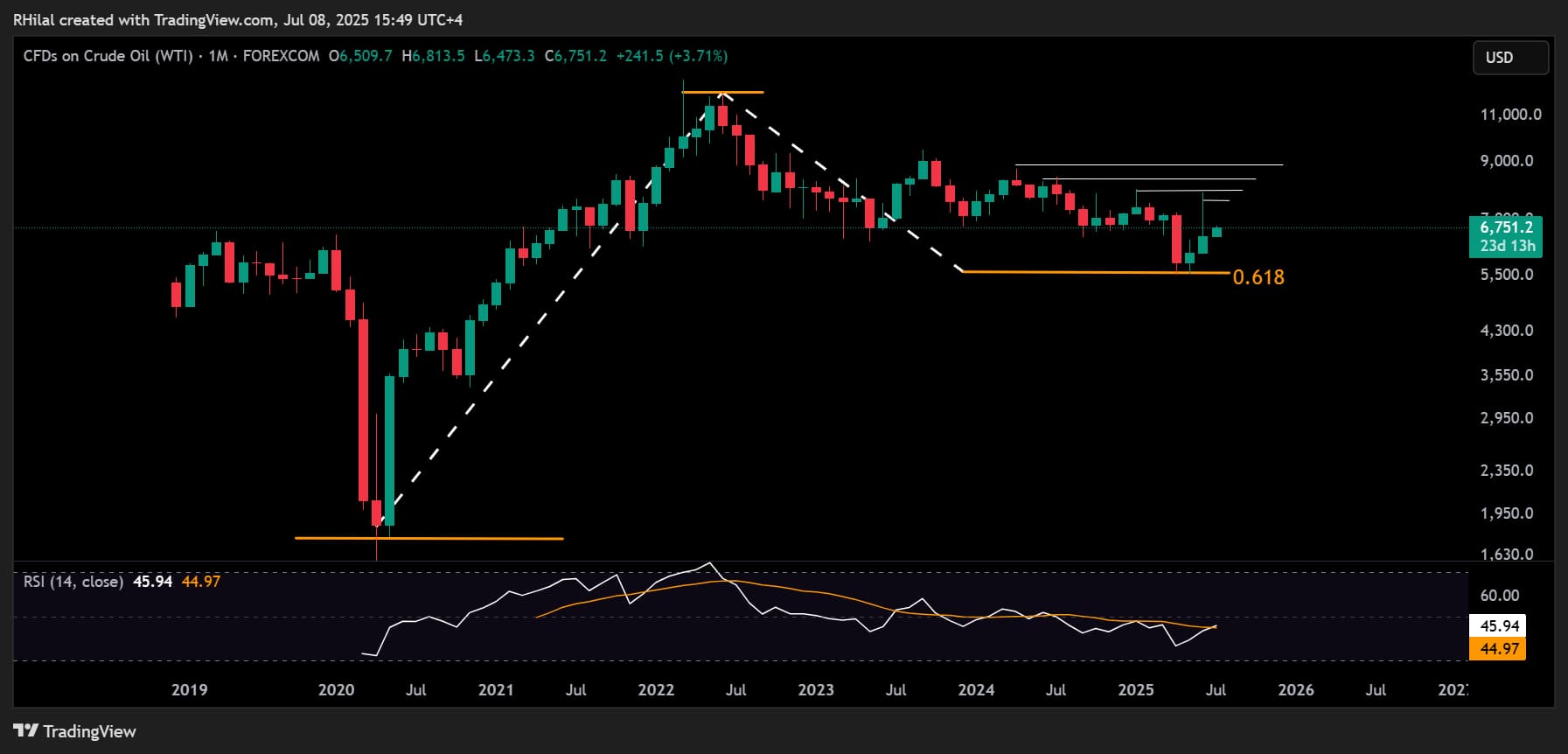
On the monthly chart, WTI has bounced off the 0.618 Fibonacci retracement of the 2020–2022 uptrend, near $55. This level coincided with oversold momentum last seen in 2020, extreme market pessimism driven by tariff fears, and OPEC’s unwind strategy. A return to this zone—or further down toward $49—could present another long-term bullish entry, as it aligns with the lower boundary of a decades-spanning uptrend channel dating back to the 1800s.
Crude Oil H2 Outlook: 3-Month Time Frame – Log Scale
Source: Tradingview
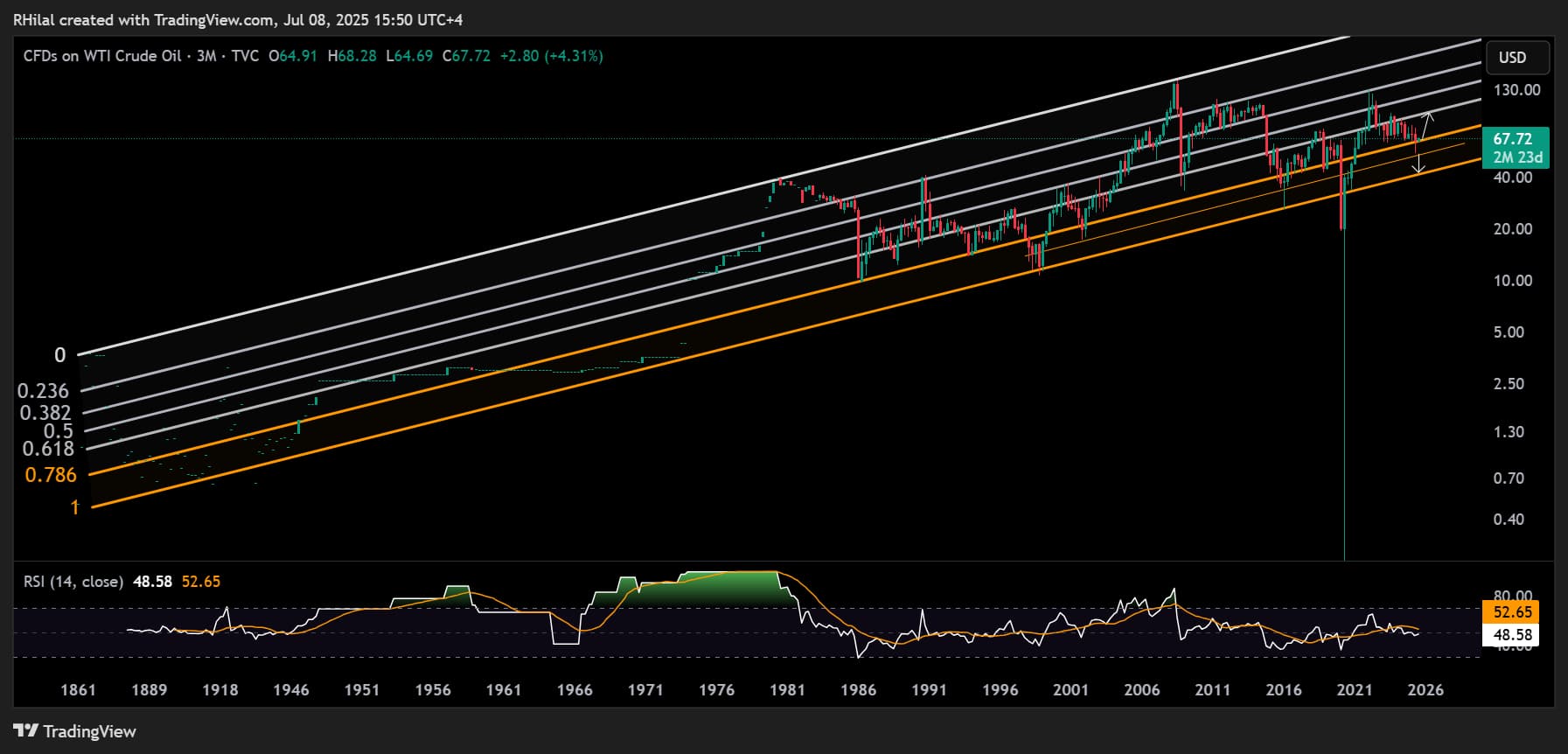
From a multi-decade perspective, WTI remains above the 0.786 Fibonacci trendline within the long-term channel. This structural support suggests that the broader uptrend remains intact. Near-term downside risks—linked to trade disputes, demand shocks, or oversupply—remain quantifiable towards the 49 zone, along the lower boundary of the channel. The last breakdown below this structure occurred only during the COVID-19 collapse, a historically extreme market event.
Written by Razan Hilal, CMT
Follow on X: @Rh_waves