

June begins with the cryptocurrency market showing broad short-term weakness once again. Demand has continued to fade, pressured by uncertainty around possible new tariffs and concerns that a stronger-than-expected US jobs report could give the Federal Reserve more room to stay restrictive.
In this environment, activity across the crypto market has started to deteriorate quickly, reflecting a sharp drop in confidence. If these conditions persist, weakness could remain a key driver over the coming trading sessions.

NFP fails to revive market appetite
The trading week was already difficult for cryptocurrencies. Risk appetite had weakened after new updates from the United States pointed to the possibility of tariffs of up to 12.5% on more than 60 economies worldwide. This raises the risk of renewed trade tensions and could reduce demand for more volatile assets, including cryptocurrencies.
The situation did not improve after the release of the US NFP employment report. The data showed 172,000 jobs created in May, well above the 85,000 expected. Rather than confirming a labor market slowdown, the report showed that employment remains solid and could give the Fed more room to maintain a restrictive stance over the next few months.
This effect is already visible in the Federal Reserve probability table, where markets now assign a probability above 40% to a possible rate hike in December of this year. This is a relevant shift, as only a few days ago that expectation was positioned closer to March 2027. Recent employment data may be accelerating the market’s perception of a more aggressive Fed in the short term.
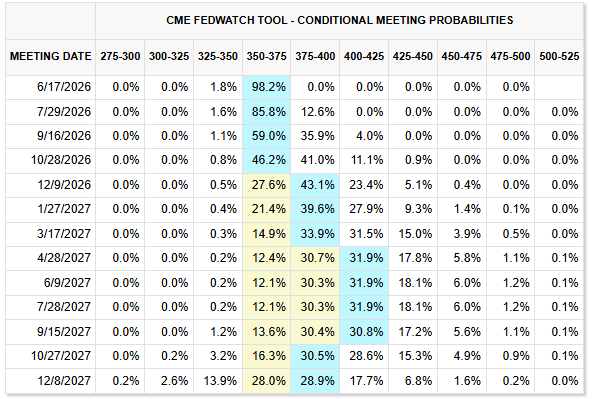
Source: CME
This combination of events is not favorable for crypto demand. On one side, concerns over renewed trade tensions have increased; on the other, the possibility of a more restrictive Federal Reserve, with elevated rates for longer, has also gained strength. This could raise borrowing costs, reduce available liquidity, and limit demand for risk assets such as cryptocurrencies over the coming months.
This loss of appetite is already showing up in Bitcoin activity metrics. Open Interest, which measures the total number of open long and short positions, has fallen toward the 23.1B area, coinciding with updates around possible tariffs and the NFP release. This decline reflects a meaningful exit of positions from the BTC market. Since it has happened alongside the price pullback, it may also point to a relevant exit of long positions and weaker short-term demand.

Source: Cryptoquant
Overall, the lack of appetite for markets such as BTC is becoming increasingly clear and may be spreading across the broader cryptocurrency market. While expectations of more aggressive central banks and concerns over potential tariffs remain in place, demand could continue to deteriorate and keep meaningful selling pressure on crypto markets over the coming sessions.
Bitcoin relative to other markets
Now, the negative correlation between Bitcoin and the US Dollar Index remains relevant, based on the average of the last 25 trading sessions. The coefficient remains below -0.5, reflecting a meaningful inverse relationship between BTC price movements and dollar strength. It is important to remember that correlation coefficients can change over time.

Source: Data – TVC, StoneX, Tradingview
This relationship matters because the US dollar has started to recover significantly in the short term, while Bitcoin has moved in the opposite direction, showing persistent weakness. This may indicate that capital flows are finding more appeal in assets perceived as more stable, such as the US dollar, instead of moving into volatile markets like cryptocurrencies.
This behavior suggests that the crypto market is losing appeal relative to other assets, especially safe-haven markets like the dollar. In this context, cryptocurrencies are not clearly behaving either as attractive risk assets or as defensive alternatives during recent sessions. This could make it harder for consistent demand to return quickly and may keep selling pressure relevant over the coming sessions.
Confidence returns to critical lows
Looking at the Crypto Fear and Greed Index, confidence has fallen sharply in recent sessions. The indicator is now near 16 points and has returned to “extreme fear” territory, a level not seen since March 2026. This reflects a rapid deterioration in crypto market confidence in the short term.
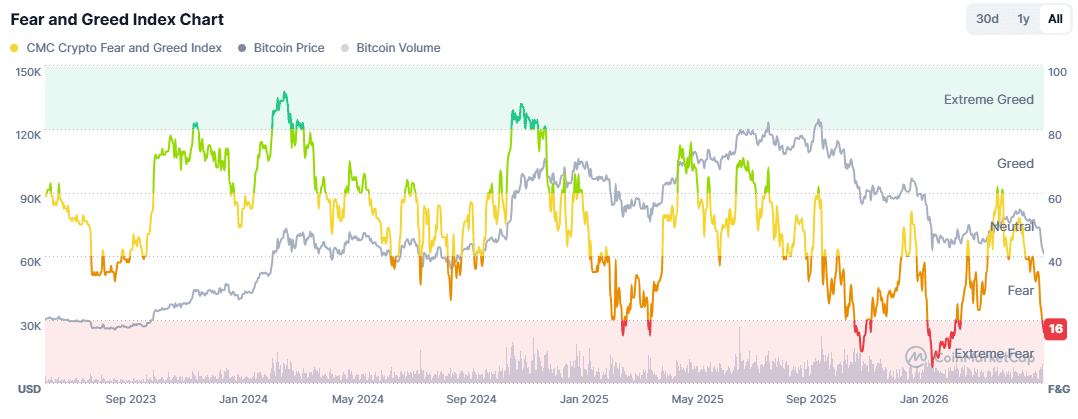
Source: Coinmarketcap
This behavior shows that market participants remain highly concerned about cryptocurrencies. Until the index recovers more clearly, it will continue to suggest that conditions are not favorable for a stronger demand environment. It may also point to a consistent phase of weakness across the crypto market that could remain relevant over the coming trading sessions.
Written by Julian Pineda, CFA, CMT – Market Analyst
Follow him on: @julianpineda25