
- Dollar forecast: ‘Liberation Day’ tariffs to return unless trade deals are struck by 9 July
- Jobs data offers little lasting support for the greenback
- Markets bracing for renewed FX volatility amid trade letter threats
The US dollar has retraced much of its NFP-driven gains from yesterday. While the headline numbers weren’t as strong as they initially appeared, the solid reaction in both bond and equity markets indicates that investors found the report encouraging overall. Now, attention is shifting to potential tariff-related volatility ahead of the July 9 deadline, when the so-called ‘Liberation Day’ tariffs are set to return. Trump has hinted that letters are being sent to trading partners in the coming days, outlining their new tariff rates. Back in April, during the height of market turbulence, safe havens like the Swiss franc, euro, and yen outperformed. Could we see a repeat of that defensive shift this time around? For now, the dollar forecast remains slightly skewed to the downside.
Tariff tensions take centre stage
President Trump has confirmed that letters are going out — possibly as early as today — to as many as a dozen countries. These letters will outline tariff hikes ranging from 10% to a potential 70%, with implementation due to begin on 1 August. Meanwhile, Treasury Secretary Bessent added further fuel to the fire, suggesting that as many as 100 countries could soon be slapped with reciprocal tariffs of at least 10%, though some are expected to ink deals before the 9 July deadline.
To that end, the term ‘Liberation Day tariffs’ has become the buzzword in Washington. These are the higher, punitive rates that were temporarily suspended — a 90-day pause — to allow space for negotiation. Unless formal trade deals are in place by 12:01 AM EST on 9 July, the full force of these tariffs will come into play. Countries without agreements risk seeing rates jump back up to 20–30% or more.
Canada has already managed to buy itself some time — until 21 July — by capitulating to US demands to scrap its digital services tax. Meanwhile, China’s deadline remains 12 August, although the recent framework agreement on rare earth exports and countermeasure relief suggests some flexibility. Whether this tentative accord will be enough to stall further tariffs remains to be seen — no formal document has yet been released.
FX markets remain cautious
While the US House has now passed Trump’s wide-reaching tax and spending bill — with the President expected to sign it imminently — it has done little to shift market sentiment. The dollar remains offered, perhaps because of concerns the bill will do more harm than good in the long term as it increases the debt and boost inflation.
A stronger jobs report unable to life dollar forecast
One might have expected the US dollar to find some footing following a stronger-than-anticipated June jobs report and a noticeable uptick in short-dated US yields. Yet, the greenback remains tethered to the soft end of its recent range, barely lifting itself from yesterday’s lows. The USD/JPY, for example, was back down to 144.30, after climbing to above 145.00 post NFP.
It appears that the spectre of tariffs and the political drama surrounding them are keeping dollar bulls at bay.
Despite the firmer tone in yields, which would traditionally buoy the currency, FX markets remain wary. Investors are perhaps positioning for a fresh bout of volatility as Washington prepares its next salvo in the trade war.
Technical Dollar Forecast: Dollar Index (DXY) key levels to watch
With the Dollar Index (DXY) making lower lows and lower highs, the dollar forecast is clearly bearish from a technical standpoint, too. For this to change, we do need to see at least a break above the bearish trend line. For now, resistance at 97.10 has held:
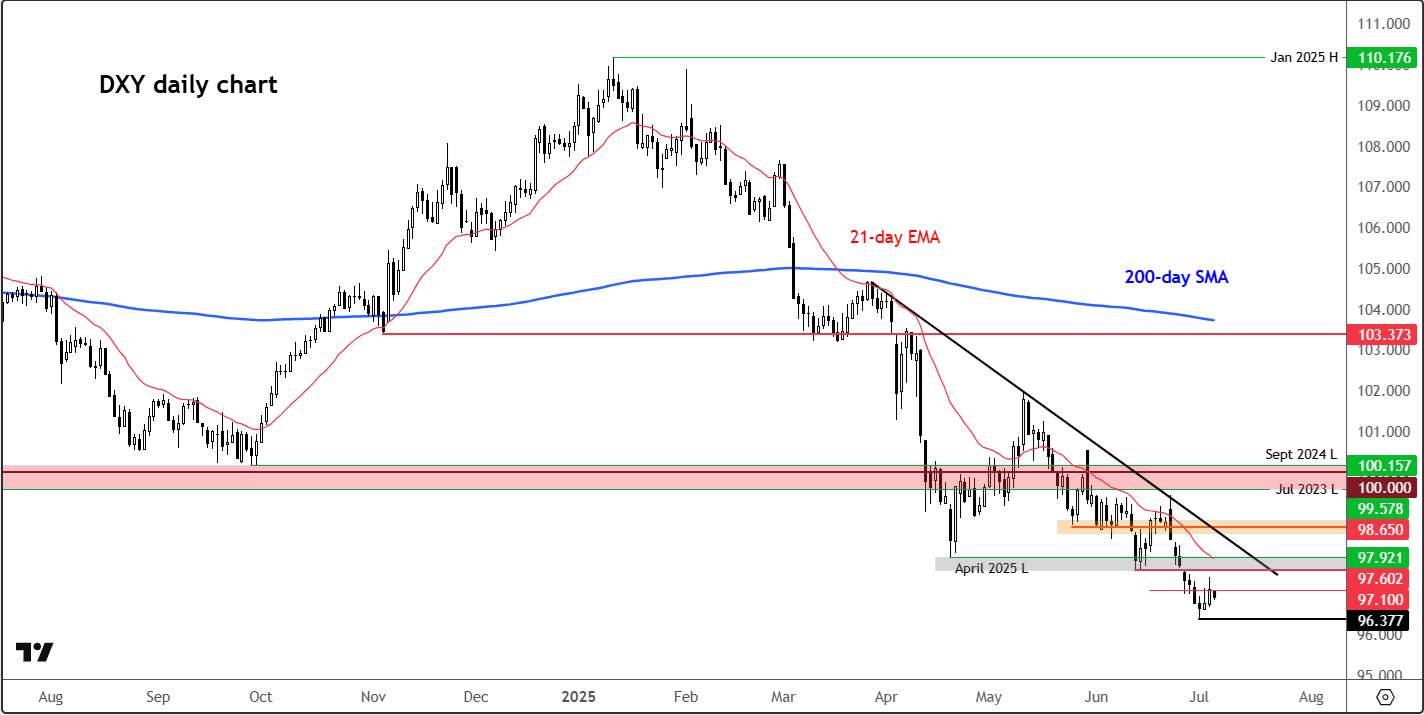
From here, we could see the DXY chart drop to test liquidity below this week’s low at 96.3 before it decides on its next directional move. Below that, there are no immediate obvious support levels, so watch for round handles like 96.00, 95.00 etc., to offer potential bounces.
As far resistance levels, well 97.10 represents a short-term hurdle which has been defended thus far today despite a brief break above it yesterday. Above here, 97.60 to 97.92 marks an important zone. This is where the 21-day exponential average meets prior support, including the low from April.
With American markets closed for Independence Day, today’s session is expected to be light. But with only a few days remaining before the tariff ceasefire ends, traders will be glued to headlines. And unless there’s a last-minute flurry of trade breakthroughs, dollar softness looks likely to persist.
-- Written by Fawad Razaqzada, Market Analyst
Follow Fawad on Twitter @Trader_F_R