
- EUR/USD forecast stays cautiously optimistic heading deeper in Q4
- German fiscal stimulus and easing US rate expectations could support the euro in the months ahead
- Political stability in France and weaker oil prices adds to near-term resilience
The EUR/USD was up for the third day at the time of writing in mid-October, boosted largely by French political breakthrough, weakening oil prices and rising expectations that the Fed will deliver those two promised interest-rate cuts this year. I will hold onto my $1.20 call for the pair, as seasonal dollar weakness and German stimulus combine to provide support for the popular FX pair in the months ahead. My EUR/USD forecast thus remains positive, as it hovers just below the 1.17 handle, and having just broken above its short-term bearish trend line. Key support is around 1.15 handle.
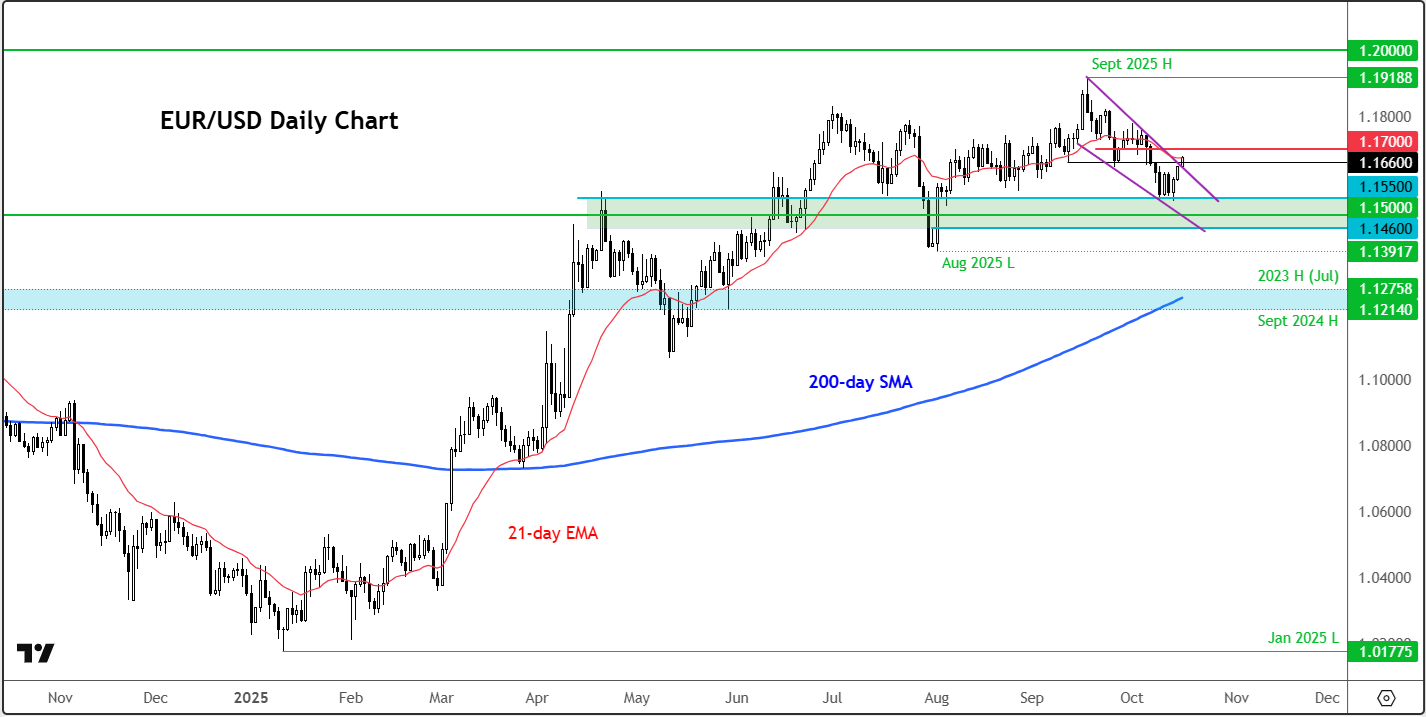
What to make of the EUR/USD’s recovery
The recent recovery comes after the euro lost momentum in recent weeks from its prior bullish trend that one point looked as if it would surge to $1.20. The underlying issue here seems to be the persistent softness in eurozone data, which has kept alive the European Central Bank’s dovish camp and curbed investor enthusiasm for a more aggressive push higher. But many traders argue that the euro should be performing better given the combination of a looming US government shutdown and rising expectations of a Federal Reserve rate cut later this month. But in recent days, it seems the eurozone macro story is holding more sway. Industrial activity and consumer sentiment indicators have disappointed in recent weeks, and that has limited speculative appetite for fresh euro longs – especially after markets already front-loaded their optimism earlier this year ahead of Germany’s long-awaited fiscal stimulus.
German Stimulus: a longer-term tailwind for the euro
The multi-year German spending package, which breaks the country’s self-imposed debt brake, is one of the most significant policy shifts in years. Berlin’s plan to channel nearly a trillion euros into defence, infrastructure, and green investment has already been priced in by markets as a potential game-changer for Europe’s growth outlook.
Although most of this stimulus will not meaningfully hit the economy until 2026, its approval has already lifted sentiment around European assets. Germany’s deficit is expected to rise from €41 billion to €143 billion by year-end, which would be a meaningful fiscal expansion after years of restraint.
For the EUR/USD forecast, this bodes well for the medium to long term. The euro is likely to benefit as spending filters through to higher investment and growth expectations across the bloc. But for now, with implementation still some time away, traders will likely continue to take a cautious stance, keeping their bullish appetite low.

Dollar weakness could persist as Fed rate cuts loom
On the US side, the dollar has been easing as markets price in a near-certain rate cut at the next Federal Reserve meeting. Comments from Fed Chair Powell have reinforced the view that the central bank has enough justification to cut even if official data releases remain frozen by the ongoing government shutdown.
The shutdown was expected to persist well into November, adding uncertainty while attention also turns towards the looming US-China trade headlines. The upcoming APEC summit in Korea, where Presidents Trump and Xi are expected to meet, will be watched closely. The 10 November expiry of the current tariff truce raises the stakes, and China’s threatened export controls on rare earths have stirred concern across the G7. Any escalation could dent global risk sentiment, which in turn might limit euro gains despite the softer dollar backdrop. However, with the single currency seen as more of a safe haven currency, the downside should be limited.
Other factors supporting the EUR/USD forecast
Adding a modest tailwind for the euro, French politics appear to be stabilising after Prime Minister Sébastien Lecornu survived a second no-confidence vote. The government’s compromise to delay pension reforms appeased the Socialists and calmed investor nerves. French bonds and the euro both welcomed the outcome, viewing it as a sign of continuity at a delicate time for the eurozone.
Meanwhile, seasonality factors might also play a part in helping the EUR/USD rise towards our $1.20 target in the coming weeks. The US dollar index has returned an average of -0.56% in December, making it the second worst month after April when it has averaged a return of -0.65%, looking at the average performance of the DXY since 2010. If history repeats itself, then we could see the EUR/USD climb to $1.20 by December, if not before.
So, assuming there is no major deterioration in global risk sentiment that would cause a major rally in the US dollar, the EUR/USD forecast leans modestly bullish over the medium term but remains clouded by near-term headwinds, including soft data, the US-China trade standoff, and the lingering US government shutdown.
-- Written by Fawad Razaqzada, Market Analyst
Follow Fawad on Twitter @Trader_F_R