
Following the long bank holiday weekend, investors are slightly alarmed by the latest US military actions in Iran, causing oil prices to rebound around 4% from their lows hit on Monday (and around 2% on the day). That, in turn, has seen index cash and futures trim a good chunk of their gains made since markets closed on Friday. In the FX space, things have been a lot quieter and here the major pairs formed only small gaps in response to the weekend’s posts by Trump suggesting negotiations with Tehran were “proceeding nicely”. But some of that optimism has now faded with US forces carrying out what they described as “self-defence” strikes in southern Iran early on Tuesday. The near-term EUR/USD forecast remains tilted to the downside, as a result.
No signs of a deal yet
The latest US attacks of Iranian targets risks undermining an already fragile ceasefire. Trump has also warned yesterday that “it will only be a Great Deal for all or no Deal at all”, while threatening a return “to the battlefront and shooting, but bigger and stronger than ever before”. With the US dollar having already only retreating slightly, before rebounding mildly today, investors are becoming more attentive to the inflation implications of higher energy prices than to the geopolitical headlines themselves. The resilience in the greenback points to a market beginning to reassess the Federal Reserve’s trajectory. Rather than moving steadily towards easing, policymakers may instead feel compelled to keep a firmer grip on policy while energy-driven inflation risks linger in the background.
Dollar finds support as Fed may be forced to drop easing bias
Despite the major indices holding to a big chunk of their weekend gains, this hasn’t weighed on the dollar much at all. Instead, the US currency has remained comparatively firm, supported by growing expectations that the Fed could adopt a more cautious — and potentially more hawkish — tone over the coming months.
That narrative gained traction last week with investors worrying that persistently elevated oil prices could eventually feed into inflation expectations. Markets briefly moved to price in the possibility of another 25bp rate increase this year, pushing Treasury yields higher and flattening the yield curve, before hopes of a deal triggered some unwinding of those moves in the second half of last week.
Still, the dollar remains largely supported. The broader question now is whether any meaningful diplomatic breakthrough in the Middle East would materially weaken the greenback. At this stage, a peace deal itself looks more questionable than anything else. But assuming a deal is reached – a big assumption - then the dollar should weaken as the likes of the euro and pound find some love as investors price out some of the stagflation risks attached to those currencies. Still, a sustained move lower in the dollar looks unlikely. Investors are increasingly focused on how higher energy costs may affect inflation and economic momentum globally, rather than on the geopolitical developments themselves.
What other factors will investors be watching this week?
It is a quieter week for data, meaning most of the attention will remain, once again, on oil prices and the Strait of Hormuz. That said, there ae a couple of economic reports that are worth watching, with markets likely to pay closer attention to some labour market indicators alongside the PCE release. Another firm inflation reading would strengthen the argument that the Fed would have no choice but to change its bias towards tightening, especially while price pressures remain sticky in services and energy.
Meanwhile, this week’s European calendar includes inflation updates from several member states alongside revised first-quarter GDP figures. None of those releases are likely to produce major volatility on their own, but collectively they will help shape expectations around how cautious the European Central Bank may become through the summer.
Expectations for aggressive ECB tightening have steadily moderated in recent weeks and that’s keeping the EUR/USD forecast contained. Markets that were previously pricing multiple rate increases this year, but have significantly scaled back those bets, reflecting a deteriorating growth backdrop across the eurozone. Part of that repricing has followed the retreat in oil prices from recent highs, but weaker business activity surveys have also contributed to the softer outlook. Recent PMI readings suggest that eurozone growth momentum is fading, raising the possibility of a contraction during the second quarter.
Technical EUR/USD forecast and key levels to watch
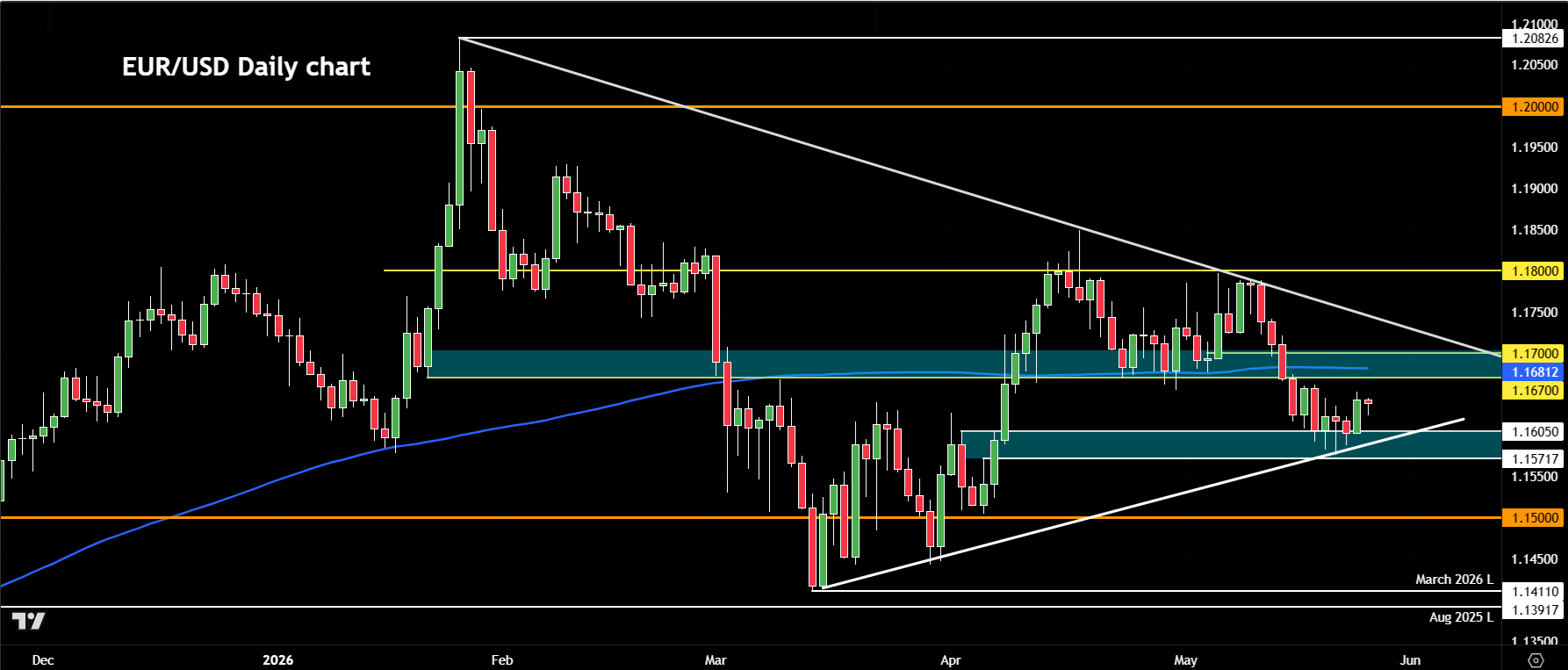
As was the case before, the EUR/USD bears need to see a clean below the 1.1570-1.600 support zone to open the door for another test of 1.1500. At the same time, any meaningful progress towards a temporary deal may only offer limited support for EUR/USD until such a time that oil prices fall sharply again. Europe is still likely to face the lingering effects of the recent energy shock for several months, which could put a ceiling to near term to any short-term gains. To get past the key 1.1800 resistance level, this would most likely require a confirmed deal between the two sides.

-- Written by Fawad Razaqzada, Market Analyst
Follow Fawad on Twitter @Trader_F_R