
There was a sense of calm in the markets for much of today’s session, as global stocks rallied and crude oil gave back a chunk of Monday's gains. All that helped to benefit the EUR/USD, gold and other risk assets. The US dollar traded mixed ahead of key data, which came out largely as expected. But with uncertainty in the Strait of Hormuz remaining and high oil prices elevated, this means that stagflation risks remain front and centre for the eurozone. For now, the EUR/USD forecast remains tilted slightly lower in this environment.
Dollar likely to hold its ground despite recent wobble
The US dollar traded mixed today after last week’s wobble. The greenback came under pressure last week, largely driven by Japanese intervention and a more hawkish tilt from both the European Central Bank and Bank of England. Today, the Reserve Bank of Australia delivered the expected rate hike, its third in this cycle. With other central banks growing hawkish, some analysts are expecting the US dollar to stage a deeper decline. However, given the oil situation, and with the US being a net oil exporter, the dollar looks well placed for a rebound, particularly against currencies tied to economies heavily reliant on oil imports – such as the euro.
On Monday, there was some clashes involving ships in the Strait of Hormuz and missile strikes against the United Arab Emirates. That saw oil prices rally sharply, before easing back today after the US dismissed the prospect of a return to active war with Iran.
Still, crude prices have rallied sharply in the last couple of weeks with the Strait of Hormuz still shut. While today’s slight pullback has allowed the euro some breathing space, the risk of sustained elevated energy prices remains very real. That backdrop tends to favour the dollar and could continue to weigh on the EUR/USD forecast.
EUR/USD forecast still tilted to the downside
The recent push higher in EUR/USD, driven by chatter around a possible June rate hike from the ECB, feels a touch overstretched. The macro picture in the eurozone isn’t encouraging. The data is starting to take on a stagflationary tone: growth is clearly losing momentum, yet inflation expectations remain sticky. Germany’s weakening consumer sentiment and softer business surveys across the region, as we saw last week, highlight that shift. Added to that high energy costs, and the overall outlook starts to look rather delicate.
Now under normal conditions, rising rate expectations would lend solid support to the currency. While it has done a little this time, the EUR/USD hasn’t exactly been surging higher. If the ECB tightens policy into a slowing economy, it risks exacerbating the downturn rather than stabilising it.
A strong foundation for sustained euro appreciation can only come with energy prices weakening again.
Key levels and near-term price action
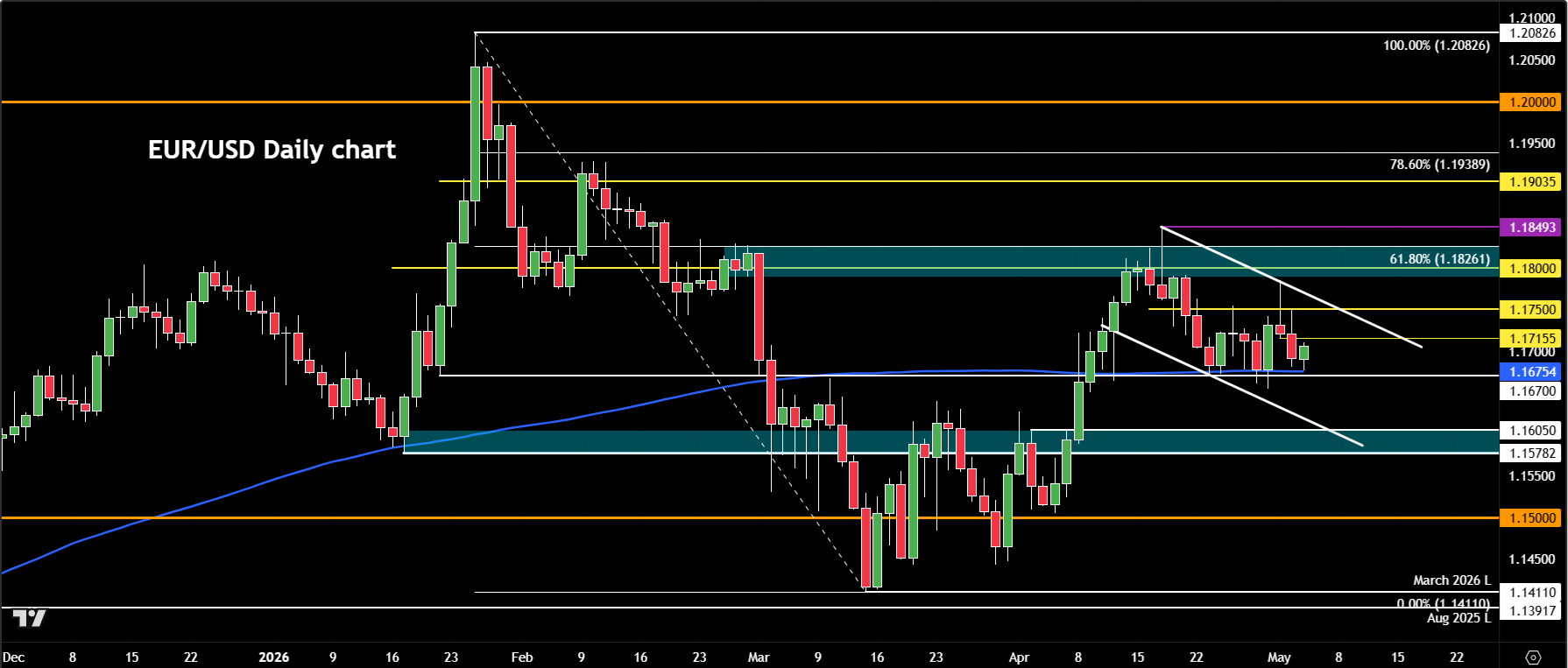
From a tactical perspective, the 1.1715 is the initial level of potential resistance on the EUR/USD chart, marking the low of the inverted hammer candle from Friday. Above that, 1.1750 area is worth keeping a close eye on. If the EUR/USD breaks that then the technical picture would start to look a little more constructive. On the other hand, if the next support at 1.1670/5 breaks first, then this would tilt the outlook back to bearish. Here, we have prior support and the 200-day average converging. For now, the technical outlook on the EUR/USD is fairly neutral.
US Services PMI was in line, as focus turns to jobs data
Attention now shifts to upcoming US data, which could prove pivotal for the EUR/USD forecast.
The ISM Services PMI was released earlier. This could have been an important release to watch. As a forward-looking gauge covering the largest portion of the US economy, it often plays a key role in shaping expectations around growth and Federal Reserve policy. But as it turned out, the PMI came out at bang in line with expectations at 53.6. Its employment component, which can also offer early clues ahead of the labour market data, was a decent 48.0 vs. 45.0 last month.
The next big release is Friday’s publication of Nonfarm Payrolls, due on May 8. This is typically the standout event of the week and a consistent market mover. The current “low-hire, low-fire” narrative has kept US equities steady, with investors not yet overly concerned about inflationary spillovers from higher energy prices.
After last month’s upside surprise of 178K, the question now is whether we’ll see a repeat. A strong print would likely reinforce dollar strength and weigh further on EUR/USD, while a softer reading could offer the pair some near-term support.

-- Written by Fawad Razaqzada, Market Analyst
Follow Fawad on Twitter @Trader_F_R