
- Strait shut, ship seized, threats escalate
- Traders fade Asia move on Monday playbook
- UAE swap line, yuan talk caps USD bid
Weekend escalation meets familiar Monday script
Optimism over a looming peace deal between the United States and Iran has been shoved back in the box in early Asian trade on Monday, with a fresh deterioration in the backdrop helping unwind part of Friday’s move, including in EUR/USD and GBP/USD.
Instead of progress, traders arrived to headlines that the Strait of Hormuz had been shut again after barely reopening, Iran had rejected another round of talks, the US had seized an Iranian cargo ship trying to run the blockade, and Donald Trump was threatening to wipe out bridges and power plants if Tehran refused his demands. That is not what imminent peace looks like.
Yet the market reaction remains far more measured than what the newsflow would suggest. Mondays have repeatedly become the window for timely conciliatory Truth Social posts from Trump, or leaked headlines citing unnamed officials claiming talks are constructive and a deal is nearing completion. Since the war began, traders have seen early Asia moves reverse too many times to trust the initial reaction.
And that’s already evident in the price action, with earlier losses being trimmed, no doubt reflecting expectations we’ll see the same script play out again, helped along by reports a US delegation is once again heading to Islamabad for another round of talks.
Separate reports that the United Arab Emirates has discussed emergency financial support with Washington, while also threatening to settle oil exports in China’s yuan if assistance is not forthcoming, may also be capping the dollar rebound at the margin by feeding broader de-dollarisation themes.
For the euro and pound, the weekend developments are negative. Both Europe and the United Kingdom are net energy importers, meaning higher oil prices act as a direct terms of trade hit while also increasing downside risks to growth should supply shortages begin to emerge. Yet neither EUR/USD nor GBP/USD has seen meaningful declines in Asian trade.
With little in the way of market-moving economic data due over the next 24 hours, headline risk will mix with technicals to likely set the tone in both pairs on Monday.
Friday reversal signal meets 1.1742 support
Source: TradingView
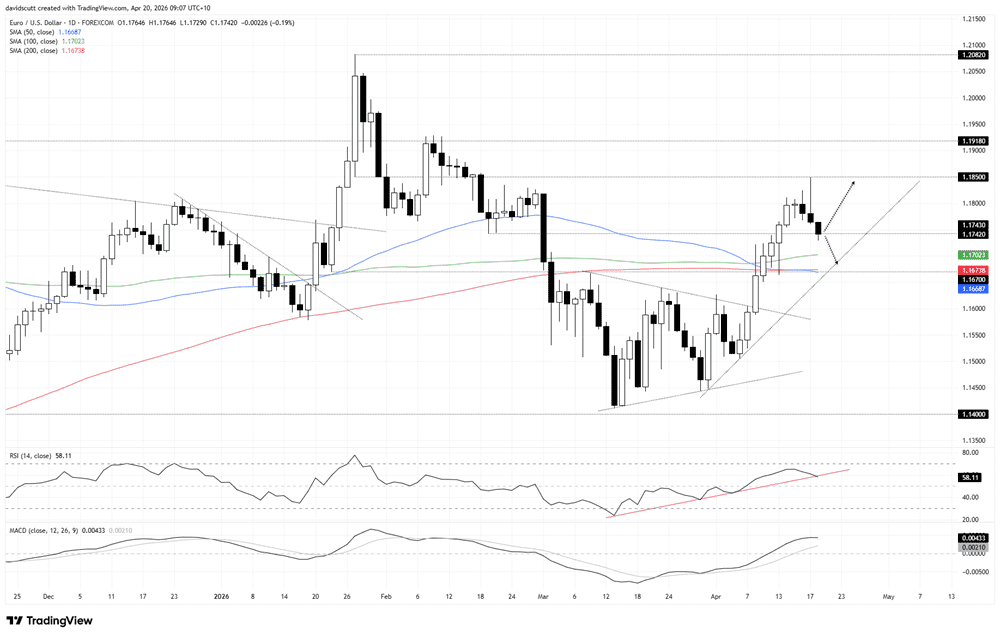
EUR/USD is testing 1.1742 support, with the bearish signal from Friday’s inverted hammer beginning to play out in Asia. That’s the first downside level of note for traders, with 1.1670 another to keep on the radar should the unwind gather pace, marking the intersection of the 50 and 200-day moving averages alongside horizontal support.
Should we get another abrupt turnaround like so many other Mondays recently, 1.1850 is the first level of note on the topside. Those three levels provide a roadmap for traders assessing setups today.
The message from the oscillators still tilts bullish in directional terms, with RSI (14) holding above 50 and trending higher, while MACD remains positive after crossing above the signal line from below over a month ago. But both are showing early signs of rolling over, meaning it’s not an especially convincing signal set to work with, particularly in these headline-driven markets.
Cable pressured with 1.3483 tested
Source: TradingView
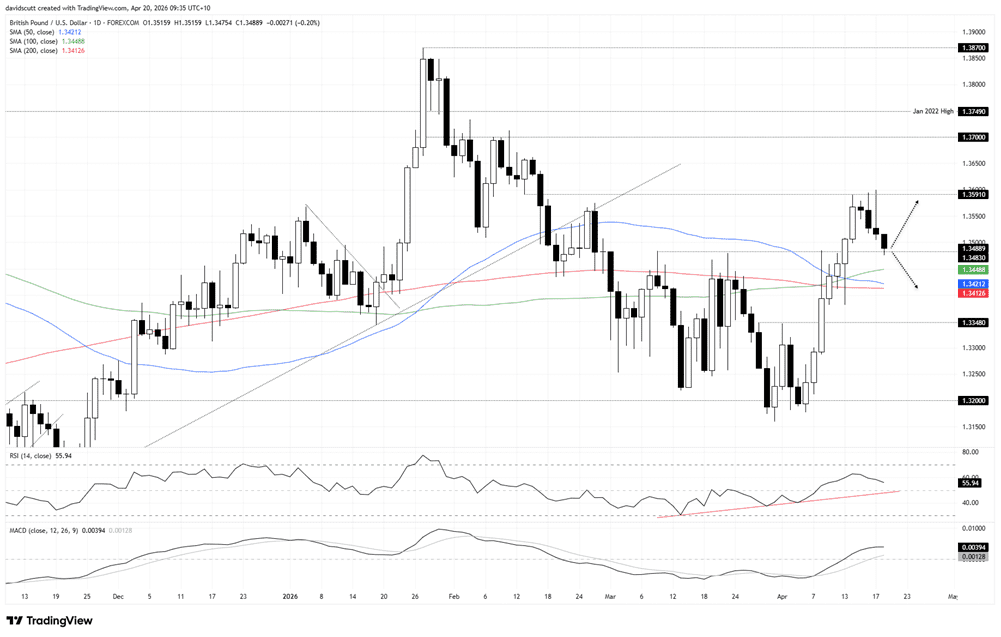
The technical picture is perhaps very similar for GBP/USD, with three rejections in four sessions at 1.3591 resistance late last week culminating in a retracement back to support at 1.3483. That’s the initial range for traders to watch today.
On the downside, a cluster of key moving averages are layered between 1.3449 and 1.3413, with the 200-day the one to watch at the lower end of the range. If we were to see another abrupt reversal, a retest and break above 1.3591 may see offers emerge between 1.3700 and the January 2022 swing high at 1.3749.
RSI (14) and MACD both remain mildly bullish in directional terms, although with both either rolling over or looking like they soon will, the message is quickly shifting neutral, placing greater emphasis on the price action to guide setup selection.