
The trading week begins with EUR/USD posting a decline of more than 0.4% in the short term, driven by a renewed strengthening of the U.S. dollar. This move follows the breakdown in Middle East negotiations, which has revived risk sentiment in markets and prevented the euro from maintaining the consistent demand seen in the previous week.
As this uncertainty around the Middle East persists, it is likely that a more consistent phase of indecision could emerge in EUR/USD price action over the coming sessions.

Peace negotiations weaken
Last week, one of the most relevant developments in market risk sentiment was the ceasefire agreement between the United States and Iran. However, after nearly a week in place, negotiations were suspended on Saturday, and hours later President Trump ordered a blockade of the Strait of Hormuz by the U.S. Navy.
Iran responded by stating that this action represents a direct violation of the ceasefire, marking a clear breakdown in the negotiation process and once again reigniting risk sentiment in the markets in the short term.
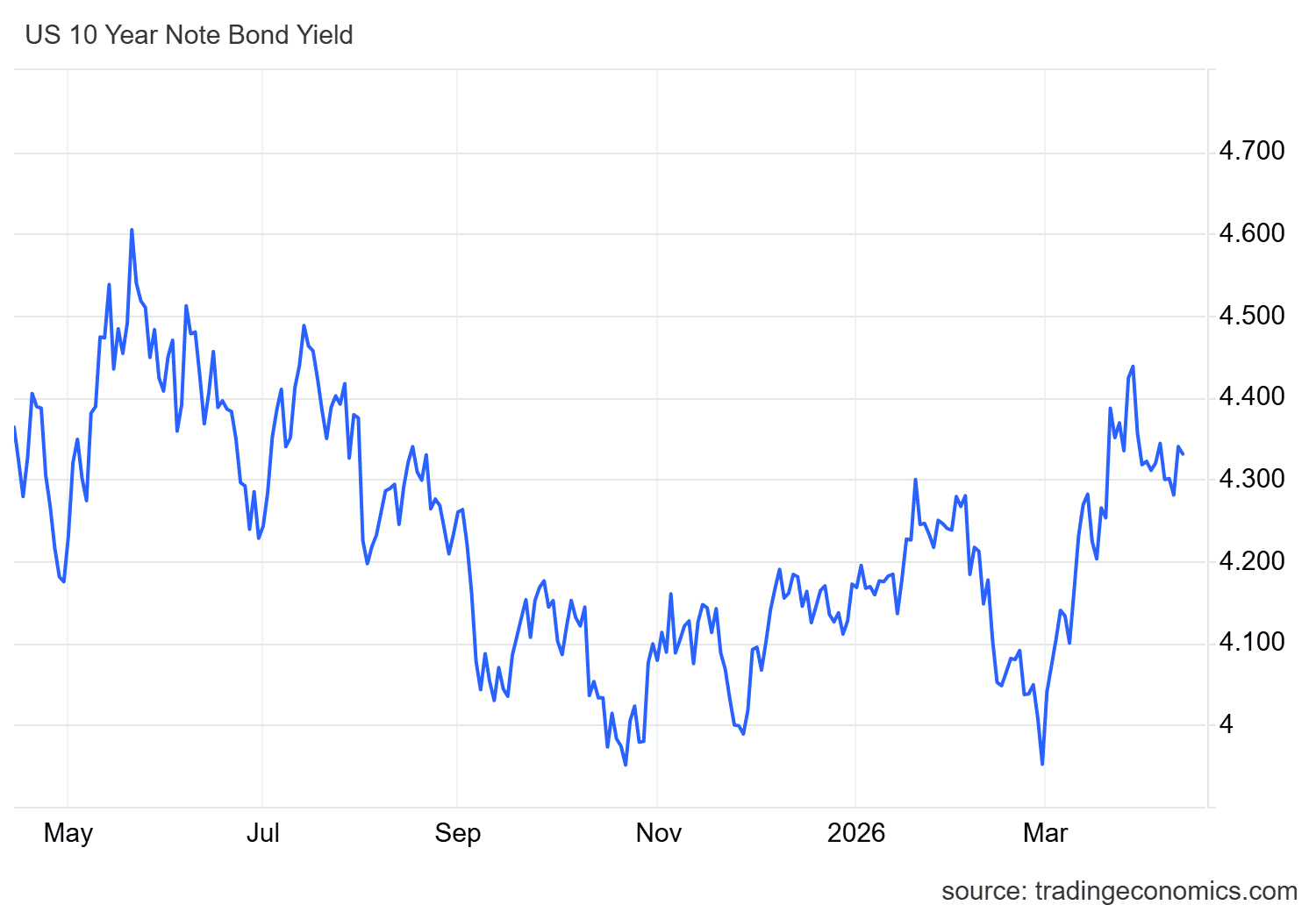
This development has caused the decline in U.S. 10-year Treasury yields observed last week to begin stabilizing. This is relevant because bonds continue to act as an attractive safe-haven asset, particularly as yields remain elevated, supporting both demand for fixed income and the U.S. dollar.
Recent price action shows that the 10-year yield has stabilized around the 4.32% level, suggesting that these instruments continue to offer short-term attractiveness as a stable refuge.
Source: TradingEconomics
In this context, as long as there is no clear resolution to the Middle East conflict, markets may continue to favor assets such as U.S. Treasuries. This could prevent a more pronounced weakening of the dollar while also limiting the euro’s ability to gain ground consistently, reinforcing a phase of indecision in EUR/USD in the near term.
What is the central bank outlook?
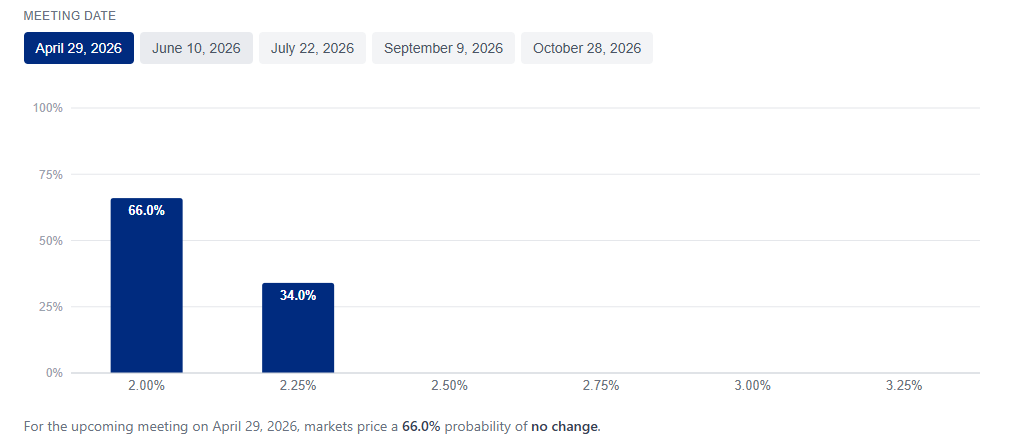
Currently, the probability that the European Central Bank will keep its deposit rate unchanged at 2.00% stands around 66%, while there is also a growing probability of approximately 34% of a potential increase to 2.25% in the April 29 decision. This reinforces the view that the ECB maintains a firm stance in the short term.
Source: ECBWATCH
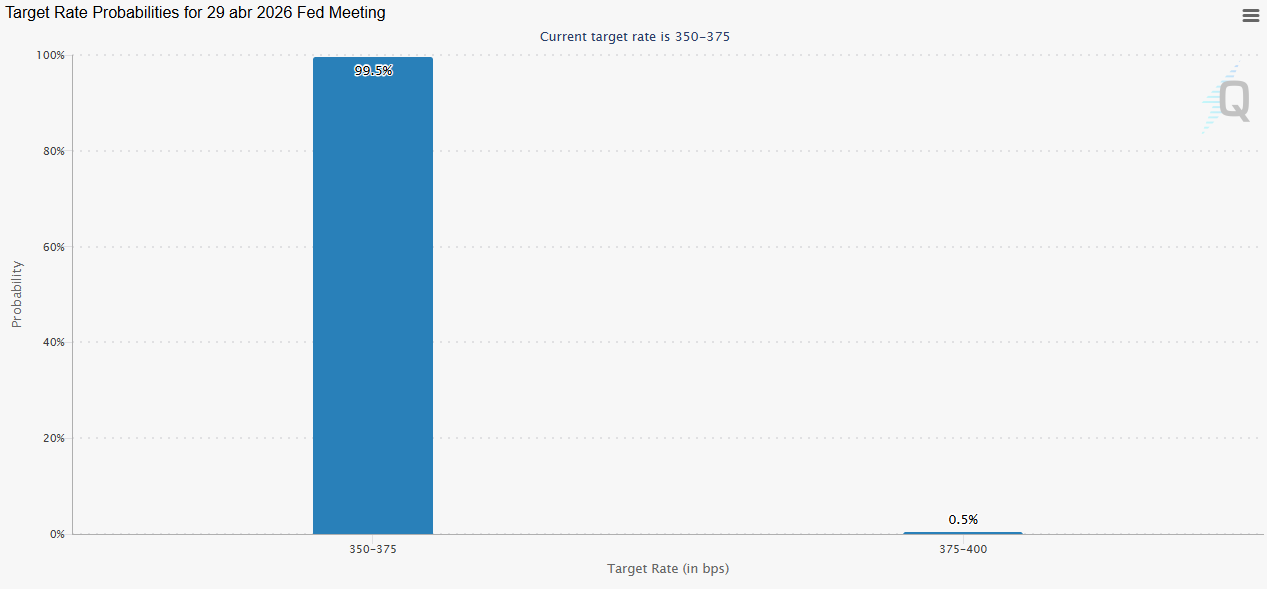
A similar dynamic is observed in the Federal Reserve outlook, where there is a 99.5% probability that the current interest rate at 3.75% will remain unchanged in the next decision. This reflects a neutral stance from both central banks, with no significant changes expected in the short term.
Source: CMEGROUP
The key takeaway from this scenario is that the interest rate differential between the U.S. and the eurozone remains significant, with no clear signs of narrowing in the short term. This continues to favor dollar-denominated assets over euro-denominated ones.
If this differential persists, it may continue to act as a barrier to sustained euro strength, potentially resulting in moderate weakness in EUR/USD over the medium term.
EUR/USD Technical Outlook
Source: StoneX, Tradingview
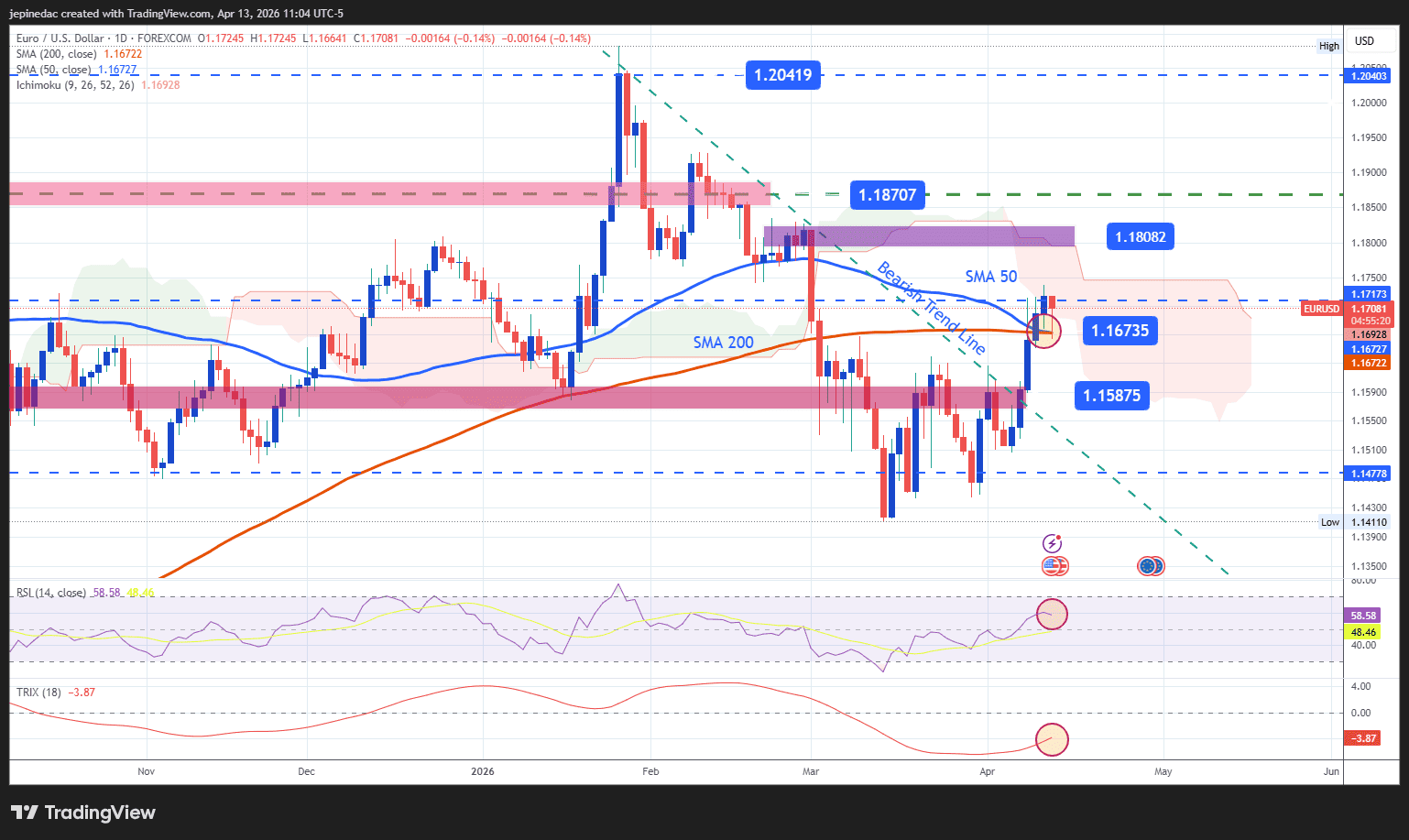
- Bullish momentum begins to fade: Since last week, the euro had shown a strong bullish impulse, pushing price above the 50- and 200-period moving averages. However, a reduction in candle size is now evident, reflecting a loss of momentum and giving way to a short-term neutral phase. If buying pressure fails to consolidate, price could enter a phase of indecision or sideways movement in the coming sessions.
- RSI: The RSI is beginning to flatten, suggesting that although buying momentum remains present, it may be entering a phase of consolidation or pause. If this continues, neutral conditions may remain dominant in the short term.
- TRIX: The TRIX indicator maintains an upward slope but remains below the zero line, indicating that long-term moving average momentum still reflects a bearish bias. Unless a sustained recovery above this level occurs, downward pressure may continue to limit EUR/USD upside.
Key levels:
- 1.18082 – Key resistance: A significant high that represents the main upside barrier. A move toward this level could reinforce the bullish bias and support the formation of a more defined upward structure.
- 1.16735 – Near-term barrier: A neutral level aligned with the 50- and 200-period moving averages. Price action around this zone could favor a range-bound scenario in the short term.
- 1.15355 – Key support: A level below the key moving averages. A move toward this area could reactivate a more dominant bearish bias in the coming sessions.
Written by Julian Pineda, CFA, CMT – Market Analyst
Follow him on: @julianpineda25