

The euro has started to gain dominance in the short term, with EUR/USD posting two consecutive bullish sessions and accumulating gains of more than 1%. The recent buying pressure has been driven mainly by a loss of momentum in the U.S. dollar, amid a backdrop of intensifying political and economic tensions between the United States and Europe. If this renewed sense of risk persists, a more dominant bullish bias could continue to support EUR/USD price action in the coming sessions.

The dollar gives up significant ground
Since the weekend, markets have been reacting to announcements from President Donald Trump, who outlined plans to impose initial 10% tariffs, starting February 1, on products imported from approximately eight European countries, should support for his proposal to acquire Greenland fail to materialize. It was also stated that these tariffs could increase to as much as 25% if European countries do not cooperate.
During the latest trading session, further developments emerged as President Trump directly threatened France with imposing a nearly 200% tariff on wine exports if the country does not join his international initiative known as the “Board of Peace”, amid the broader diplomatic dispute surrounding Greenland. The French government has described these threats as an attempt at economic coercion and political interference, firmly rejecting the idea of complying with U.S. demands to avoid trade sanctions.
This ongoing exchange of statements has steadily increased risk perception across markets, prompting capital outflows from the dollar toward alternative safe-haven assets and currencies. As the U.S. dollar is directly involved in the escalation of tensions, it has begun to show persistent weakness. This trend is already reflected in the DXY index, which measures the dollar’s strength against its major peers and has fallen from 99.4 to around 98.5 in just two sessions, highlighting a notable decline in short-term demand.

Source: TradingEconomics
Under this scenario, the euro appears to be benefiting from dollar weakness, attracting increased demand as the European region is perceived as more predictable and stable compared to the political noise coming from the United States. As long as indecision and repeated threats remain part of the U.S. agenda, the dollar may continue to lose ground, allowing a more dominant buying pressure to support EUR/USD movements in the near term.
Does the European Central Bank matter in this context?
Beyond the diplomatic backdrop, it is important to note that the European Central Bank (ECB) will hold its first monetary policy meeting of 2026 on February 3. At this stage, markets assign a probability of around 94.5% that the deposit rate will remain at 2.00%, an expectation that also extends to the next three policy decisions.

Source: ECBWATCH
In an environment where the euro is beginning to assume a role as a temporary safe-haven currency, the ECB’s neutral stance on interest rates becomes particularly relevant. This stability helps prevent significant downside pressure in the European fixed-income market in the short term. As investors continue to seek exposure to perceived safe assets, such as European bonds, a steady inflow of capital into the region could persist, strengthening demand for the euro and potentially supporting sustained buying pressure in EUR/USD.
EUR/USD Technical Outlook
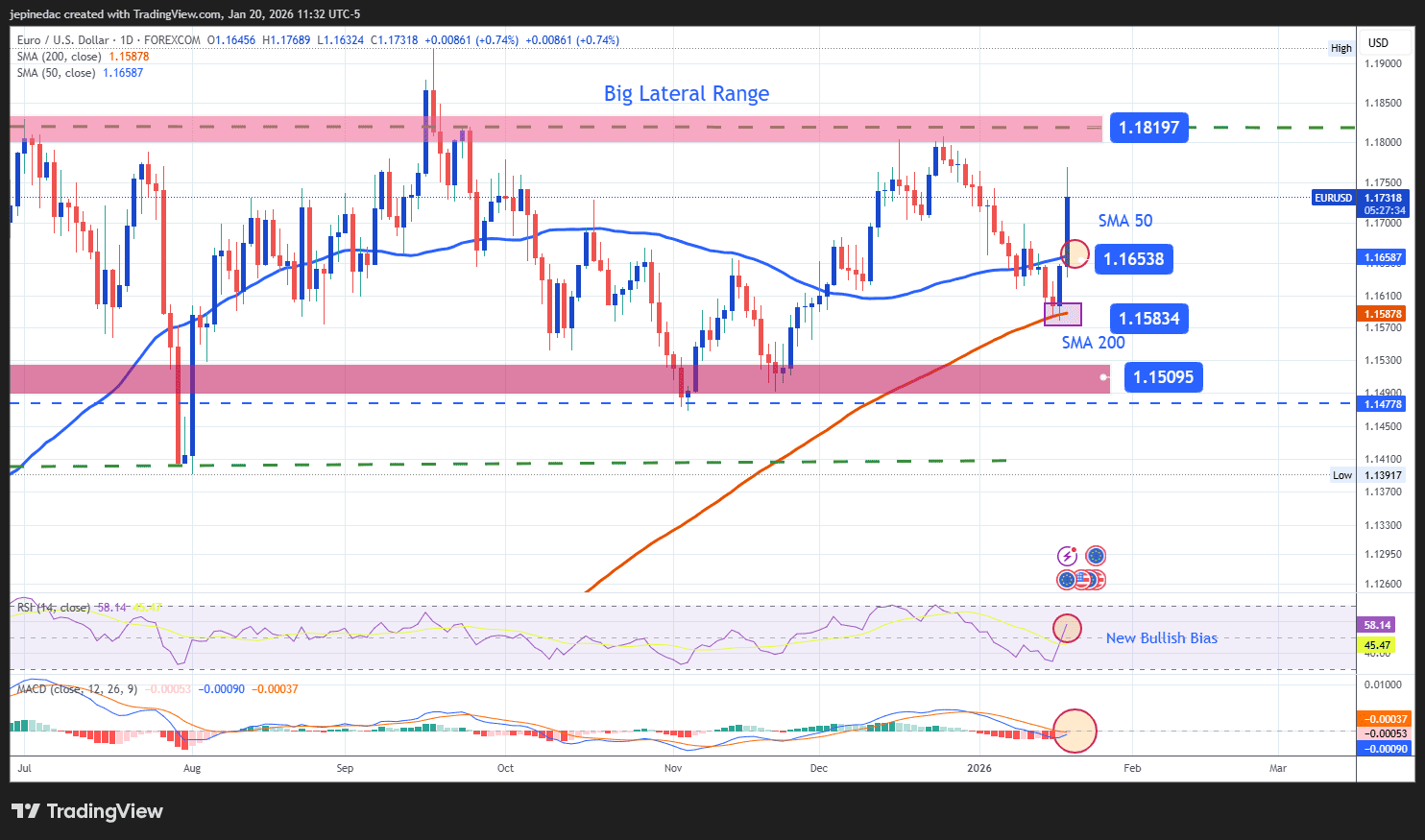
Source: StoneX, Tradingview
- The broad sideways range continues to dominate price action: For several months, EUR/USD has traded within a well-defined sideways range, capped near 1.18197 and supported around 1.15095. In the short term, a meaningful bullish impulse has re-emerged, reviving buying pressure; however, this move remains insufficient to break above the upper boundary of the range. As long as this resistance holds, the sideways structure is likely to remain a key feature of the pair’s behavior.
- RSI: The RSI is showing a clearly upward slope, holding above the neutral 50 level. This suggests that the average momentum over the last 14 sessions has turned predominantly bullish, which could continue to support upward pressure if the indicator maintains this trajectory.
- MACD: A similar signal is emerging from the MACD, whose histogram is approaching a potential crossover above the zero line, pointing to a possible dominance of bullish momentum in short-term moving averages. If sustained, this could allow the bullish bias to gain further traction in the coming sessions.
Key levels:
- 1.181979 – Key resistance: This level aligns with the upper boundary of the sideways range and represents the main barrier for further upside. A sustained breakout above this zone could open the door to a new bullish trend.
- 1.16538 – Nearby barrier: A recent neutral zone, aligned with the 50-period simple moving average, which may act as a reference level during potential short-term pullbacks.
- 1.15834 – Definitive support: This level coincides with the 200-period simple moving average. A pullback toward this area could reactivate bearish pressure and extend the broader sideways structure observed in recent months.
Written by Julian Pineda, CFA, CMT – Market Analyst
Follow him on: @julianpineda25