
The EUR/USD closed the week with a consistent bearish bias, and over the last two trading sessions it has recorded a decline of close to -0.3%, reflecting structural weakness in the euro and sustained short-term strength in the U.S. dollar. The selling pressure that has started to gain prominence is mainly driven by the renewed strengthening of the dollar against its major peers, supported by expectations of neutral interest rates from the Federal Reserve. As long as dollar strength persists, selling pressure is likely to remain relevant in EUR/USD price action over the coming sessions.

Dollar Strength Returns
Recent weeks have been marked by the release of key U.S. employment and inflation data. However, all of these indicators share a common feature: they have failed to alter expectations for neutral interest rates, at least through the first quarter of 2026, from the Federal Reserve. Current probability distributions suggest there is a greater than 65% chance that the central bank will keep rates unchanged over its next three policy decisions, through April 2026, at the current 3.75% level, with a low probability of near-term rate cuts. This reinforces the view that a neutral policy stance continues to dominate the monetary landscape.
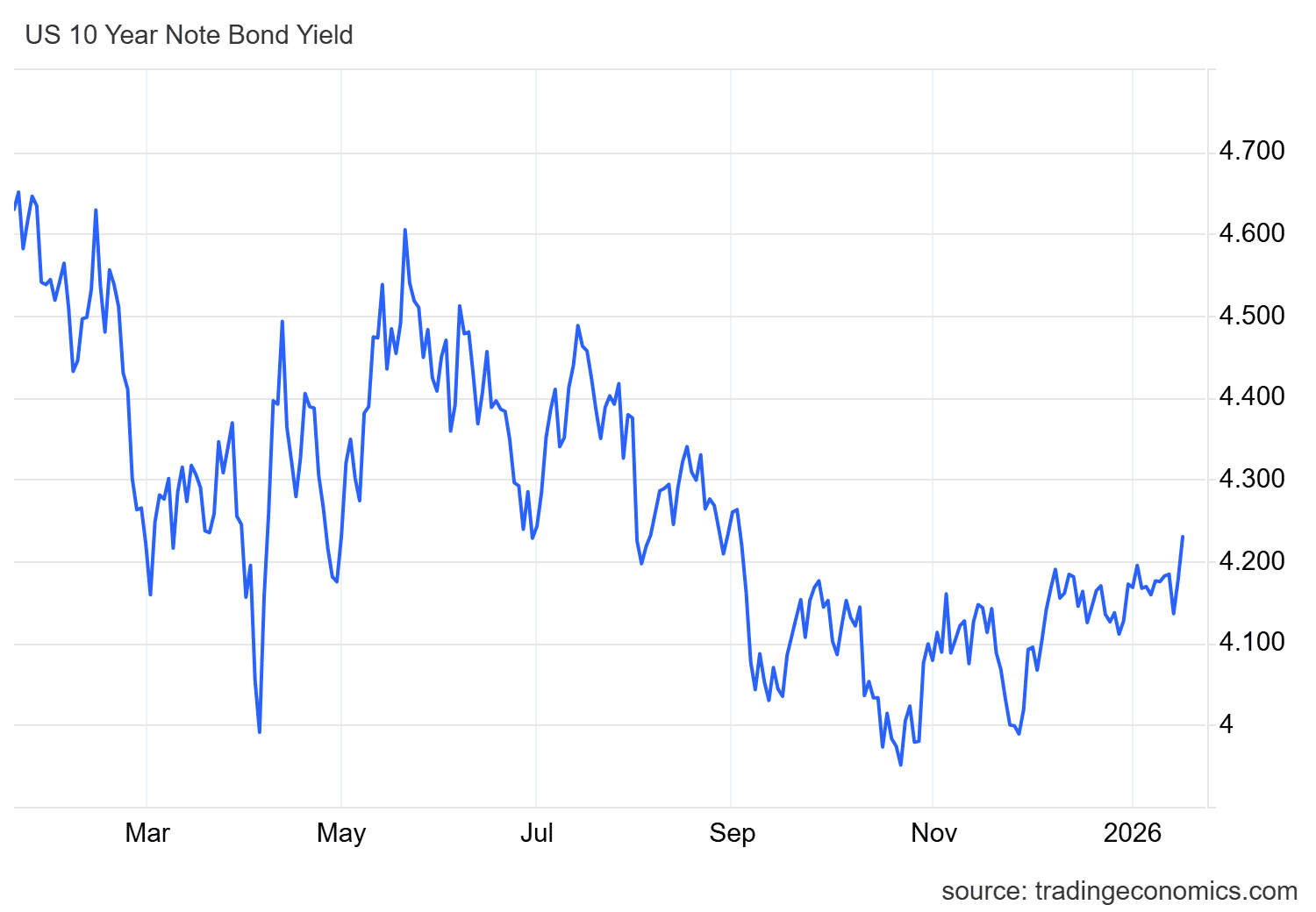
This backdrop has become particularly relevant for the U.S. fixed-income market, as sustained expectations of neutral rates have supported a consistent recovery in U.S. 10-year Treasury yields. At present, the yield curve shows a sustained move above the 4.2% area, a level not seen since September 2025, highlighting a strengthening in yields over the short term.
Source: TradingEconomics
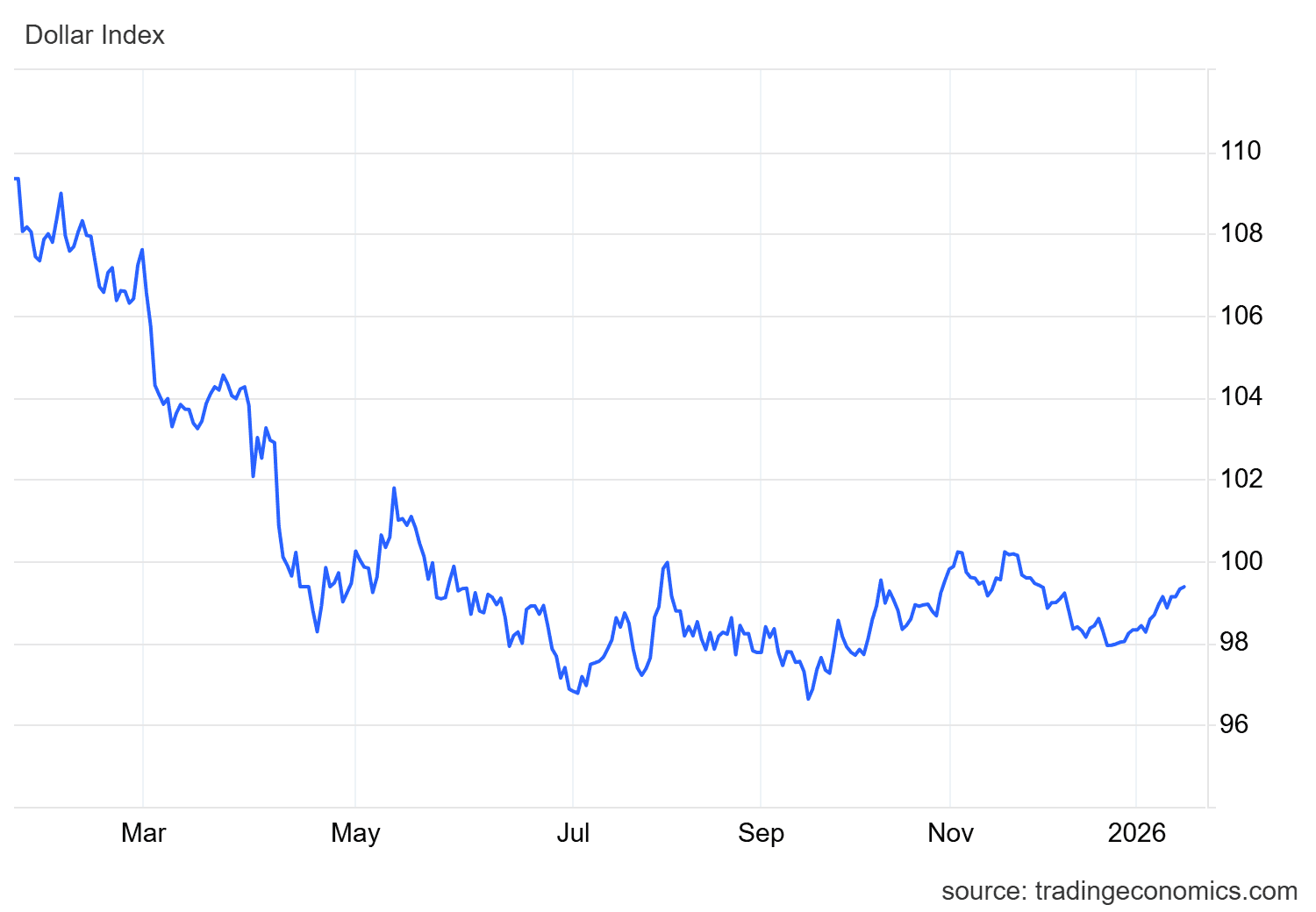
The recent behavior of the bond market has been significantly supporting U.S. dollar strength, as higher yields tend to attract foreign capital inflows into the United States, increasing demand for dollars. This has once again made dollar-denominated assets more attractive relative to those denominated in euros. In fact, this dynamic is clearly reflected in the DXY index, which measures the dollar’s strength against other currencies and is currently maintaining an upward slope, moving above the 99-point area and approaching the psychological 100 level. This move confirms that the dollar’s recent recovery has been consistent and that stronger demand has begun to dominate its price action.
Source: TradingEconomics
In this context, as long as the Federal Reserve maintains a neutral rate outlook, the dollar may continue to show short-term strength, potentially leading the euro to lose further ground. This scenario stands out as a relevant catalyst for the consolidation of a dominant bearish bias in EUR/USD over the coming trading sessions.
EUR/USD Technical Outlook
Source: StoneX, Tradingview
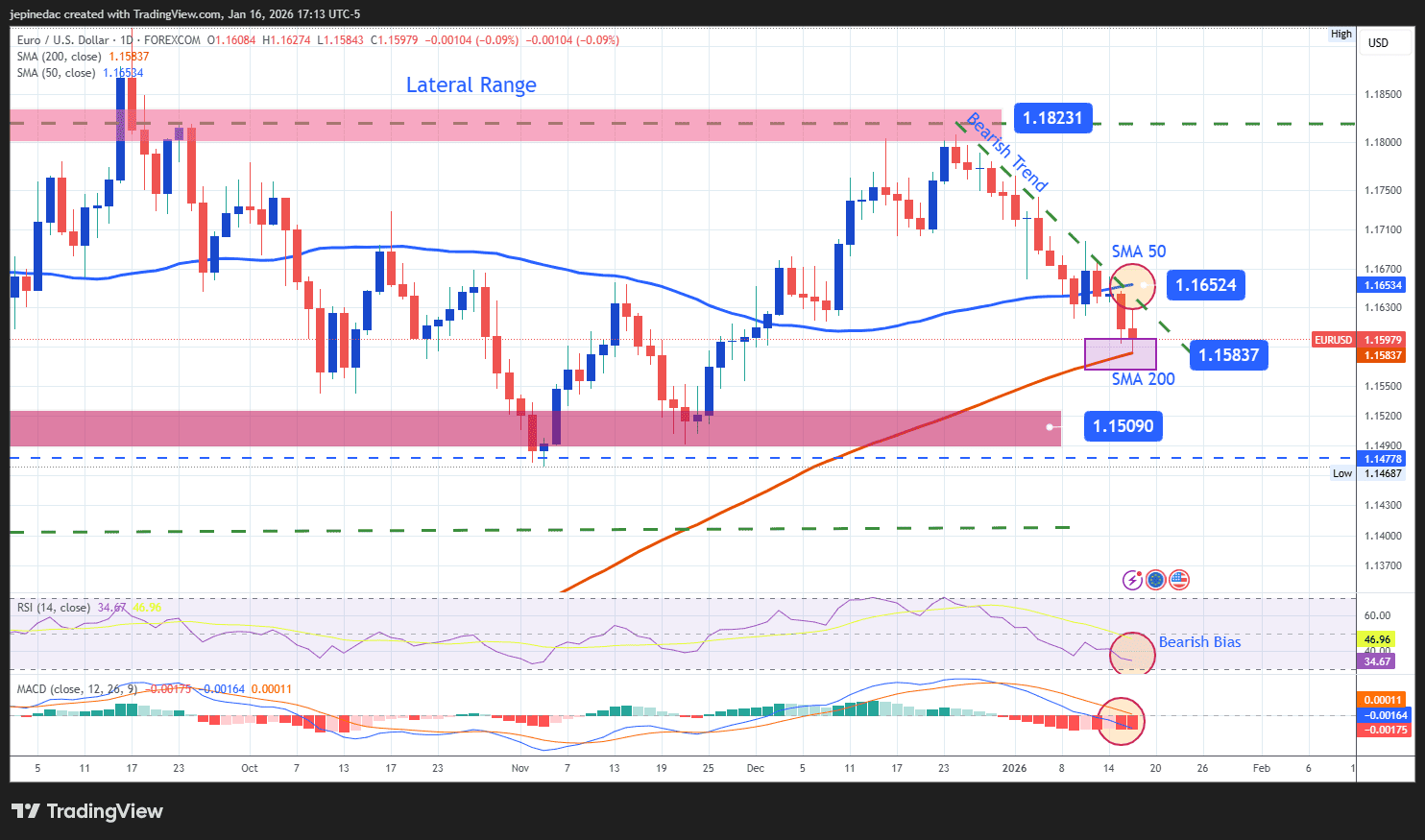
- A new bearish trend begins to emerge: Since December 24, average EUR/USD price movements have started to form a sequence of lower highs, giving rise to a short-term bearish trend. Although price continues to trade within a broad long-term sideways range, the recent formation of this trendline suggests that the selling bias may persist in the coming sessions, particularly given the absence of meaningful bullish corrections that would threaten this structure.
- RSI: The RSI maintains a downward slope and remains below the neutral 50 level, indicating that bearish momentum continues to dominate short-term market behavior. As long as this pattern holds, selling pressure is likely to remain relevant.
- MACD: The MACD histogram continues to oscillate below the neutral zero line, signaling that average moving average momentum remains in bearish territory. If this behavior persists, selling pressure is likely to continue dominating price movements.
Key Levels:
- 1.16524 – Key resistance: A level that aligns with recent highs and the 50-period simple moving average. Sustained moves above this zone could invalidate the new short-term bearish trend and open the door to a more meaningful bullish bias.
- 1.15837 – Nearby barrier: A level aligned with the 200-period simple moving average. As long as price remains below this area, the bearish bias is likely to continue dominating in the sessions ahead.
- 1.15090 – Major support: A level corresponding to the lower boundary of the long-term sideways range, aligned with the lows observed in recent months. A sustained move toward this zone could reinforce the formation of a more solid bearish trend over the coming weeks.
Written by Julian Pineda, CFA, CMT – Market Analyst
Follow him on: @julianpineda25