
Over the past five trading sessions, gold has shown a consistent bullish bias, accumulating a gain of more than 2% in the short term. Buying pressure has remained firm in recent sessions as the U.S. dollar has weakened, but also because the independence of the U.S. central bank has been called into question. This situation increases uncertainty and strengthens the appeal of the precious metal as a safe-haven asset, supporting its short-term recovery.

Is the Fed’s Independence at Risk?
President Trump surprised financial markets earlier this week with his comments about the possible dismissal of Lisa Cook, a member of the Federal Reserve’s Board of Governors and a relevant figure within the central bank. This announcement sparked an immediate reaction because, under normal circumstances, Fed members hold long-term fixed mandates and it is rare to see any attempt to interrupt them prematurely. The mere suggestion represents an unusual event in U.S. institutional history and opens the door to a new stage of uncertainty.
It is important to emphasize that the Federal Reserve is considered one of the most independent central banks in the world. This independence has been a cornerstone of international market confidence in the U.S. dollar and the country’s monetary policy. However, even the suggestion of political intervention raises doubts about the autonomy of the institution and concerns that decisions may become driven by the government’s immediate political interests rather than long-term economic stability.
If the government manages to influence the central bank’s composition, it is likely that new members would push for lower interest rates, potentially below the current 4.5%, which would directly impact Treasury yields and global demand for dollars. This would give gold, as the dollar’s rival asset, more room to rise and reinforce its role as a safe haven. At the same time, a loss of independence at the Fed could lead to a higher inflation risk, since the institution may be more willing to adopt a flexible monetary stance in response to rising prices, further undermining investor confidence.
Such a scenario, where domestic political pressure combines with external confidence erosion, is generally negative for financial markets. For now, gold appears to be the most attractive alternative to absorb the impact of these shocks, consolidating its position as a safe-haven asset amid the political and economic uncertainty emerging in the United States.
What About the U.S. Dollar?
The DXY index, which measures the dollar’s strength against a basket of currencies, has displayed a downward slope and is currently hovering around 98 points. Most importantly, this weakness has been consistent in the short term and could intensify selling pressure if the index fails to stabilize.
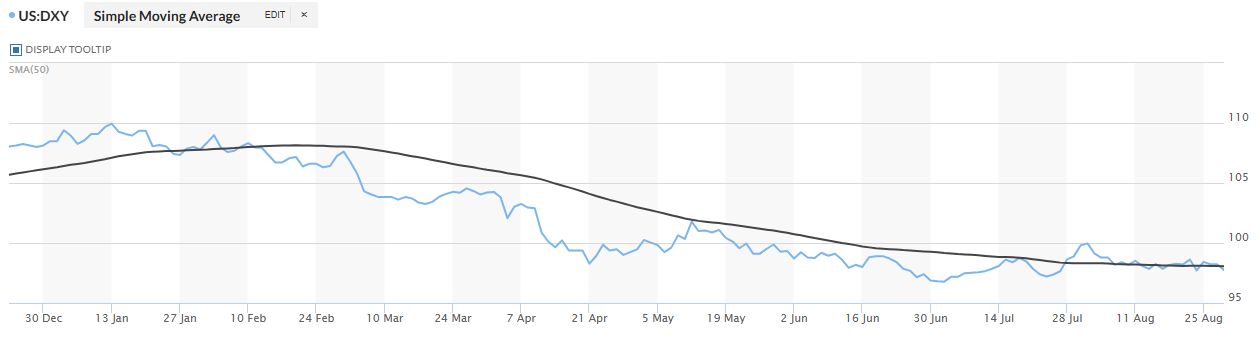
Source: MarketWatch
According to MarketWatch, the lack of confidence in the dollar is linked both to expectations of lower interest rates and to recent clashes between the Fed and the central government. As long as this trend persists, investors are likely to shift their attention toward more solid assets such as gold, which has historically been the dollar’s main rival in times of uncertainty.
Gold Technical Outlook

Source: StoneX, Tradingview
- Sideways range remains: Gold continues to fluctuate within a lateral channel defined between $3,400 as resistance and $3,200 as support. In recent sessions, the price has attempted to move back toward the upper end of the range, although these moves have not been strong enough to confirm a clear breakout. For now, this lateral formation remains the prevailing technical structure in the short term.
- RSI: The RSI line maintains an upward slope above the 50 level, reflecting increasing buying momentum. If this trend continues, gold could experience stronger buying pressure in the near term.
- MACD: The MACD histogram continues to oscillate above the zero line, suggesting that the average strength of the moving averages is tilting upward. If this momentum holds, buying pressure could consolidate even further.
Key levels to watch:
- $3,400 – Major resistance: This level marks recent highs and the upper boundary of the lateral channel. A sustained close above it could trigger a new bullish leg, potentially resuming the long-term uptrend that has remained dormant on the chart.
- $3,300 – Near-term barrier: This technical area coincides with the 50-period moving average. It may act as a key pivot to limit pullbacks, particularly if the price fails to hold above $3,400.
- $3,200 – Critical support: This level represents the base of the channel and recent lows. A break below it would put the current structure at risk and could pave the way for a clearer bearish trend in the short term.
Written by Julian Pineda, CFA – Market Analyst
Follow him at: @julianpineda25