

Are capital flows rushing into gold because of fear of a possible US attack on Iran? Or is this perhaps a continued bid out of China as reserves attempt to diversify away from the US Dollar? There’s a lot of speculation about what might be causing it but the move in gold is undeniable, as every minor pullback has so far been hit hard and aggressively by bulls. And over the past 48 hours that move in gold has went from extreme to even more extreme as the metal has barged through the 5400 and 5500 psychological levels and at this point is seeing resistance rest just under the 5600 handle.
Gold Hourly Price Chart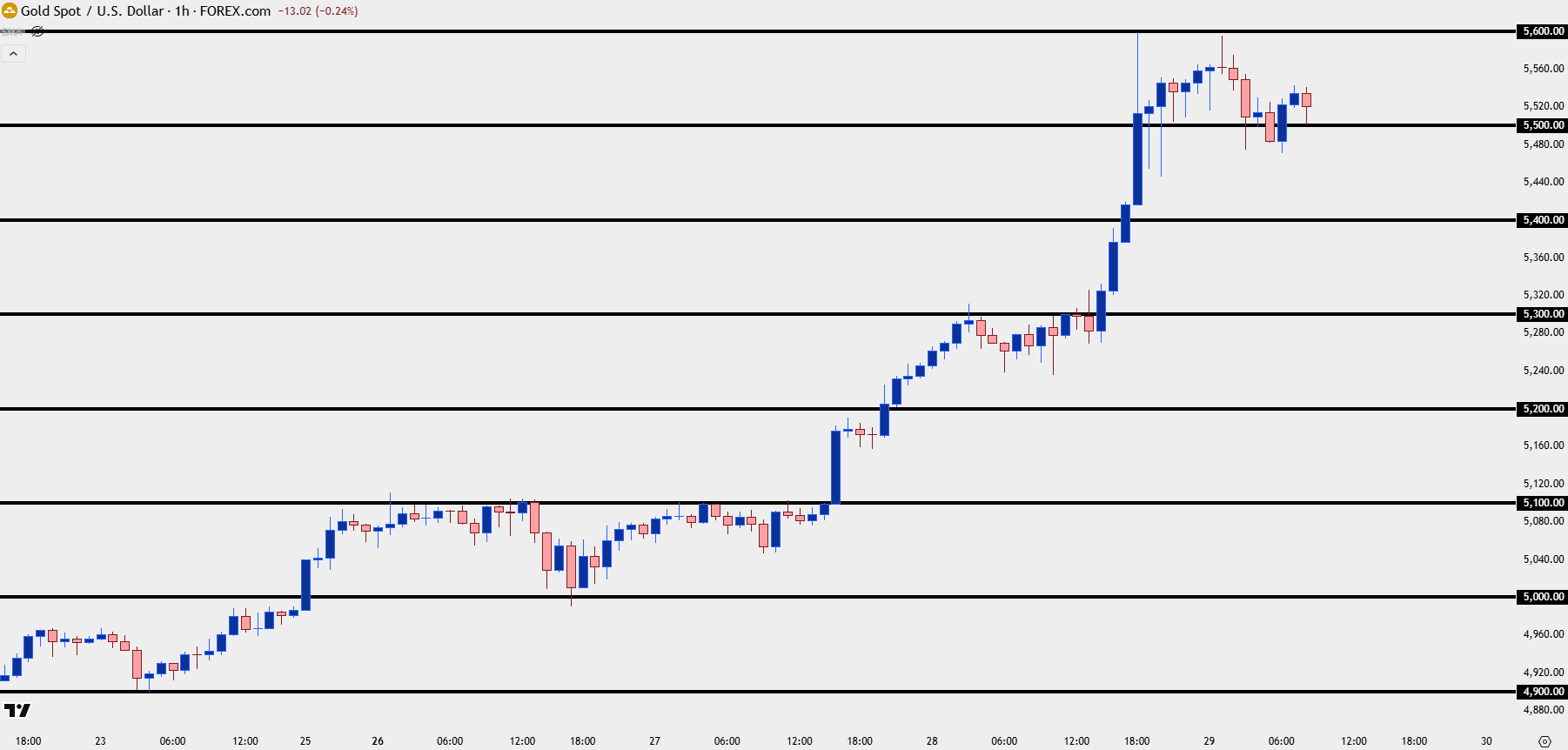
Chart prepared by James Stanley; data derived from Tradingview
Gold Rally Just Keeps Going
While fundamentals are often a push point for price that relationship isn’t necessarily direct, as it’s buying and selling, supply and demand that actually brings on higher prices in a true market environment. And normally, there’s give and take a long the way, which explains the pauses in the move that we saw in the final two months of 2024 or from April to August of last year or again towards the end of 2025, with bull pennants forming in each scenario.
The reason this happens is because of positioning. Something happens that causes buyers to increase demand, and as a spark point for gold it was the Austan Goolsbee comment back on February 14th, 2024, when the Fed seemingly shrugged off high inflation to instead telegraph their desire to cut rates ahead of the US election later in the year, when gold began to finally break out from the $2k resistance that had held for the prior three-and-a-half years.
Since then inflation hasn’t shown below target via CPI or Core PCE and the Fed has cut 175 basis points, with possibility for even more along the way. And later in the year it’s highly expected that we’ll get a more-dovish Fed chair that will bring even more rate cuts to the economy as President Trump has said multiple times that a willingness to cut rates is a ‘litmus test’ for whomever he picks to run the Fed.
But that doesn’t seem to explain the current run as all of that information was well-known even coming into this year. What’s happened so far in 2026 is a bullish market has become even more outlandishly bullish and the positioning that will normally lead to a form of ‘two steps forward, one step back’ hasn’t really shown.
This suggests that there’s some big players buying regardless of gold being in an extreme overbought state. The natural next question is ‘why.’
Gold Daily Chart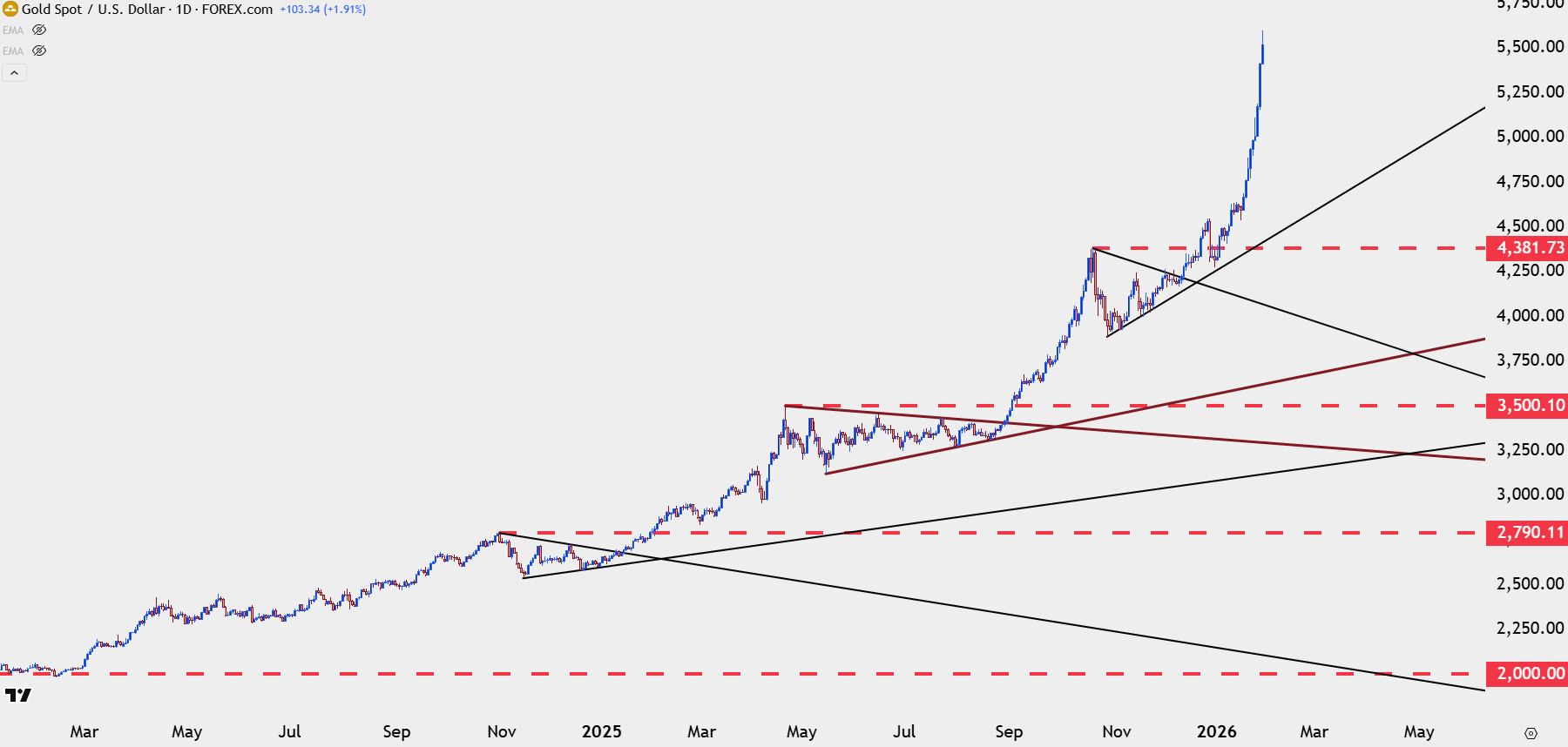
Chart prepared by James Stanley; data derived from Tradingview
Gold, The What v/s the Why
One of the reasons I follow price action so closely is that for trading strategy, the ‘why’ usually matters far less than the ‘what.’ Because it’s only with hindsight that we’ll know why something happened with any degree of certainty and that hindsight analysis is not going to help to set up trading strategy or manage risk.
So, first things first, this trend remains aggressively bullish and this is reason to bias towards continued upside in gold until evidence presents otherwise. On that note – traders then have two options, to either chase gold and hope that the run continues without much of a pullback, or to wait and try to get some element of pullback, similar to the 5250 support that showed earlier in the week, at which point risk can be managed more efficiently.
While that sounds like a loaded decision set, it really depends on who you are and how you manage risk because there’s possible downside for either path. For the patience approach, the fact of the matter is that pullback may not arrive anytime soon, and if it does, it may just continue pulling back. Waiting for a cleaner entry is no assurance or promise of successful entry. And for the more aggressive stance of buying and hoping that the move continues, well the risk there is clear – it might pull back even more and this would require either a very wide stop or a higher probability of loss. And, again, there’s no certainty here.
The reason I often default towards the path of patience is psychological. Failure has to be accepted as a part of trading strategy because the future, regardless of how strong any trend might be, the current run in gold included, will remain as uncertain. Failure, even if expected, can take a toll on a person’s psychology especially if repeated and persistent. But – if one is disciplined and sticking to a plan, at the least, there’s something to feel good about. Whereas letting excitement get the better of our decision-making processes and chasing a move or a market runs a major risk as failure, in that case, would seemingly be more of a responsibility as we didn’t execute a plan, or take a structured approach.
And between the options of losing capital because our excitement got the best of us, driving us to chase a market versus missing an opportunity, I’d prefer the latter from the former.
But to frame this a different way – that’s the type of behavior that allowed for the pullbacks in gold to develop coming into this year. The fact that there isn’t more of a pullback, and, seemingly, panic buying in the extreme size that is showing is driving even fresher and fresher highs is notable.
For support, there have been windows of opportunity. We saw it coming into this week with an ascending triangle, and then yesterday with the 5250 test. Again, there’s no assurance that the pullback won’t deepen on that next test of support, wherever it might be, but the fact that the trend has remained as strong as it provides reason for continuing to bias this for topside continuation.
As of now, we’re seeing inflections at psychological levels as spot gold remains in fresh territory. The 5600 level has so far held resistance and 5300 was resistance before that, which seemingly becomes support potential in deeper pullback scenarios. Current lows have held around 5475 and if there is a deeper drop, the 5400 level stands out as important before 5300 comes back into play.
Gold Hourly Price Chart
Chart prepared by James Stanley; data derived from Tradingview
--- written by James Stanley, Senior Market Analyst, Global Macro