
Gold remains stuck between a rock and a hard place, with the directional bias remains tilted to the downside. While dovish Federal Reserve repricing and lower oil prices in the last couple of days has provided some support, the metal is still undermined by the elevated yields and the risks that oil prices may rebound and create fresh volatility for financial markets. Meanwhile, the technical resistance is also there with the metal now stuck in a bearish trend. Uncertainty over US-Iran situation continue to create the highest source of pressure, while central bank buying means downside is also limited. For now, the path of least resistance and the near-term risks to our gold outlook remain slightly tilted to the downside.
Gold rebounds – for now
Gold briefly slipped below last week’s low of $4,111 before recovering as oil prices and Treasury yields retreated. The pullback in yields has been particularly helpful, after a period of rising borrowing costs and a stronger US dollar put considerable pressure on the precious metal. However, nothing significant has changed fundamentally to support sustained pressure yields or the dollar.
Granted, we have seen some weaker US macro data of late, while comments from Fed officials John Williams and Philip Jefferson, who have pushed back against expectations of an October rate hike, have also helped gold. Friday’s weaker-than-expected US jobs report saw the probability of an October increase fall to just 20%. The resulting dovish repricing has helped limit gold’s downside.
Next week’s US CPI report is the next big data release. A softer inflation reading would probably reinforce the recent dovish Fed repricing and give gold another leg higher. But a hotter number, particularly if Middle East tensions remain unresolved, could push yields higher and expose gold to another round of selling.
Central banks continued to purchase gold in August
Central bank demand remains a structural positive for gold. According to the World Gold Council, global central banks reported net purchases of 39 tonnes in August, taking reported year-to-date buying to around 170 tonnes. China was the largest buyer during the month, followed by Uzbekistan and Poland. Continued official-sector accumulation provides an important floor for gold, even if it does little to resolve the short-term bearish picture.
Technical Gold outlook and levels to watch
Today’s false breakdown below last week’s low of $4,111 is technically a positive sign, but only if it leads to a sharp squeeze higher. So far, the gains have been modest at best, so the picture remains less convincing – and the bearish trend could resume.
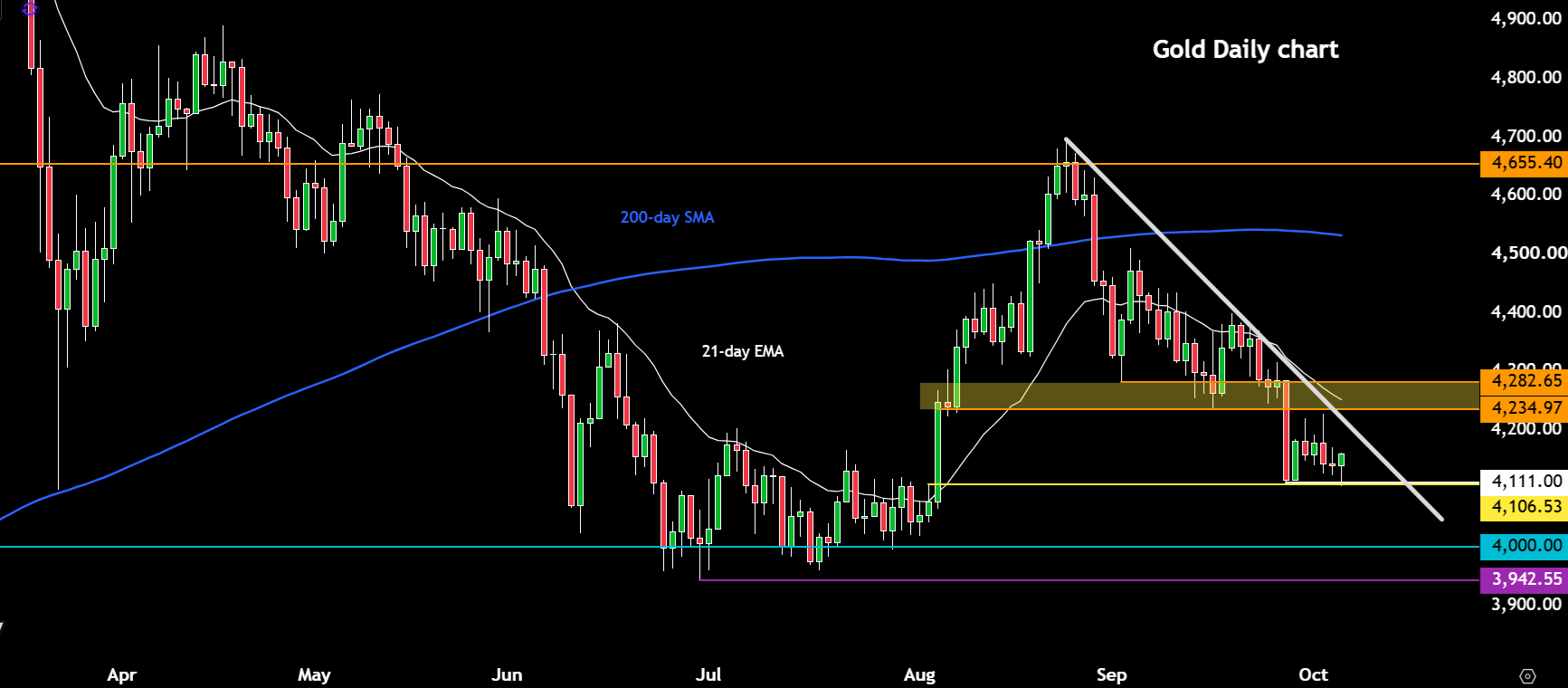
Indeed, the larger trend is still bearish. Gold has been trending lower since its January peak, although the psychologically important $4,000 level managed hold during the summer months. This remains the key long-term line in the sand. A decisive break below it would significantly weaken the broader bullish structure.
In fact, as can be seen on the weekly chart, gold is currently testing a major support zone between $4,000 and $4,120. The market has bounced from this area, which is encouraging for the bulls, but it needs to build on that recovery.
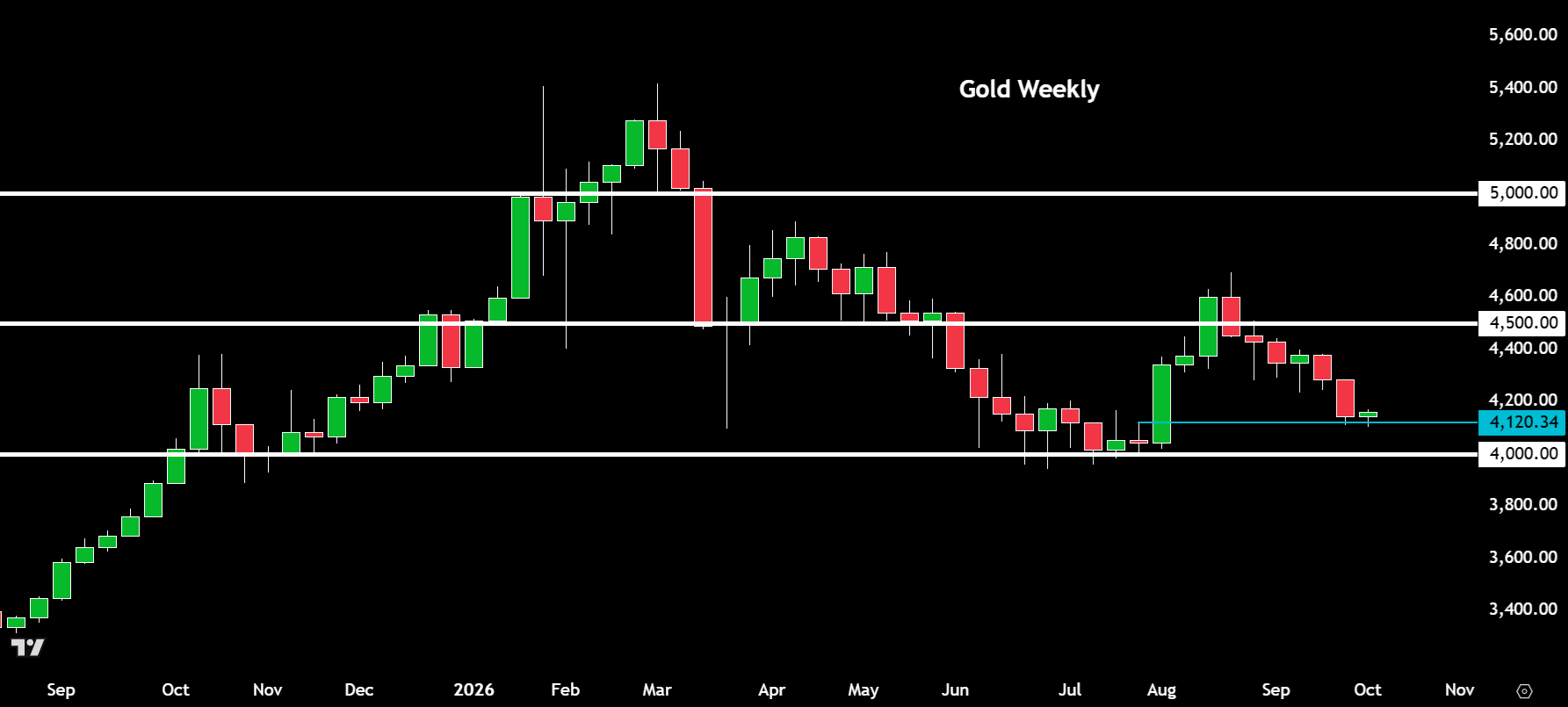
If the above support breaks on the weekly time frame, then it could a cold autumn for gold bulls.
Meanwhile, the daily chart is more concerning. Spot gold remains below both its 21-day exponential moving average and 200-day simple moving average, while the sequence of lower highs and lower lows remains intact. The recent bounce could therefore still prove to be nothing more than short covering.
For the technical picture to turn convincingly bullish, and for us to drop out near-term bearish gold outlook, the metal needs to break the near-term bearish trend and reclaim the $4,235–$4,282 resistance zone at the very least. Until that happens, the sellers retain the advantage.
A decisive break below $4,106 would instead expose the $4,000 area, followed by the June low around $3,942.
For now, consolidation is the name of the game. Gold has fundamental support from persistent central-bank demand, but the technical trend has yet to turn. The next major move is likely to be dictated by the combination of US-Iran developments, oil prices, bond yields and next week’s CPI report.