
- Tight inverse link with yields reasserts
- CPI and PCE to test the relationship
- $4800-$4850 caps, $4700 supports
Summary
Gold’s relationship with US yields has tightened sharply, putting US inflation data in focus. With CPI and core PCE set to test that link, and the price holding a clean range between $4700 support and $4800-$4850 resistance, the next move likely comes down to whether yields push higher or roll over from here, with developments around the US-Iran ceasefire an additional swing factor in the background.
Yield relationship reasserts
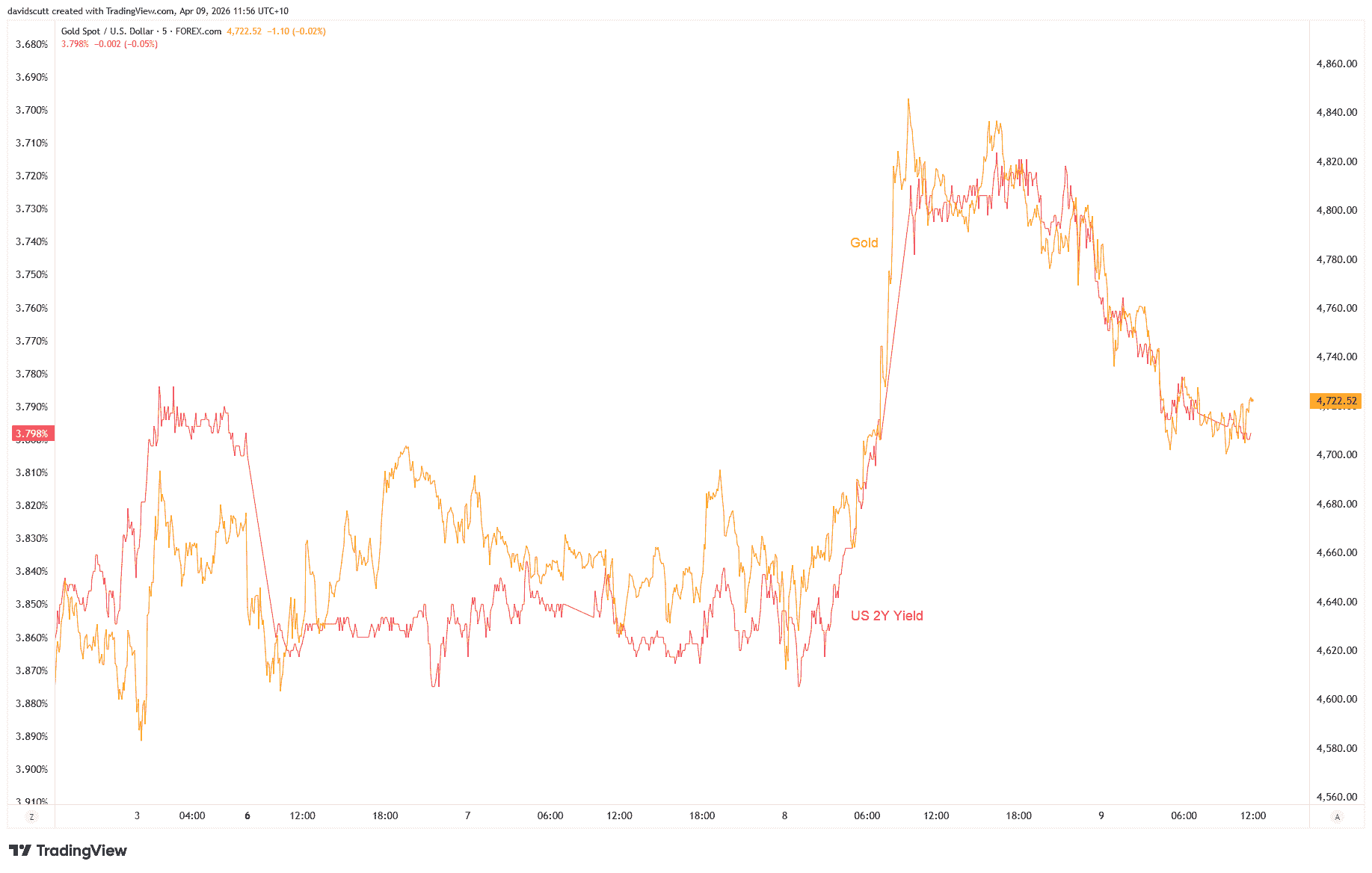
The tight inverse relationship between gold and US Treasury yields over the past week suggests historic drivers may be starting to reassert themselves after a prolonged period where bullion behaved more like an asset at the outer extremities of the risk spectrum, with both realised and implied volatility that put crypto to shame.
Source: TradingView
Whether the rates linkage lasts remains to be seen, but with correlation coefficients sitting in the negative high 0.9s across both short and longer-dated Treasury yields, it puts not only developments in the US-Iran ceasefire in focus, but also a heavy run of US data that will test the relationship almost immediately.
Inflation to test the link
Source: TradingView (US EDT shown)
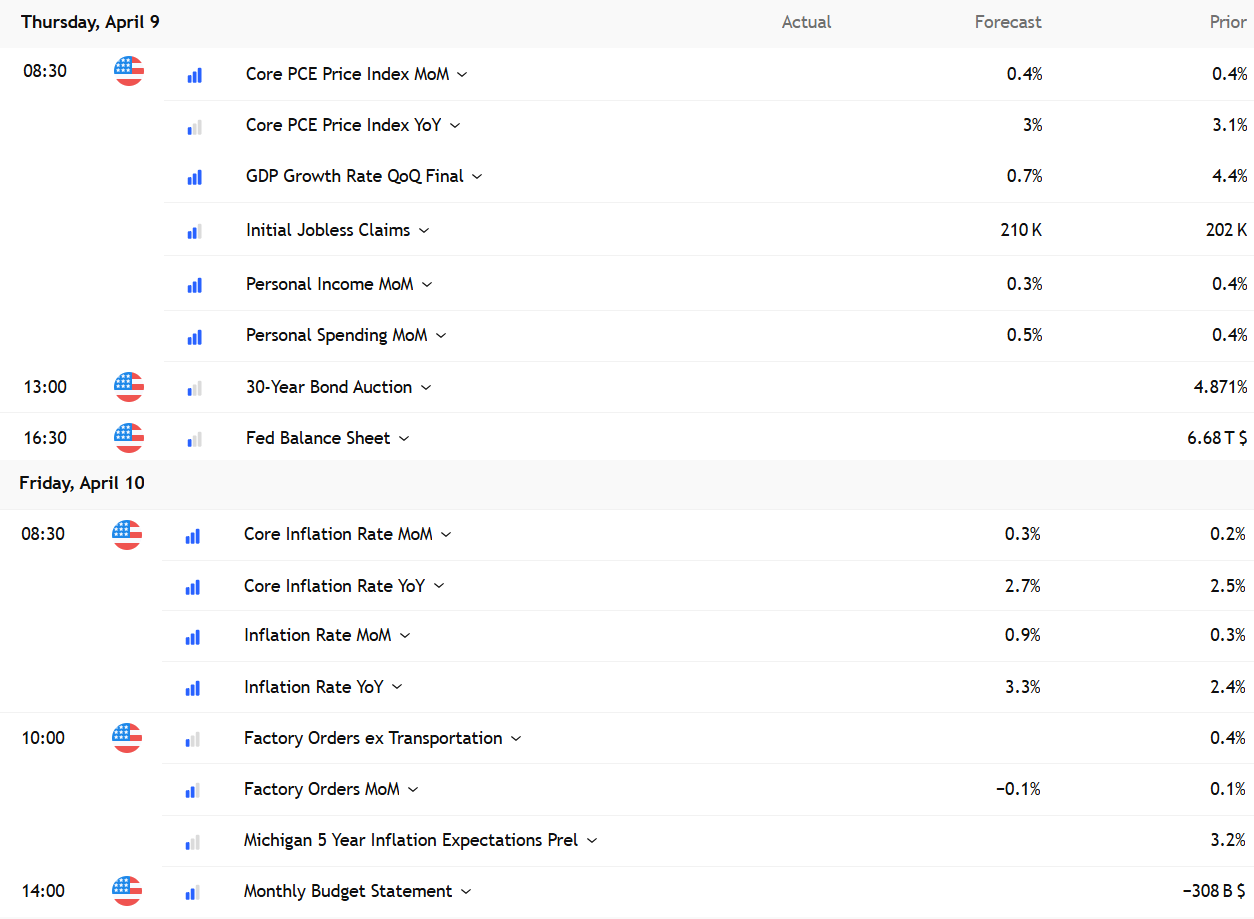
While the Fed’s preferred underlying inflation measure, the core PCE deflator, will be released later today, the data remains somewhat dated, covering February and arriving before the energy price sparked by the Iran war. As such, there may be more interest in the income and spending data given the implications for consumption and broader economic activity in the March quarter, with strong outcomes likely to fan fears of a potential inflation acceleration, while any softness may help ease those concerns given the implications for activity and hiring.
After a soft 10-year Treasury note auction on Wednesday, the auction of 30-year Treasury bonds may also be of interest to traders given the implications for yields. But the honest assessment is that Friday matters far more than Thursday when it comes to the calendar, headlined by the release of March consumer price inflation.
A big lift in the headline index is expected on the back of energy prices, but the key question for markets is whether we see immediate bleeding into the core measure. Any upside surprise on the 0.3% level forecast may see markets yet again flip to pricing the risk of rate hikes from the Fed this year, not cuts. Given the focus on inflation expectations, the University of Michigan 5-year measure arrives at a convenient moment, delivering a near real-time assessment on perceived risks to future consumption behaviour and wage demands.
Upside surprises in the inflation reads are likely to lift Treasury yields, an outcome the correlation analysis earlier suggests may weigh on bullion. The opposite obviously applies if we see material undershoots. Beyond the known data, the key risk to monitor remains the ceasefire in the Gulf.
Clean price action

Source: TradingView
My only observation on the daily chart on the right is that the bearish pin candle reinforces the message from earlier this month that sellers are waiting between $4800 up to $4850, making that the key reference point overhead for traders to be aware of.
Zooming into the H4 on the left reinforces not only that message but also how clean the price action has been in gold in what’s been an otherwise chaotic macro environment. $4700, which previously acted as resistance, has now flipped to support, making it the first level of note on the downside, with $4600 and $4550 others to watch should the prevailing range give way.
If the price were to break above $4850, $4975 is the next topside target for bulls, with the 50DMA located in between. With RSI (14) and MACD generating a neutral signal on momentum, I don’t have a directional bias, instead putting more weight on price action around known levels for guidance.
As a short-term trade idea, longs could be considered above $4700 with a tight stop below, targeting a retest of $4850 resistance. Confidence in the setup is not particularly high, so a back-test and bounce from $4700 would be preferable before entry.