
Gold fell just under 3% last week, its second consecutive weekly drop. The metal was on the defensive after the early-week bounce faded. The drop wasn’t as sharp as the sell-off at the end of January, but it was still noticeable. Still, gold managed to cling onto the $5,000 level. Much of the pressure came from the surge in oil prices, which pushed both the US dollar and bond yields higher. Iran’s new leader Mojtaba Khamenei suggested that closing the Strait of Hormuz could remain a strategic tool against adversaries. He also warned that additional fronts could open if the conflict escalates and national interests demand it. Those remarks quickly rippled through financial markets, sending oil prices higher once again and reinforcing the upward pressure on yields and the dollar. As a result, gold found itself squeezed between competing forces: rising geopolitical tensions offering some haven support, while stronger yields and a firmer dollar weighed on sentiment.
It is all about crude oil
Crude oil was once again become the dominant driver for broader markets. Brent crude closed above $100 per barrel on Friday, and market indications suggested prices could climb another 5% over the weekend as the Middle East conflict continues to intensify. The latest spike in oil sent equity indices lower across the board at the end of the week, while the dollar extended its rally. That combination proved a difficult backdrop for gold, which struggled to attract sustained buying interest despite the geopolitical backdrop.
The extreme volatility in oil markets is hardly surprising. Traders are still trying to determine what a fair value for crude should be under the current circumstances. On one hand, there has been a significant release of emergency oil reserves, while sanctions on certain Russian cargoes already at sea have been temporarily relaxed in an attempt to ease supply concerns.
These measures followed the dramatic surge in oil prices triggered by the US-Israel strikes on Iran and Tehran’s subsequent retaliatory attacks across the Gulf. Those attacks have effectively disrupted traffic through the Strait of Hormuz, one of the world’s most strategically important energy chokepoints. Roughly 20% of global oil supply normally passes through this narrow waterway, and any disruption there immediately raises concerns about global energy availability. The halt in tanker traffic has therefore intensified fears about supply shortages and pushed oil prices sharply higher.
Gold outlook: Rising yields and dollar overshadow haven demand
The knock-on effects of this energy shock have been felt across financial markets. Oil’s surge has fuelled inflation concerns, pushing bond yields higher and strengthening the US dollar as traders reassess the outlook for interest rates. Expectations for any rate cuts have been dialled back considerably, and that shift in policy expectations has added further upward pressure on yields. Expect non of the major central banks meeting next week to be dovish.
For gold, that creates a difficult environment. Rising yields are typically a headwind for non-yielding assets such as gold and silver, which offer no income and carry storage costs. In recent months gold had managed to show impressive resilience despite elevated yields, but in the last couple of weeks that hasn’t been the case.
Still, haven flows have prevented gold from falling sharply. The metal has remained relatively supported by the broader geopolitical backdrop, even if macro forces are currently limiting any upside momentum.
Technical gold outlook: Key levels to watch on XAU/USD
All told, gold’s price action remains choppy and largely confined to a consolidation range. Elevated volatility continues to offer opportunities for both bulls and bears, but the market still appears to be waiting for a clearer directional catalyst.
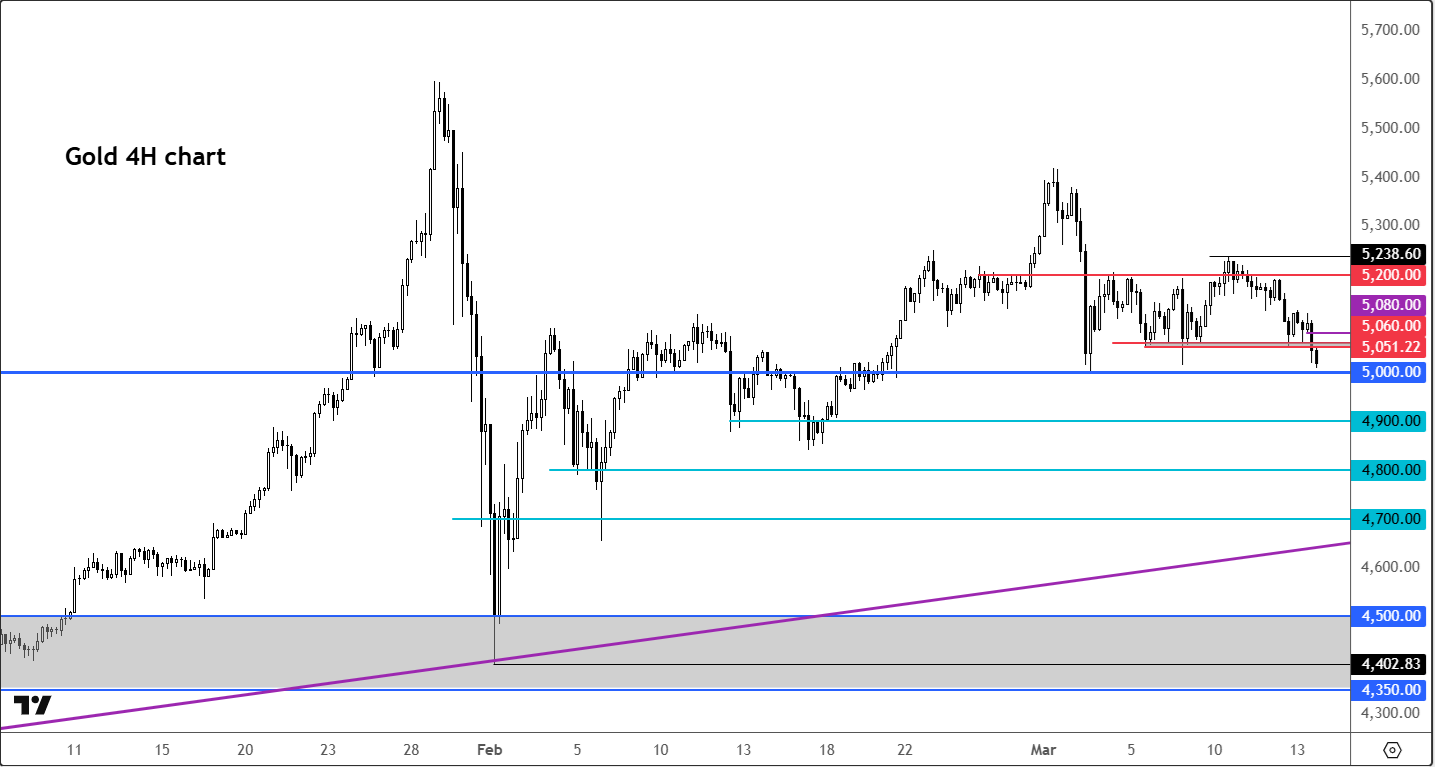
From a technical perspective, this remains very much a level-to-level market.
Support is currently clustered around the key $5000 level. This level has been tested from above a couple times in recent sessions and, so far, buyers have managed to defend it.
As long as we avoid a decisive break below $5000, the bulls would remain happy. However, if this level gives way, then there are not a lot of near term or obvious support levels until $4,900, which is the next round handle. Below that $4,800 and then trend line at $4,700 come into focus.
On the topside, initial resistance sits between $5150 and $5060. This area had offered support several times in recent days, before we finally saw a meaningful downside break at the of last week. Above this region, there is not of a lot of obvious resistance levels until $5,200.
For now, the metal remains caught between powerful macro crosscurrents. If oil prices stabilise and yields ease, gold could quickly regain upward momentum. But for now, that doesn’t appear to be a likely outcome in the near term outlook.

-- Written by Fawad Razaqzada, Market Analyst
Follow Fawad on Twitter @Trader_F_R