
A neutral sentiment has begun to consolidate in USD/JPY price action. Over the past three trading sessions, the pair has moved by only about 0.7%, failing to establish a clear direction and alternating between bullish and bearish moves near the highs reached in 2025. This sense of indecision has persisted following the release of U.S. economic data. However, as new signals emerge regarding central bank dynamics, this neutral environment could shift in the coming sessions.

New Economic Data Enters the Market
In recent days, several relevant economic indicators for the U.S. economy have been released, and today it was the turn of initial jobless claims. While the market expected 215,000 claims, the official figure came in at 198,000, suggesting that the labor market risks that began to concern the Federal Reserve toward the end of 2025 are not materializing strongly for now.
Following this data, markets continue to price in a scenario of neutral interest rates in the United States. According to CME Group, there is a 95.02% probability that rates will remain unchanged at the January 28 meeting. For the March 18 meeting, the probability that rates stay at 3.75% has risen from 49% in December to 78.44%. A similar shift is seen for the April decision, where the probability of unchanged rates increased from 36.86% in December to 65.46%, suggesting that rates could remain stable at least until April 29, the third policy decision of 2026.
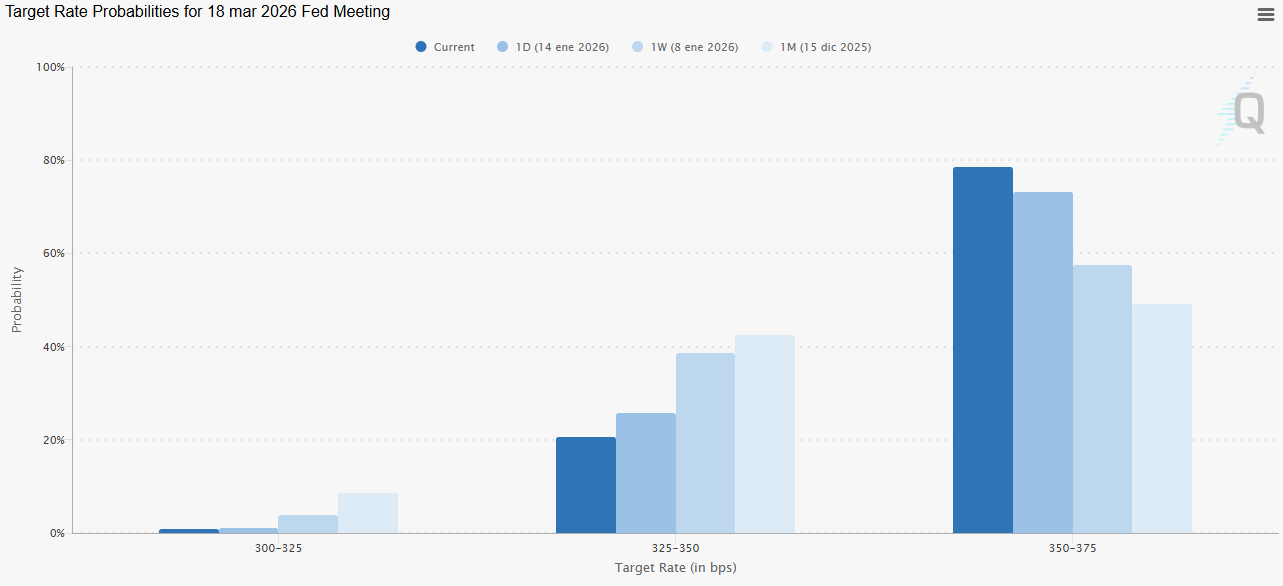
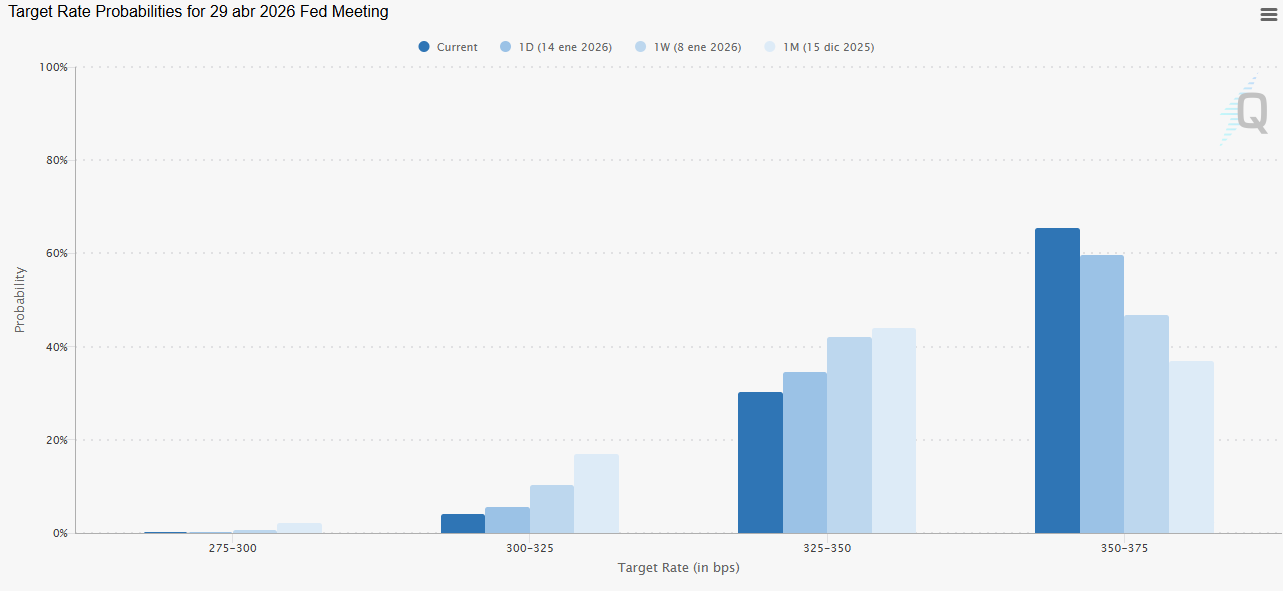
Source: CMEGROUP
In this context, the neutral rate outlook in the United States has been one of the main drivers behind the recent weakness of the Japanese yen against the U.S. dollar. The interest rate differential remains wide, with U.S. rates near 3.75%, compared to Japan’s rate of around 0.75%. As long as U.S. employment and inflation data do not alter near-term expectations for neutral rates, this environment may continue to favor buying pressure in USD/JPY. Although the market is currently in a neutral phase, Japan’s low interest rate limits the yen’s ability to sustain consistent strength, as dollar-denominated investments remain more attractive than those in yen.
Can the Bank of Japan Halt the Yen’s Weakness?
Next week, the Bank of Japan’s monetary policy decision is scheduled for January 22. While there is still limited clarity on the direction of its policy in 2026, this event may be temporarily containing yen depreciation, driven by market expectations. It is worth recalling that in its most recent decision, the central bank indicated that the current 0.75% rate could increase if inflationary pressures emerge within the Japanese economy.
In addition, the Bank of Japan has stated that it prefers not to align with joint global statements, unlike other central banks, reinforcing the view that the institution is focused on prioritizing domestic stability and Japan’s specific economic conditions.
Taking all of this into account, it is true that Japan’s low interest rate has been one of the factors allowing the yen to weaken against currencies such as the U.S. dollar in recent months. However, if the Bank of Japan decides to begin a rate-hiking cycle and adopts a more aggressive stance during 2026, this could narrow the interest rate differential with the United States and eventually reactivate a bullish bias for the yen over the long term. In this sense, next week’s Bank of Japan decision stands out as a key barrier for the continuation of buying pressure in USD/JPY.
USD/JPY Technical Outlook
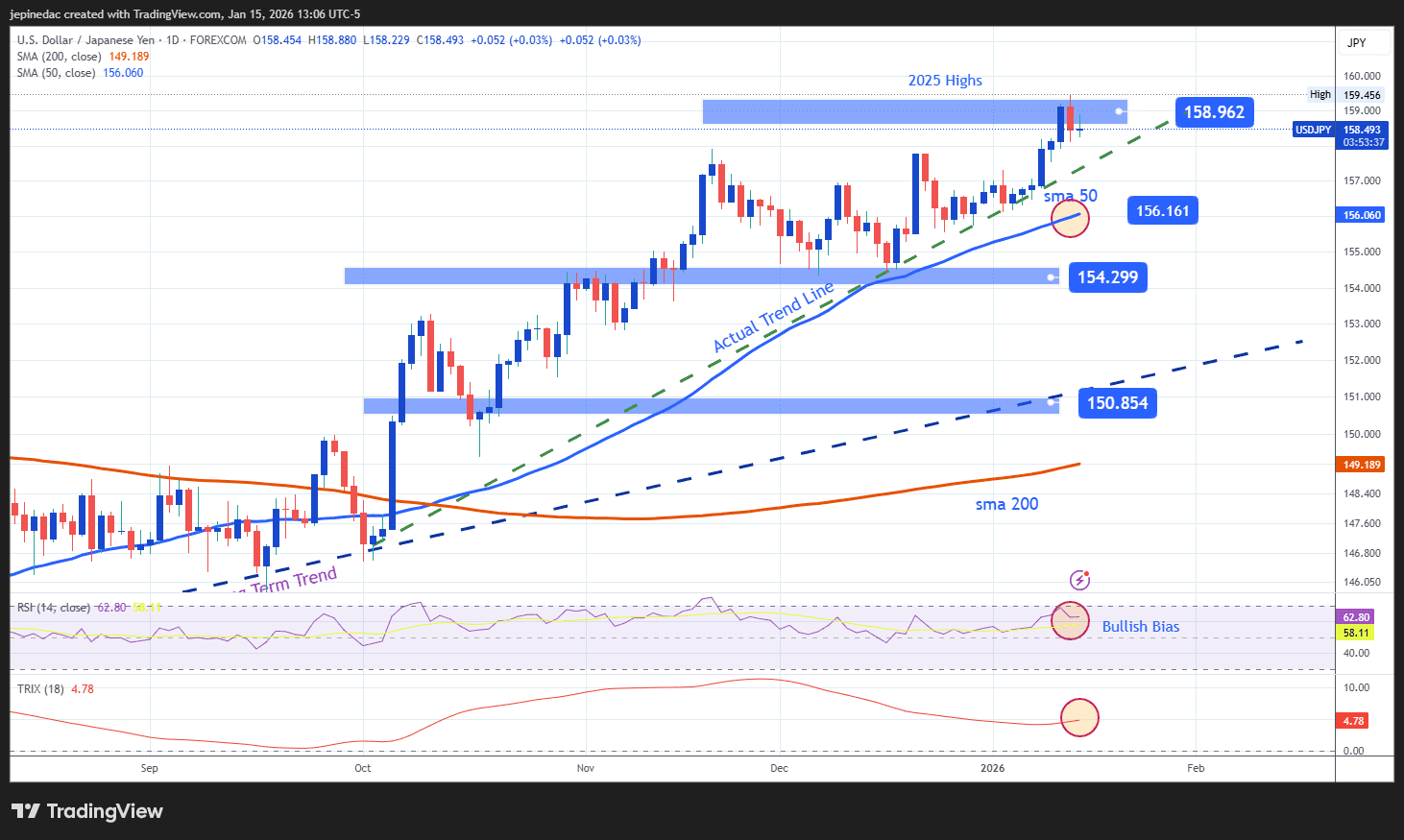
Source: StoneX, Tradingview
- The bullish trend remains dominant: For several months, USD/JPY has maintained a consistent bullish trendline. So far, bearish corrections have been insufficient to threaten this structure, leaving it as the most relevant technical formation to monitor. As long as buying pressure holds above the 2025 highs, the bullish trend is likely to continue guiding short-term price action, at least until new fundamental catalysts emerge.
- RSI: The RSI continues to trade consistently above the neutral 50 level, indicating that average buying momentum remains dominant. Recent price neutrality has not been enough to reverse accumulated buying pressure. If the RSI maintains this behavior, renewed bullish pressure could regain prominence in the short term.
- TRIX: The TRIX indicator maintains a consistent upward slope, with readings above the neutral zero line, suggesting that the average strength of exponential moving averages remains in bullish territory. This behavior supports the possibility that buying pressure seen in previous weeks could regain relevance.
Key Levels:
- 158.962 – Key resistance: This level corresponds to the 2025 highs and represents the most relevant upside barrier at present. A sustained move above this zone could confirm a dominant bullish bias and extend the current uptrend.
- 156.161 – Nearby barrierA recent neutrality level, aligned with the 50-period simple moving average. Pullbacks toward this area would not threaten the bullish trend but could act as a short-term consolidation zone.
- 154.299 – Major support: A level associated with the lows of recent weeks. Selling pressure toward this area could put the current bullish structure at risk and open the door to a more relevant bearish bias in the coming weeks.
Written by Julian Pineda, CFA, CMT – Market Analyst
Follow him on: @julianpineda25