
US futures
Dow futures 0.72%, S&P futures 0.58% & Nasdaq futures 0.48%
In Europe
FTSE 0.45% & DAX 0.46%
- US stocks rise but are on track for a weekly decline
- Oil eases from $100 as the US waives sanctions on Russian oil
- US GDP is revised lower to 0.7% from 1.4%
Stocks rise but are on track for weekly declines
U.S. stocks are heading for a modestly higher open, steadying after steep losses on Thursday as markets continue to assess the ongoing shutdown of the Strait of Hormuz, escalating tanker attacks, and oil trading near $100 a barrel.
Despite President Trump telling G7 leaders during a virtual meeting this week that Iran is close to surrendering, the reality appears quite different, with no clear signs of de-escalation.
Oil remains the key barometer to watch and is trading around $100 a barrel after spiking 9% yesterday following Tehran’s warning that crude could reach $200, despite the International Energy Agency (IEA) announcing it will move forward with a 400-million-barrel release from strategic reserves.
Perhaps the biggest problem with this crisis is that it is proving extremely difficult to price. No one knows how long the conflict may last or what the longer-term impact on oil supply will be. As a result, inflation concerns remain elevated.
In the U.S., consumers are already feeling the impact of the energy shock, with average gasoline prices rising around 20% since the war began.
On the inflation front, U.S. CPI released on Wednesday showed prices rising 2.4% year-on-year, unchanged from January. U.S. core PCE data today rose to 3.1% YoY in line with forecasts. However Q4 GDP was revised lower to 0.7% annualised in Q4, down from 1.4% in the preliminary reading. The market has shrugged off the data.
Corporate news
Adobe is falling around 8% after CEO Shantanu Narayen said he would step down once a successor is named. Narayen has been Adobe’s CEO since 2007. The announcement overshadowed Q1 results that beat expectations for both earnings and revenue.
Fertiliser stocks are rising on expectations that disruptions around the Strait of Hormuz will continue. Intrepid Potash and Nutrien are both up about 2%.
Ulta Beauty is falling more than 7% after posting weak earnings. For Q4, the retailer reported EPS of $8.01, slightly below the $8.03 forecast, while revenue of $3.9 billion exceeded expectations of $3.8 billion.
S&P 500 forecast – technical analysis
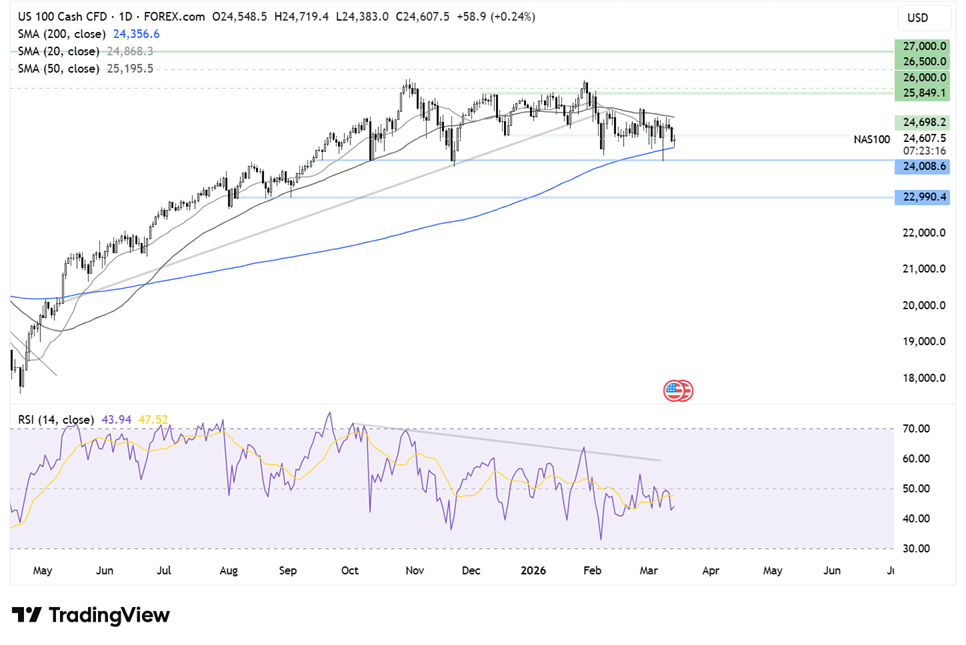
The Nasdaq continues to trade in a narrow range, capped by the 50-day SMA on the upside and the 200 SMA on the downside. However, with the price below 24,700 support and the RSI below 50, the outlook is fragile. A break below 24,335, the 200-day SMA, and then 24,000 could spark a deeper selloff towards 23,000.
Should buyers rise above 24,700 they could look for a move above the 50-day SMA at 25,200 and potentially toward 26,000.
FX markets – USD rises, EUR/USD falls
The U.S. dollar has climbed to a three-month high, benefiting from safe-haven flows amid the ongoing conflict in the Middle East. The fact that the U.S. is a net energy exporter is also supporting the currency.
Core PCE data will be in focus later today, although it is unlikely to trigger major market moves as it does not yet reflect the recent surge in energy prices.
EUR/USD is falling as the stronger U.S. dollar combines with concerns over the 40% rise in oil prices since the start of the month. Europe, which is heavily reliant on imported energy, has been hit harder, with the euro down around 3% since the conflict began.
GBP/USD is also falling amid a stronger dollar, following data showing UK GDP flatlined in January, defying expectations of a 0.2% monthly increase after December’s 0.1% expansion. The figures highlight the challenges facing the UK economy ahead of the potential stagflationary impact of higher energy prices.
Oil eases from $100 but still rises across the week
Oil prices are easing slightly, down around 2% at the time of writing, but remain on track to post weekly gains of more than 3% following a 35% surge last week.
Prices have eased after the U.S. issued a 30-day waiver allowing some countries to continue buying sanctioned Russian oil in an attempt to stabilise global energy markets disrupted by the Iran conflict.
This announcement follows the IEA's confirmation ofshrugged the release of a record 400 million barrels from strategic reserves.
These moves follow the agency’s warning on Thursday that the Middle East conflict could represent the largest oil supply disruption in history, with the key Strait of Hormuz remaining closed.