

Silver Slammed After Historic Rally
Silver took over macro headlines last year when finally breaking the 50-handle, an item seemingly elusive as silver prices diverged from gold after the historic run in 2011. While gold initially stalled at 1920 back then, silver got very close to 50 before pulling back. But what happened after seemed to prove gold’s supremacy as a safe-haven, anti-fiat asset. And with the rise in Bitcoin which seemed to take over even for gold in the latter-half of 2020, it seemed as though silver was relegated to industrial usage.
But last year started to show change on that horizon as Bitcoin diverged from gold and those anti-fiat flows hit silver markets incredibly hard, finally allowing for a break of the 50-handle in October and the metal really didn’t’ stop or slow down save for a brief pause at the end of last year when some apparent profit-taking took over.
That rally ran all the way into last week and along with it came a number of worried headlines about what the move might be saying. But after finally stalling at the 120 level last week mean reversion has begun to show and now the headlines are talking about the historic sell-off in silver which seemingly misses the big picture of the volatility that’s enveloped metals since the Fed started cutting rates even with inflation well-above their own imposed 2% target.
Silver Weekly Chart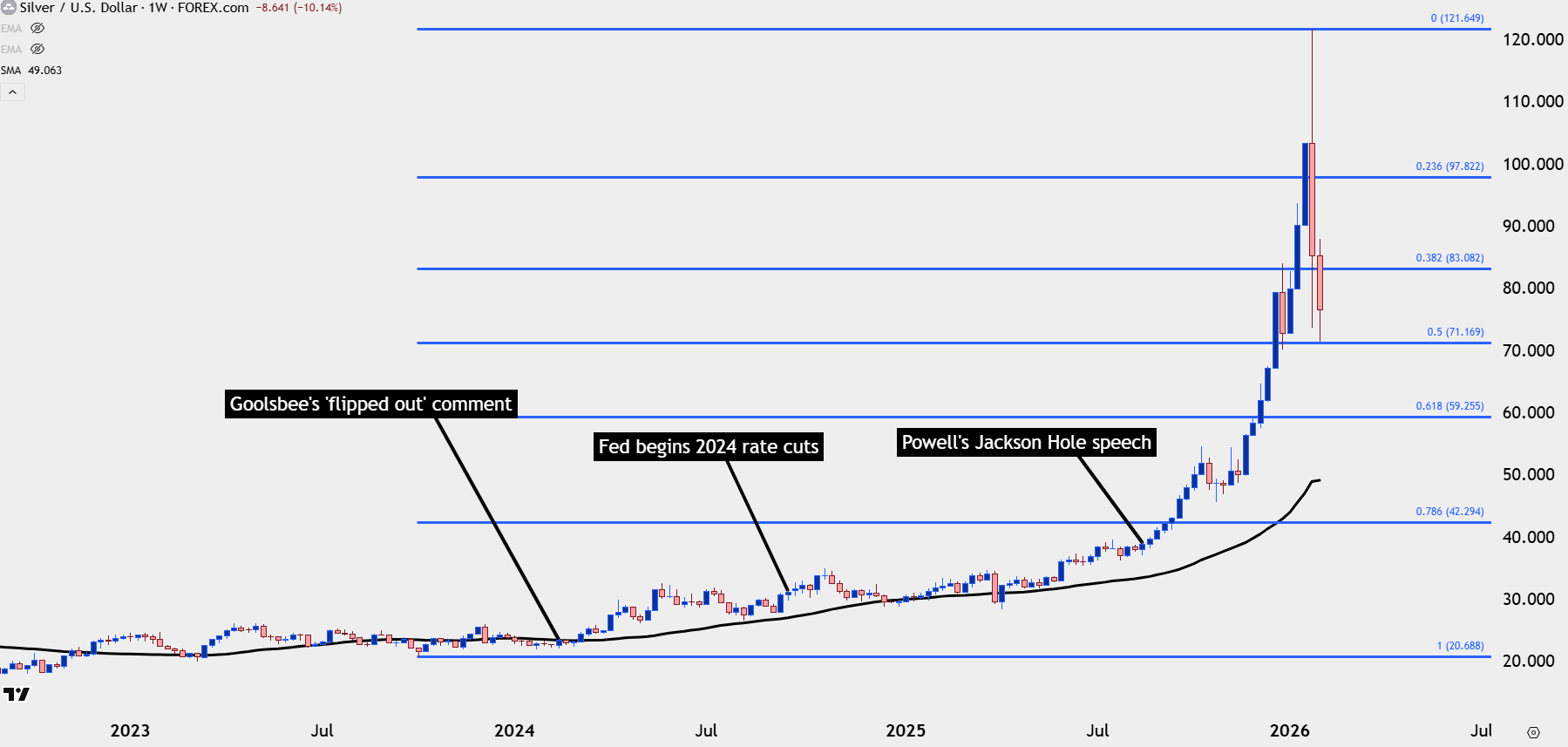
Chart prepared by James Stanley; data derived from Tradingview
Silver: The Drive
On the above chart I noted three specific events which I believe had a large role in the rally in both silver and gold.
I’ve long talked about the February 2024 CPI release and its relevance to gold. For the three and a half years prior, gold had trouble leaving the $2k level behind. But the CPI release on February 13th of that year saw gold close below the level for the first time in 2024, and this was after a hot CPI report brough question as to whether the Fed would actually be able to cut rates later that year.
But in a television interview a day later, Chicago Fed President Austan Goolsbee implored markets not to get ‘flipped out’ about a single inflation print, although inflation had remained strong for a while leading into that.
The next day gold broke out above the $2k level and never closed below it again, soon embarking on a parabolic-like run as it became more and more obvious that the Fed would cut rates, even with inflation remaining above their own target.
Silver was slower but similarly tracked that move.
The 30-handle was a big deal in silver as this was the post-2011 high, and even as gold rallied up to fresh ATHs silver was continually restrained at that level until finally posing a breakout in 2024 as the Fed began to cut rates.
But what really sent silver flying was the Fed’s rate cuts last year, with the Jackson Hole speech from Jerome Powell opening the door to rate cuts, which sent gold flying out of a bull pennant and silver above the 40-handle until, eventually, a parabolic-like move had shown up.
Adapting for Increased Volatility
Volatility gets the headlines, especially with a move such as we’ve seen with silver. But paradoxically these conditions are probably most difficult to trade for most traders, especially retail traders despite the fact that more and more seem to want to tread in those waters.
But I think one simple way of considering volatility is looking at it as an increased range of possible outcomes. And if that’s the case, this probably will come along with lower winning percentages, as there’s a higher probability of a larger move taking out a stop or reverting from the trader’s position.
The lower winning percentage will often be a negative factor for many especially retail traders, but another way to look at that increased volatility is that if getting on the right side of the move the possible reward target can be larger; so the decreased winning percentage can be addressed with even stronger or larger reward-to-risk ratios. This isn’t necessarily a strong point for many retail traders particularly new ones, but if trying to adapt to a higher volatility environment, this would seem a near necessity.
With that said, silver is running aggressively, and whether it’s topped or not is insignificant to the trader looking to set up strategy on the matter. Support and resistance still matter as this is where traders can begin setting up strategy parameters and possible risk outlays and on the below four-hour chart, I’ve simply drawn up major psychological levels in $5 increments, and from here, traders can begin setting up a game plan.
Silver Four-Hour Chart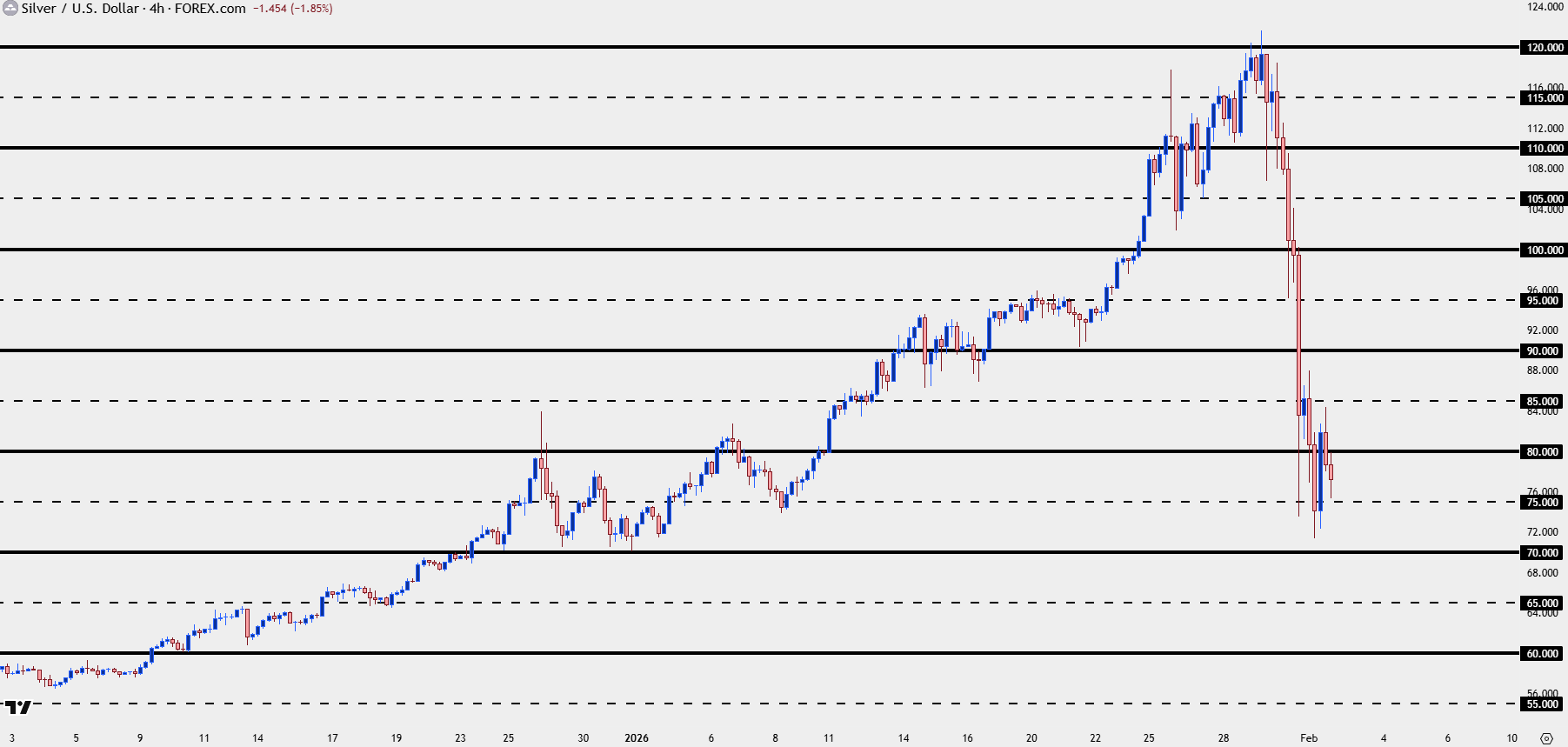
Chart prepared by James Stanley; data derived from Tradingview
Silver Strategy
There’s a lot of ways to orient support and resistance and psychological levels are some of the simpler, but feel free to add Fibonacci levels or price action swings or pivot points or whatever you might want. But the reality is support and resistance is one of the few ways to set up risk outlay based on historical performance, and below we can see several reactions from the psychological levels noted above on a short-term basis, and it appears as though silver may be trying to bottom as there’s been a slowing in selling around the 75-handle even though bears haven’t completely given up yet as noted by the resistance reaction below the 85-handle.
But – the prior resistance to that price sets the framework, and if we do see buyers pose a break of 85, particularly if a higher-low holds above 75, the door can soon open to bullish trend strategies, which would then open the door for a move up to 90 or perhaps even 95 which served as a key swing low when prices was breaking below the 100-handle.
Silver Hourly Chart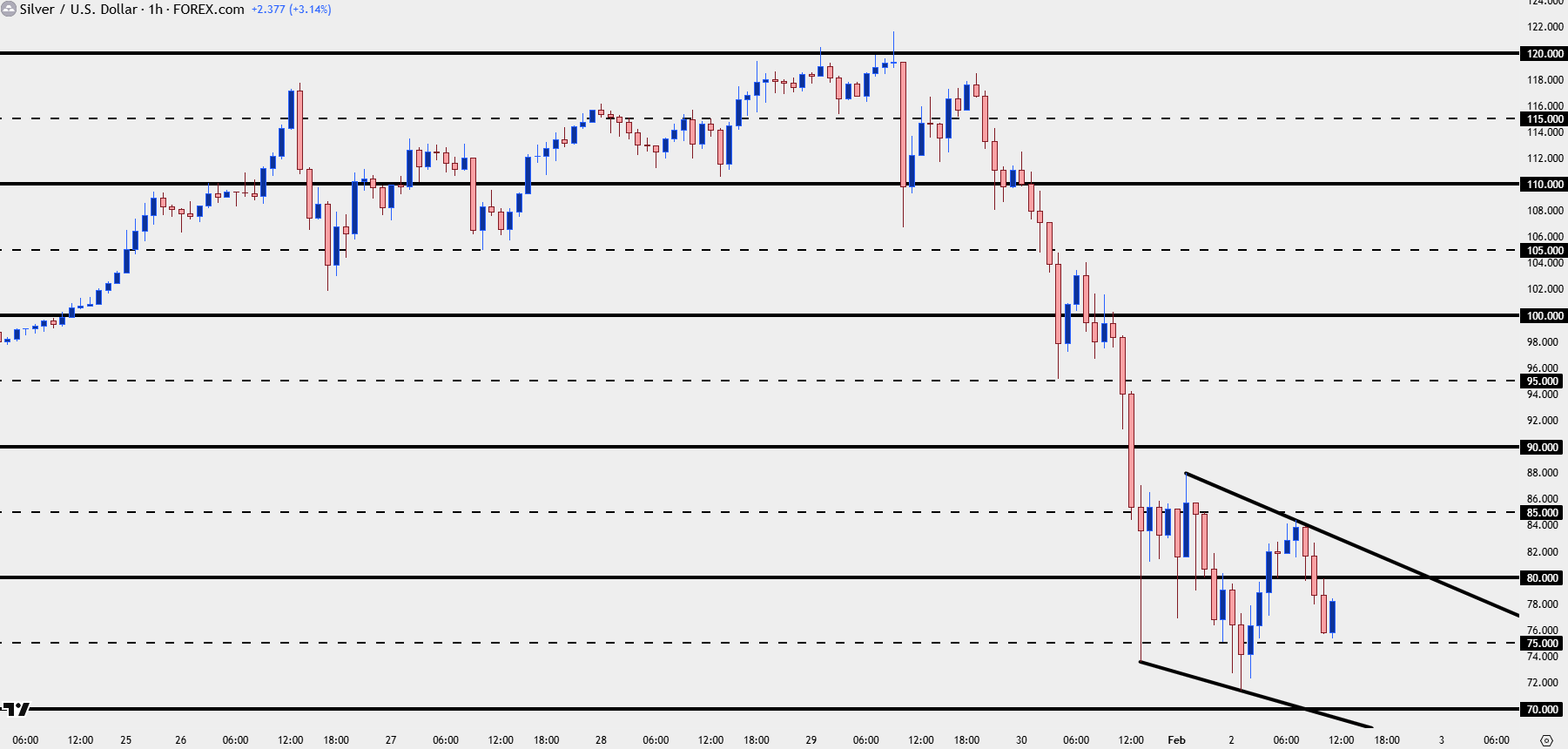
Chart prepared by James Stanley; data derived from Tradingview
--- written by James Stanley, Senior Market Analyst, Global Macro