

In the first days of the week, USD/CAD posted a modest 0.2% decline in favor of the Canadian dollar, following last Friday’s spike in volatility over a potential suspension of trade negotiations between the United States and Canada. Although the situation did not escalate, a neutral movement has emerged on the chart, which appears to be influencing short-term price action.

What Happened with the Recent Trade Tensions?
On June 27, the U.S. government formally announced the immediate suspension of all trade negotiations with Canada, following Canada’s decision to impose a 3% tax on digital services originating from the U.S.. The White House labeled the move a direct trade attack and threatened new tariffs within a week. This development sparked significant volatility in USD/CAD and weakened the Canadian dollar.
However, tensions eased over the weekend, as Canada withdrew the tax proposal, and on June 30, the White House stated that talks could resume without further obstacles.
Although the episode was brief, it revealed how quickly tensions between the two countries can escalate, particularly in response to aggressive moves from the U.S. It also highlighted the Canadian dollar’s vulnerability to trade conflict headlines, similar to previous moments of commercial friction.
Considering this, it's important to note that the Canadian dollar has maintained a prolonged upward trend in recent months, in part due to reduced trade war risk. However, if no trade agreement is reached soon, the resumption of hostilities could weaken the Canadian dollar once again, potentially fueling renewed buying pressure in USD/CAD.
What’s Going On with Central Banks?
Currently, there is a significant interest rate divergence between the Federal Reserve and the Bank of Canada. The Fed holds its rate at 4.5%, while the Bank of Canada maintains its policy rate at 2.75%. Both institutions have adopted a neutral stance, intending to observe inflation trends before making any further adjustments.
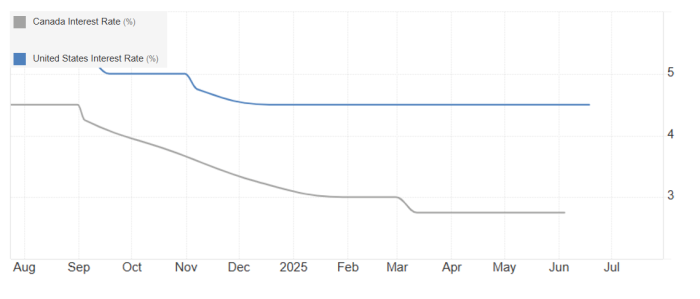
Source: Tradingeconomics
While rate divergence has not been the main driver of USD/CAD in recent months, dominated instead by the broad weakness in the U.S. dollar, it remains a latent factor. A higher interest rate in the U.S. still makes dollar-denominated assets more attractive, particularly Treasuries. If these instruments regain appeal in global markets, it could mark a turning point, boosting demand for the U.S. dollar and pressuring the Canadian dollar, ultimately supporting USD/CAD.
USD/CAD Technical Outlook
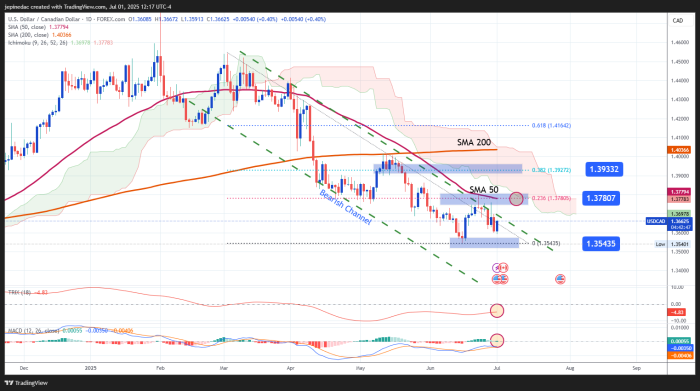
Source: StoneX, Tradingview
- Sustained Downward Channel: Since early March, USD/CAD has held a well-defined bearish channel. Recent bullish corrections have been insufficient to break the structure, keeping the channel as the dominant pattern in the short term. However, it's worth noting that the price has failed to post new lows, which could signal a shift toward a consolidation phase if this behavior continues.
- TRIX: The TRIX indicator remains below the zero line, but it is sloping upward toward the neutral zone, suggesting a loss of downward momentum. If this trajectory continues, it may open the door to a more neutral outlook in the coming sessions.
- MACD: The MACD histogram remains close to the zero line, indicating neutral momentum in the short term. As long as this setup persists, the pair is likely to remain range-bound, awaiting a clearer catalyst.
Key levels to watch:
- 1.35435 – Key support: This is the lowest level observed in recent weeks. A break below this level could confirm a stronger bearish bias and lead to a more sustained downtrend.
- 1.37807 – Nearby resistance: A key technical area that aligns with the 23.6% Fibonacci retracement, the 50-period simple moving average, and the Ichimoku cloud. A clear break above this level could invalidate the current bearish channel and trigger a bullish shift in the short term.
- 1.39332 – Major resistance: A more distant level corresponding to the 38.2% Fibonacci retracement. If the price reaches this zone, it may mark a potential trend reversal in USD/CAD, where buying pressure could begin to dominate.
Written by Julian Pineda, CFA – Market Analyst
Follow him at: @julianpineda25