
- BOJ held rates at 0.75% in an expected 8–1 decision
- Takata dissented again, but no broader support followed
- Inflation language firmed while risks were judged balanced
- Markets now look to Ueda for direction in USD/JPY
Policy Rate Holds at 0.75%
The Bank of Japan held policy steady in January, voting 8–1 to keep the overnight call rate around 0.75%, a decision fully expected by markets and economists. Takata was the sole dissenter, arguing that the price stability target had largely been achieved and that risks to prices were skewed to the upside, but with no support from other board members, the outcome was not read as hawkish. That contrasts with November, when both Takata and Tamura dissented ahead of December’s hike, a reminder that while broader dissent does not guarantee action, it is when the risk of a move starts to feel more live.
Inflation, Growth Forecasts Upgraded
In its updated forecasts, the bank left its core inflation projections for fiscal years 2025 and 2027 unchanged at 2.7% and 2% respectively, the latter consistent with its inflation mandate. The 2026 forecast was nudged up by a tenth to 1.9%. More notable adjustments were made to the alternative core measure that excludes fresh food and energy, with forecasts for 2025 and 2026 lifted by two tenths to 3% and 2.2% respectively. The 2027 projection was left unchanged at 2%, easing pressure to tighten policy aggressively by Japanese standards. The upward revisions to the nearer-term inflation outlook partly reflected firmer growth expectations, with real GDP forecasts for 2025 and 2026 raised by 0.2% and 0.3% to 0.9% and 1% respectively.
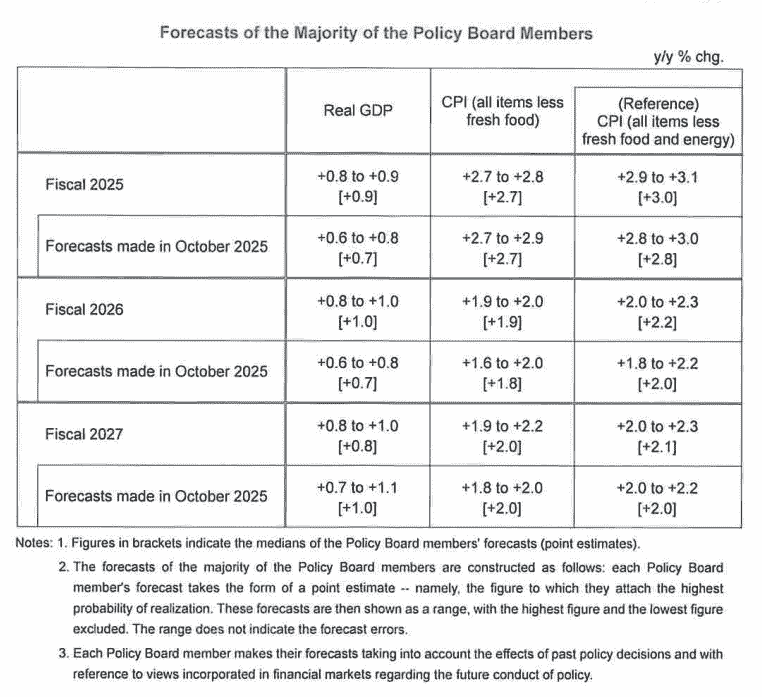
Source: BOJ
Assessment Firms Post December Hike
Following the decision to lift rates by 25bp to 0.75% in late December, there was a clear shift in tone in the latest Outlook for Economic Activity and Prices. On underlying inflation, the language was firmer than before. Previously, inflation was described as sluggish and closely tied to the pace of growth. That wording has gone. Now, underlying inflation is seen rising moderately, with wages and prices reinforcing each other, suggesting the bank is increasingly comfortable that inflation momentum can be sustained, even as policy continues to normalise.
The labour market narrative has also firmed relative to three months ago. Before the December hike, labour shortages were framed as something that would emerge later if growth improved. In the latest assessment, labour tightness is more clearly embedded in the inflation story, reinforcing the idea that wage pressures are no longer hypothetical and are starting to look more durable. That's important. On risks, the earlier assessment that growth risks were skewed to the downside has been dropped, replaced by a broadly balanced view for both activity and prices.
On the external backdrop, the tone is noticeably calmer. Trade and overseas policy risks are still acknowledged, but they are no longer framed as dominant headwinds. Overseas growth is treated as stabilising, which helps explain why the bank appears comfortable letting policy normalisation proceed at a gradual pace.
Markets Unmoved, Ueda Awaits
Source: Bloomberg
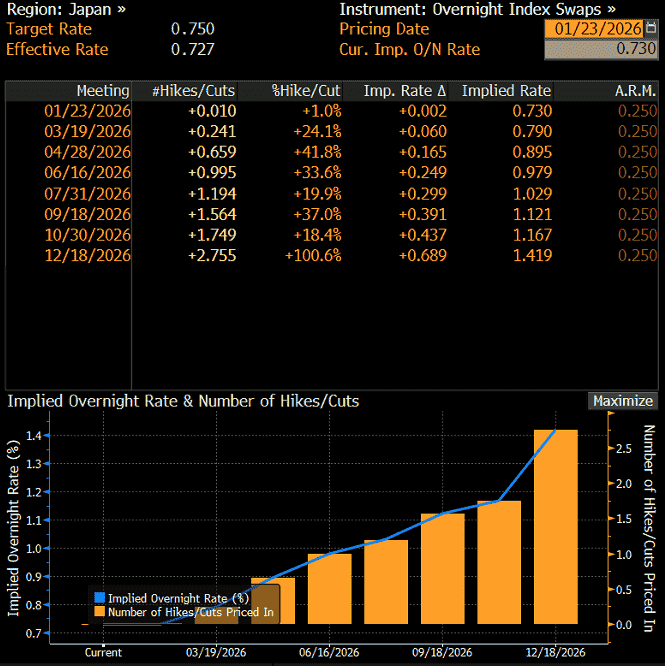
There was little reaction in the swaps market to the decision, outlook or updated forecasts, with another 25bp increase essentially deemed a lock by June with a second fully priced by December. That path would see the overnight rate lifted to 1.25%.
Source: TradingView
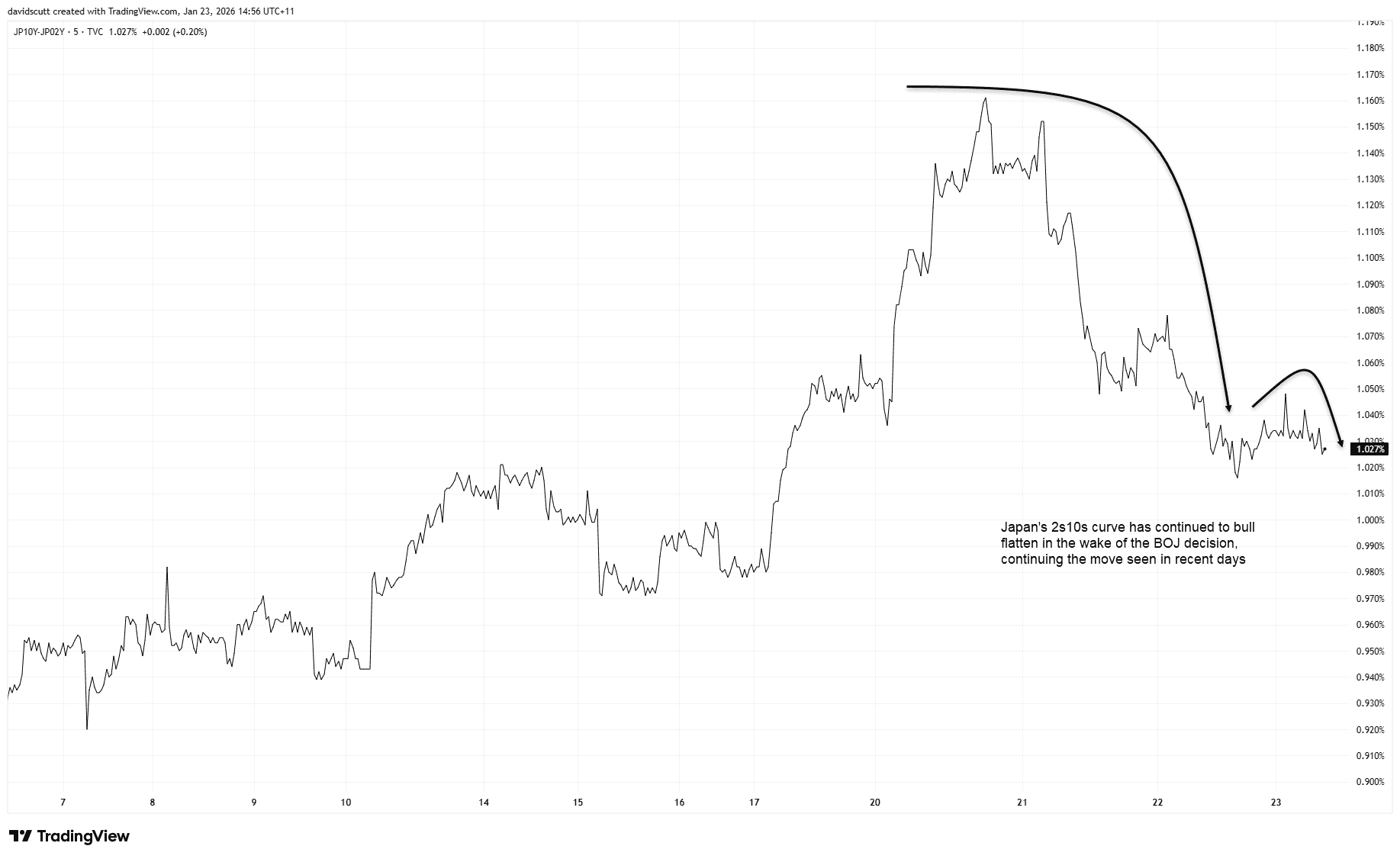
USD/JPY was also relatively steady, holding onto earlier modest gains, while the JGB 2s10s curve continued to bull-flatten, fitting with the move seen in the run-up to the meeting. Attention now turns to Governor Ueda’s press conference, scheduled to begin at 3:30pm Tokyo time. Given his recent tendency to lean dovish in post-meeting remarks, there is potential for upside in USD/JPY should that pattern continue.
USD/JPY Risks Biased Higher
Source: TradingView
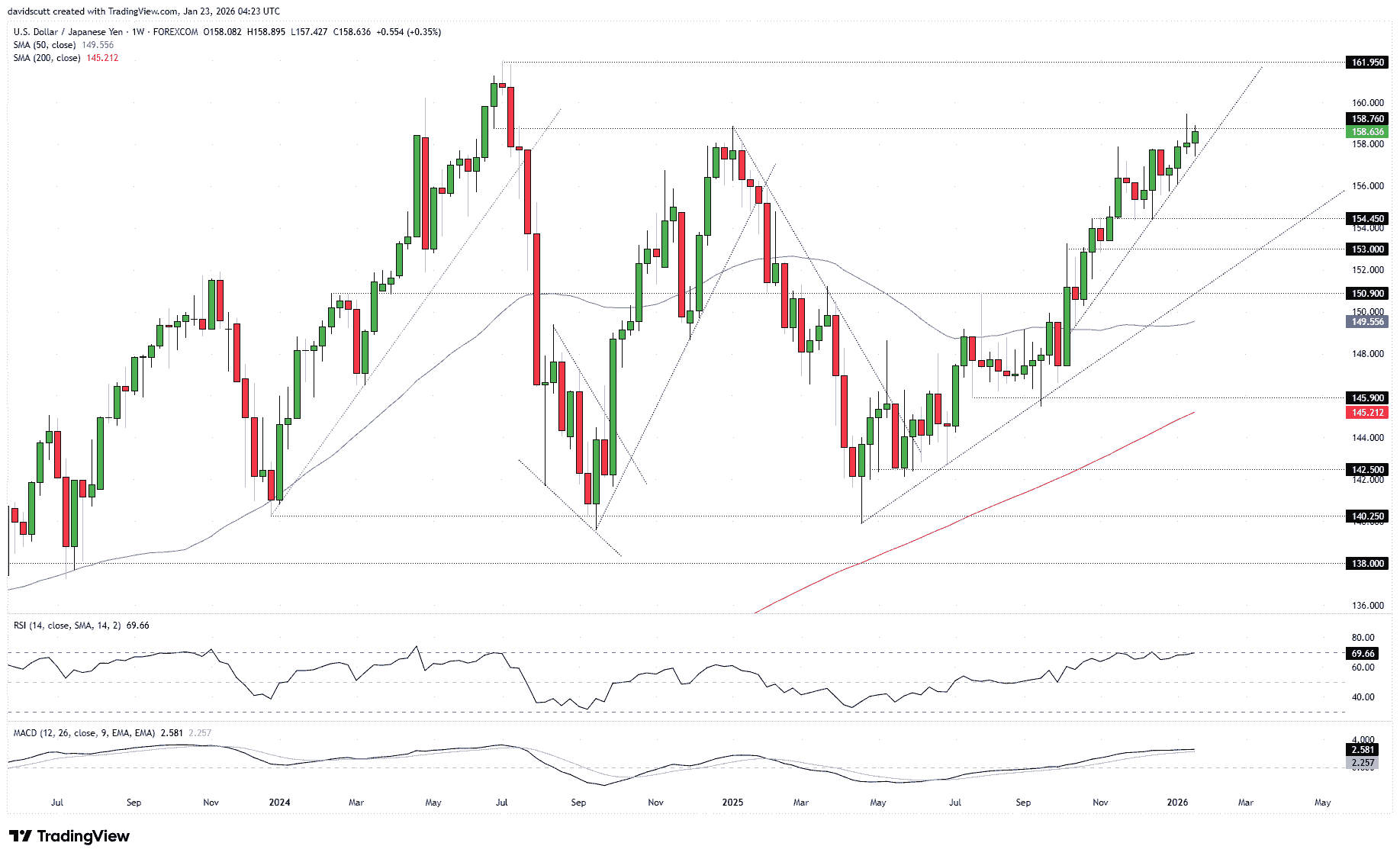
USD/JPY remains in a strong uptrend on the weekly chart, bouncing strongly from the intersection of uptrend and horizontal support at 154.45 in December to trade as high as 159.45. 158.76 is a level worth watching overhead given it has acted as support and resistance over recent years. Given USD/JPY was unable to sustain its move above the level last week, it remains relevant for anyone trading the pair.
Should USD/JPY manage to break above last week’s high of 159.45, the next logical target would be 161.95, the swing high set in June 2024. On the downside, uptrend support is found around 157.50 today, coinciding with the intersection of minor horizontal support where the pair has bounced from on three separate occasions on the daily chart over the past fortnight.
RSI (14) continues to flatline near overbought levels, indicating upside strength remains firm even if it’s no longer building, likely reflecting increased caution around these levels given it coincides with where the BOJ was instructed to intervene in 2024. MACD provides a complementary message, still trending higher above the signal line but with a flattening trajectory. The overall directional bias is therefore higher with a sprinkling of caution.
On intervention risks, as covered in a separate USD/JPY post, speed typically matters more than levels when it comes to amplifying intervention risk.