
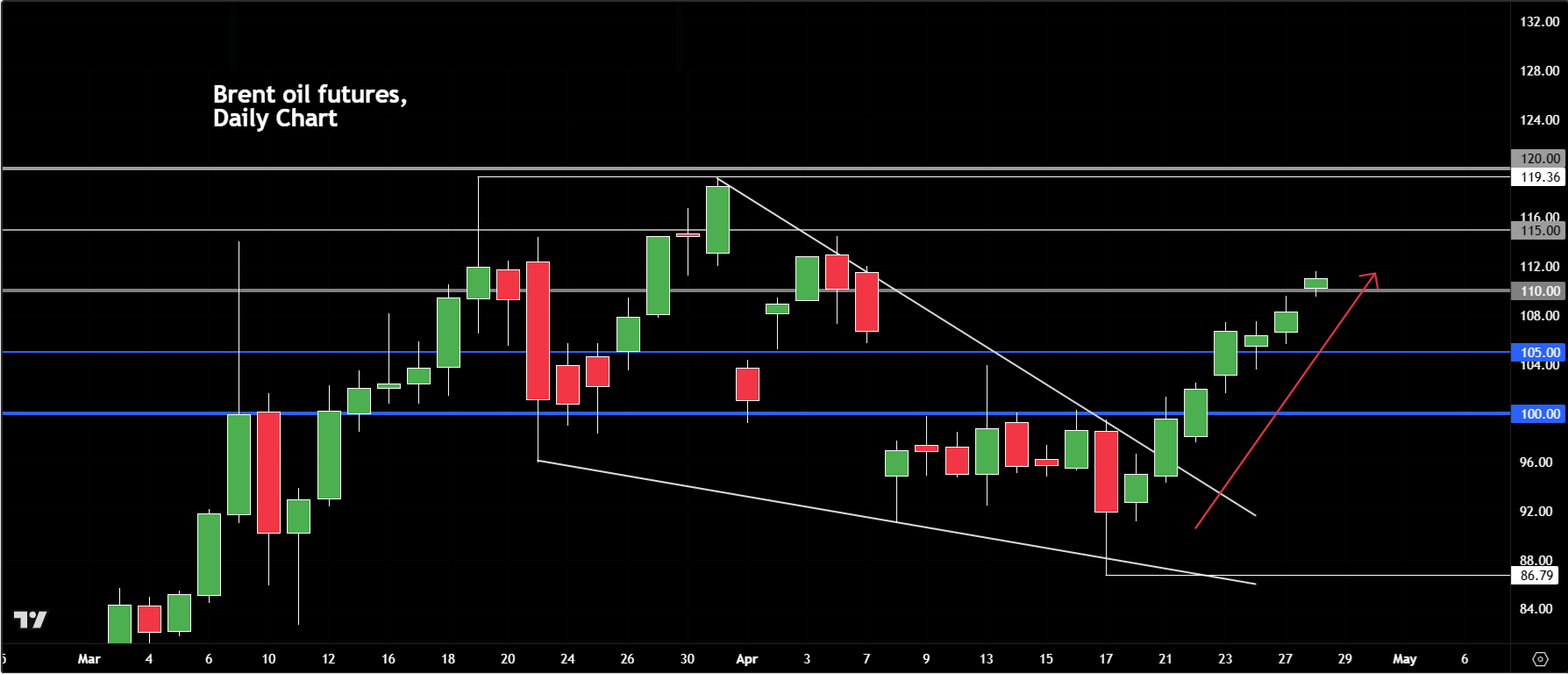
The USD/JPY was coming off its earlier lows at the time of writing, as crude oil prices climbed further higher after the Brent contract broke the $110 barrier. The USD/JPY, which has been confined to a relatively narrow range through much of April, could now stage a breakout. With the BoJ refusing to hike and oil continuing to push higher, the pressure is building for a potential break above 160.00, which, in turn, is raising the risk of government intervention to stem the yen’s drop. Investors will keep a close eye on oil prices as they show no desire to fall amid stalled US-Iran talks. Also in focus will be the FOMC rate decision on Wednesday as well as key US economic data and tech earnings. Today, though, it was all about the BoJ and oil obviously oil prices. Now that we didn’t get any major surprises from the Japanese central bank, the risks remain tilted to the upside for the USD/JPY forecast.
Testing week for the USD/JPY
This was always going to be a busy week for the yen. As well as renewed gains for crude oil prices and the Bank of Japan meeting, we also have the Federal Reserve set to announce it policy decision this week, alongside several other major central banks, while it is also a heavy earnings and data calendar week for the USD.
A slightly dollar-supportive Fed outcome combined with rising oil prices could tilt USD/JPY above recent resistance in the 159.50 to 160.00 region.
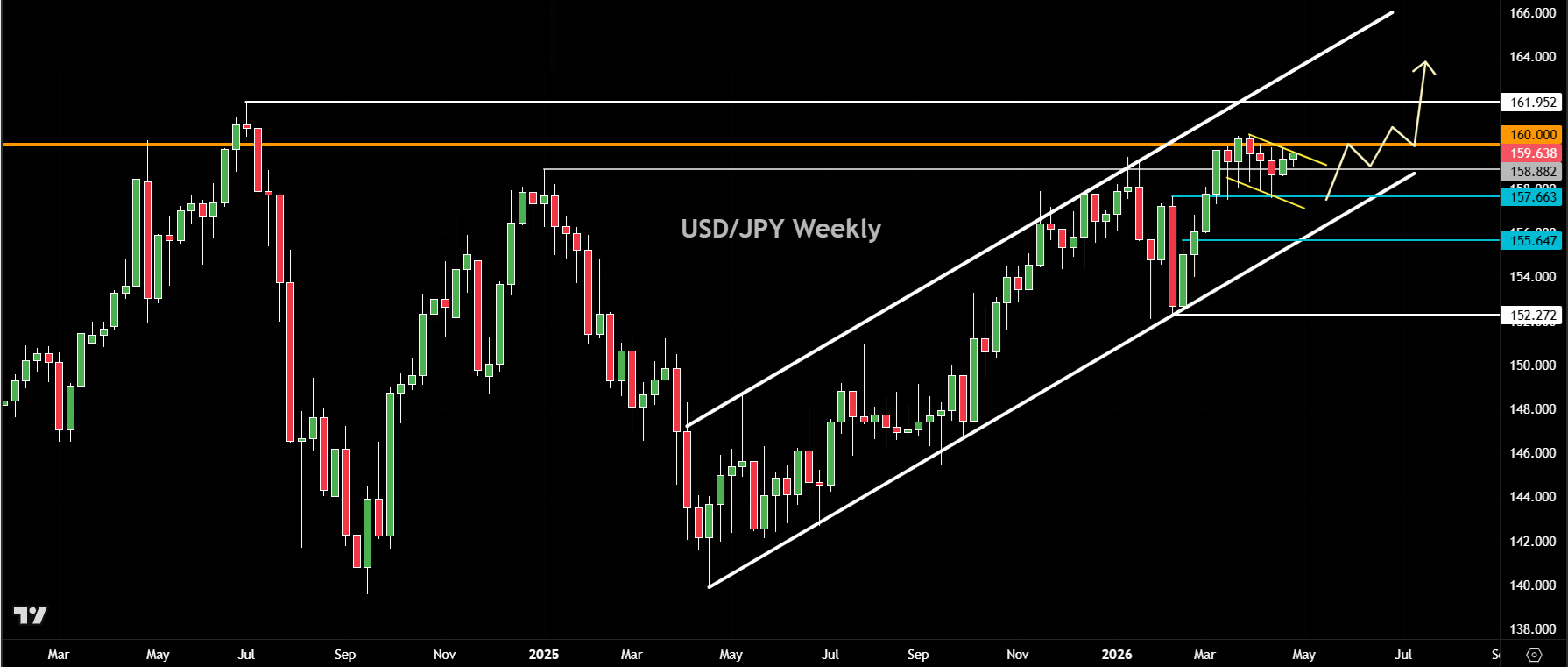
In fact, a move back towards 160.46, this year’s high, looks quite plausible for the dollar yen. And if it gets there, why stop rising? The pair could extend even more. That said, any sharp move higher would likely bring increased volatility, as markets remain alert to the risk of Japanese FX intervention.
Support levels to watch include 159.00, 158.50 and 157.70.
BoJ’s hawkish hold softened by Ueda’s tone
As mentioned, the Bank of Japan left rates unchanged, pointing to ongoing uncertainty in the Middle East as a key reason for standing pat. Even so, pressure for another hike is clearly building, with three board members dissenting in favour of tighter policy.
On paper, the meeting carried a fairly hawkish feel. Both the statement and the quarterly outlook report pointed to mounting inflation concerns and a growing willingness within the Board to keep normalising policy. But Governor Ueda struck a more measured tone in his press conference, stopping short of giving markets a clear hawkish steer. That softer messaging means the USD/JPY forecast is likely to remain tilted to the upside for now, and explains why the pair was able to recover after the initial reaction.
Ueda stressed that the situation in the Middle East remains highly fluid and said the BoJ would rather avoid committing to a firm timetable for the next move. Instead, he reiterated the broader message that the Bank remains on a gradual path towards a more neutral policy setting. As long as the economy avoids a material slowdown, further rate hikes remain on the table.
The updated macro outlook underlines the Bank’s growing concern over inflation, although Ueda again avoided signalling when the next increase could come. My base case is for the next hike in June, possibly followed by one more in the fourth quarter.
Going into the meeting, there had been some speculation that the BoJ might spring a surprise after a run of stronger inflation data, persistently deep negative real rates, and robust wage negotiations. Today’s outcome suggests that while inflation concerns are clearly intensifying, most policymakers still favour a cautious wait-and-see approach.
That said, the 3–6 vote split marks the widest division among Board members since Ueda became governor, highlighting the increasingly active debate inside the BoJ.
In the quarterly outlook report, the BoJ sharply revised higher its inflation forecasts, now expecting CPI at 2.8% year-on-year for fiscal 2026, up from 1.9% previously.
USD/JPY forecast remains bullish
The BoJ’s baseline assumption sees oil prices returning to around $70. But with oil now above $110 per barrel, and no signs of Strait of Hormuz re-opening, inflation might prove to be even more pronounced. That, in turn, could cause the BoJ to hike rates but with growth outlook also trimmed, one could argue that it might be better to just hold steady on rates and tolerate above-forecast inflation for a while. Perhaps that’s what the markets are betting on by continuing to sell the yen.

-- Written by Fawad Razaqzada, Market Analyst
Follow Fawad on Twitter @Trader_F_R