
Recent sessions have been quite positive for the Canadian dollar in the short term, as USD/CAD has posted a 4-session bearish streak in favor of the Canadian dollar, with a decline of around 1.00% in the short term.
For now, the structural selling pressure that has been expanding consistently in recent sessions is mainly driven by the persistent weakness of the U.S. dollar, as well as the relative strength shown by Canadian bond yields, which has allowed the attractiveness of the Canadian dollar to remain stable. If this factor continues to be relevant, it is possible that selling pressure in USD/CAD will remain relevant in the coming sessions.

The U.S. dollar remains weak
In recent trading sessions, the second round of peace talks between Iran and the United States has begun, with the main objective of continuing the dialogue initiated a week ago. This confirms that the diplomatic channel remains open and could even lead to an extension of the current ceasefire.
Although this scenario does not yet represent a full resolution of the conflict, it does help keep market risk perception contained in the short term.
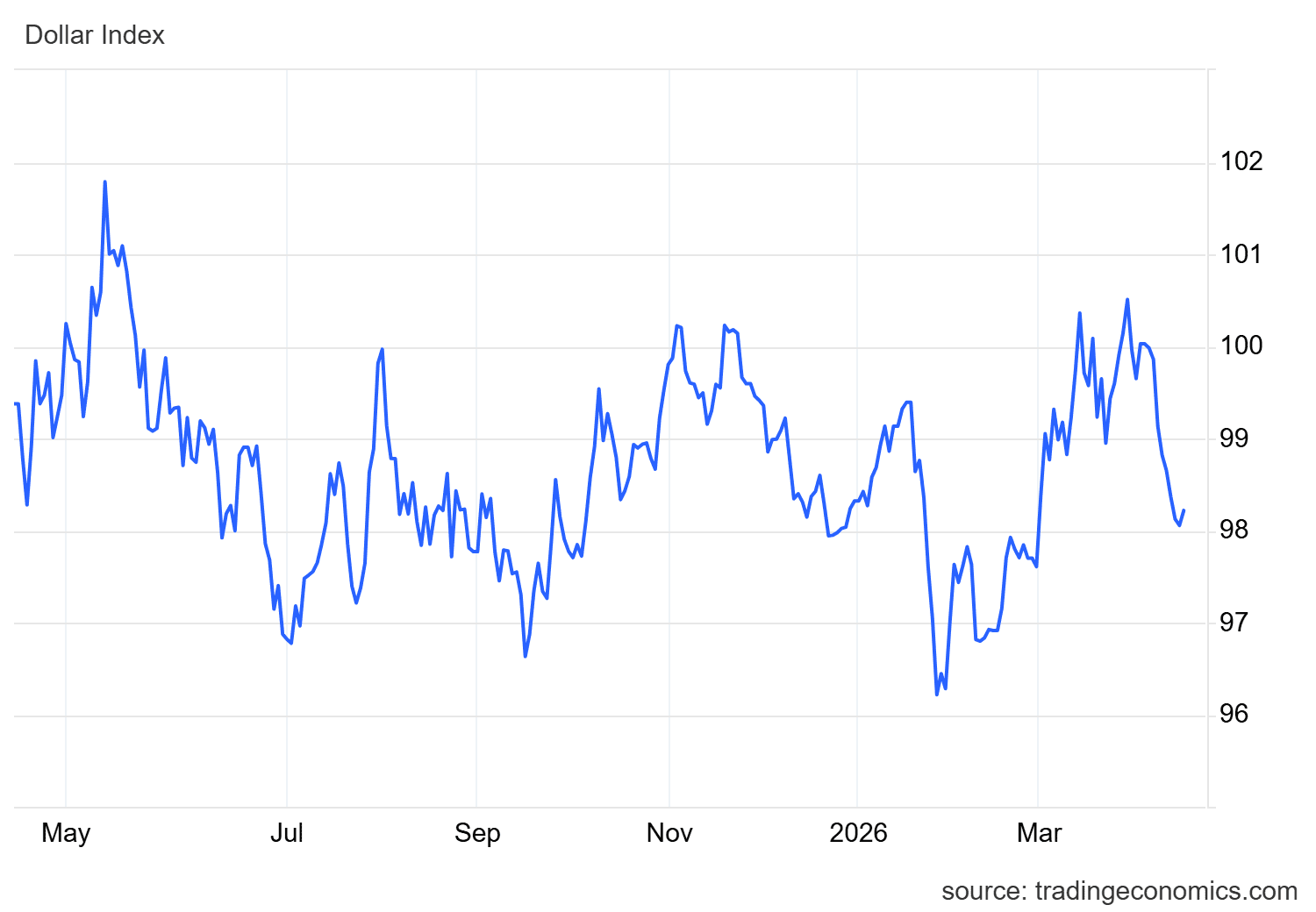
As a result, there has been a lower appetite for safe-haven currencies such as the U.S. dollar, which continues to be one of the currencies that has lost the most strength against its major peers in recent sessions. This can be seen in the behavior of the DXY index, which continues to show weakness, trading around the 98 level, far from the 100 reference zone, and maintaining a consistent downward slope.
This behavior indicates that demand for the U.S. dollar remains weak in the short term, without showing a meaningful recovery. At the same time, this environment has allowed currencies such as the Canadian dollar to gain ground and build a more consistent demand in recent sessions.
Source: TradingEconomics
In addition to this, it is also important to consider that the loss of attractiveness in U.S. dollar-denominated investments is partly linked to the behavior of the U.S. bond market.
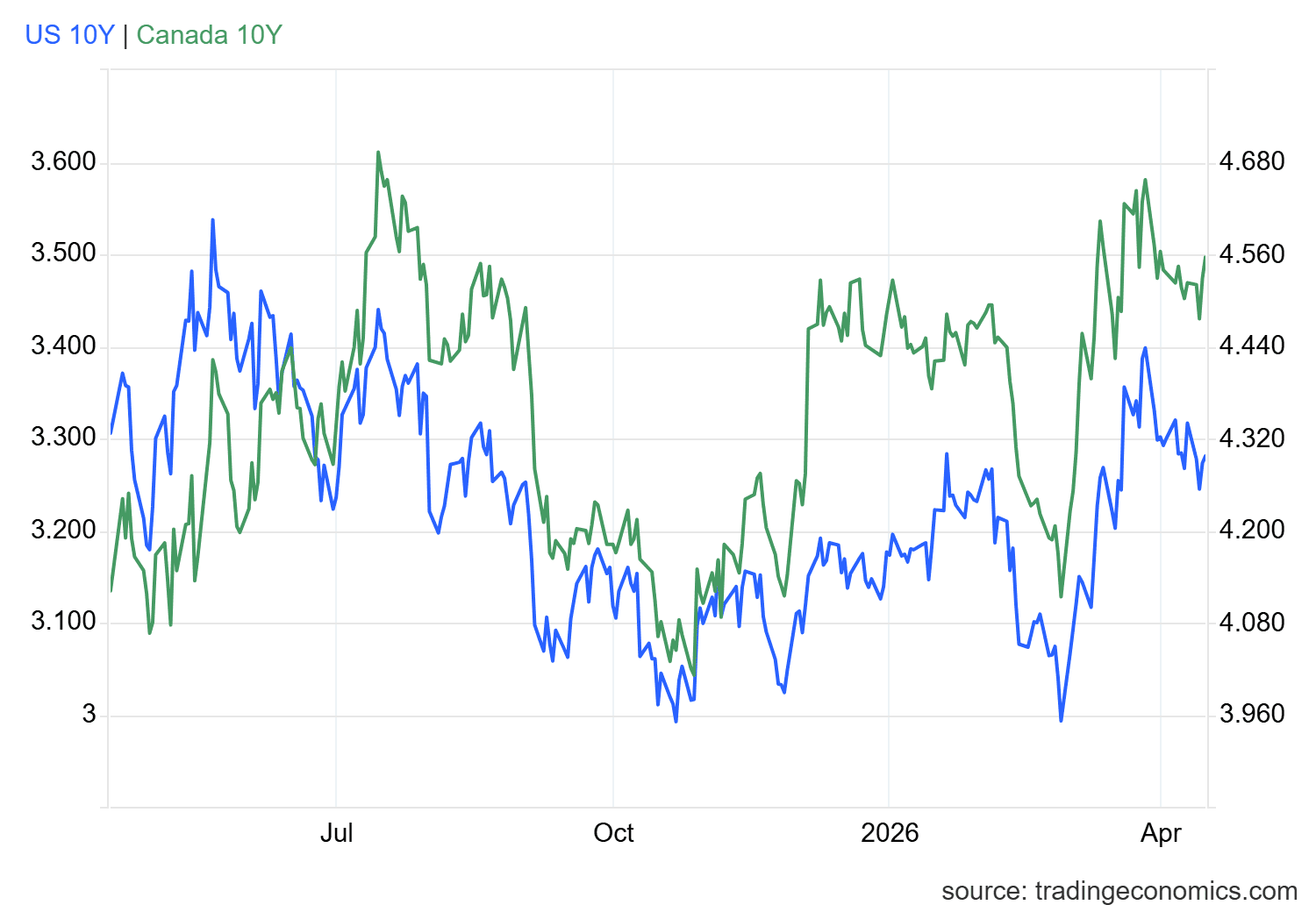
U.S. 10-year bonds continue to show weakness in their yields, remaining below the 4.3% level, and although there has been a slight recovery in recent sessions, it has not been strong enough to reverse the broader weakness observed in recent days.
In contrast, Canadian bond yields have shown a more consistent recovery, pushing yields toward the 3.5% level, reflecting a stronger dynamic compared to the U.S. bond market.
Source: TradingEconomics
In the bigger picture, this behavior is relevant because the market is starting to price in a structural weakness in U.S. interest rates, while in Canada a more consistent recovery is being observed. This could be creating a more attractive environment for Canadian dollar-denominated investments compared to U.S. dollar assets, and this dynamic may also be helping maintain a more stable demand for the Canadian dollar in the short term.
As such, the combination of weaker U.S. bond yields and reduced appetite for safe-haven currencies is reinforcing a scenario where structural weakness in the U.S. dollar continues, which in turn could keep selling pressure in USD/CAD relevant in the coming sessions.
Does the Bank of Canada matter?
The Bank of Canada’s interest rate decision, scheduled for April 29, is getting closer, and for now the expectation is that the central bank will keep rates unchanged, mainly because inflation levels are still not fully under control in the short term.
Although this stance is quite similar to that of the Federal Reserve, the key point to consider is that the recent behavior of Canadian bond yields has been stronger than that of the United States. This suggests that the pause in rate cuts by the Bank of Canada may be contributing to a more consistent stability in Canadian bond markets, while this same effect is not being reflected in U.S. bond yields in the same way.
Therefore, as long as the Bank of Canada maintains this neutral stance, the stability it provides to the bond market could continue supporting a stable demand for the Canadian dollar, which in turn could keep selling pressure in USD/CAD relevant in the short term.
USD/CAD Technical Outlook
Source: StoneX, Tradingview
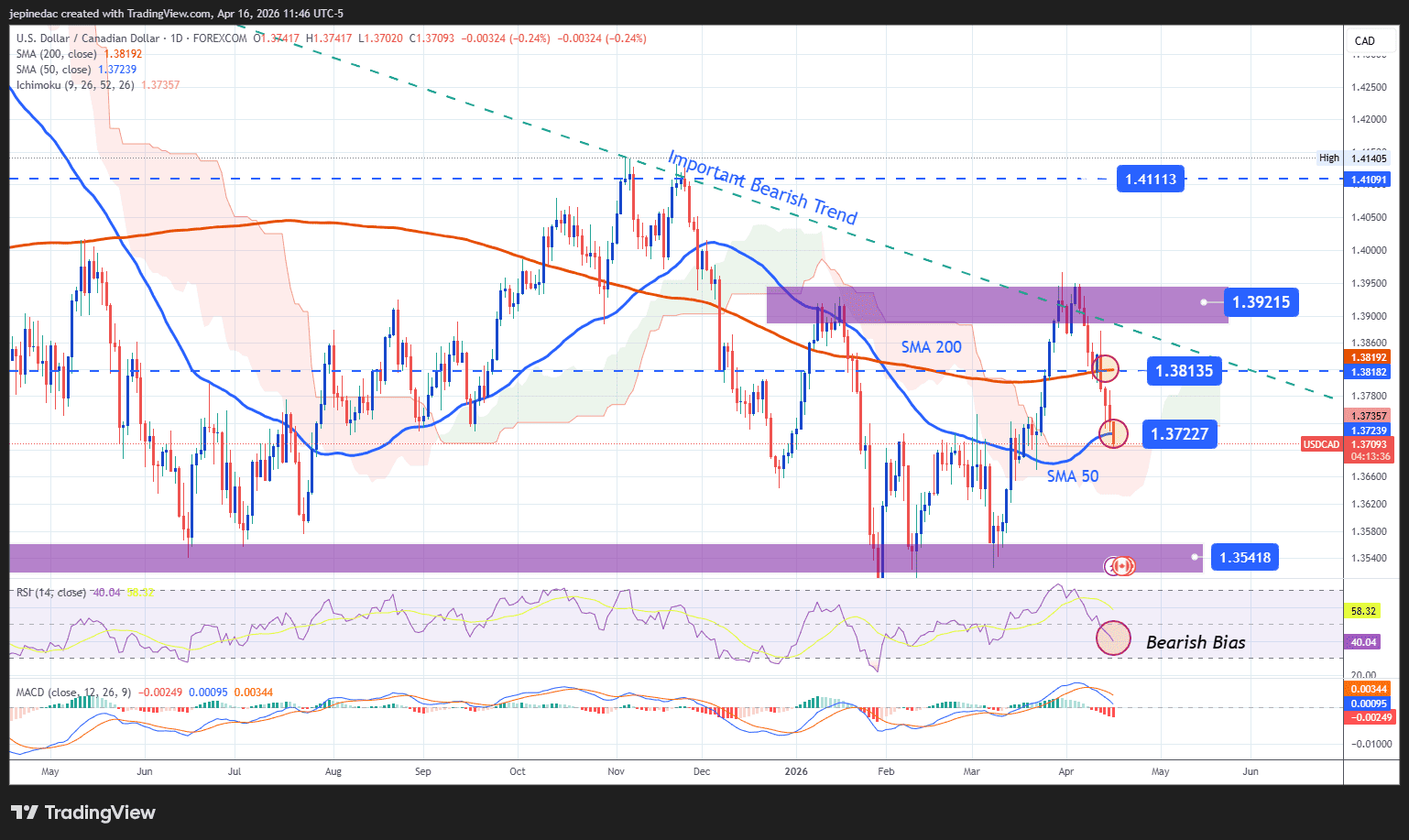
- The long-term downtrend returns to focus: Since early February, a long-term downward trendline has been present in USD/CAD price action, and the recent bearish movement has once again brought relevance back to this structure in the short term. If selling pressure continues to develop consistently, this bearish structure could remain the most relevant technical factor to consider in upcoming sessions, especially if no strong recovery attempts emerge to challenge it.
- RSI: The RSI remains below the 50 neutral level, suggesting that selling momentum over the last 14 sessions has begun to dominate price action. As long as this behavior continues, selling pressure is likely to remain relevant in the short term.
- MACD: A similar scenario can be observed in the MACD indicator, where the histogram remains consistently below the 0 line, indicating that short-term moving average momentum continues to show a bearish bias. This reinforces the importance of continued selling pressure in USD/CAD in the coming sessions.
Key levels:
- 1.38135 – Key resistance: A level aligned with recent highs and the 200-period moving average. Price movements toward this level could bring back more consistent buying pressure, potentially putting the current downtrend structure at risk.
- 1.37227 – Key barrier: A neutral level aligned with the 50-period moving average. Price action that remains close to this level could trigger a more consistent indecision bias, potentially leading to the formation of a range-bound structure in the coming sessions.
- 1.35418 – Key support: A level aligned with the lows of 2026 and the most relevant downside barrier in the short term. Price movements that approach this level again could reinforce the dominance of the bearish bias and support a further extension of the long-term downtrend as the dominant technical structure in the coming weeks.
Written by Julian Pineda, CFA, CMT – Market Analyst
Follow him on: @julianpineda25