
Although the week has started to move in favor of the yen in the short term, with USDJPY showing a consistent decline over the last two sessions of around -0.5%, this move appears to reflect more of a phase of indecision rather than a solid recovery of the Japanese currency, especially after the strong appreciation of the U.S. dollar seen last week.
In this context, the recent pullback in the pair seems more like a short-term adjustment or pause, rather than the beginning of a more robust directional move. For now, neutrality has become more evident as the market awaits the monetary policy decisions from the Federal Reserve and the Bank of Japan, whose outcomes could directly influence both the yen and the dollar in the short term. As the policy path of both central banks becomes clearer, indecision could continue to dominate price action.

Central bank decisions approach
During tomorrow’s session, both the Bank of Japan and the Federal Reserve are expected to announce their interest rate decisions. In both cases, the most likely outcome points toward a cautious and neutral stance. The Bank of Japan is expected to keep rates at 0.75%, while the Federal Reserve is likely to hold rates at 3.75%, maintaining a wide rate differential between the two economies.
This expectation is based on recent communication from both central banks, which suggests that conditions are not yet sufficient to justify a shift in monetary policy, reinforcing a wait-and-see approach in the short term. However, beyond the decision itself, the market will be particularly focused on forward guidance, especially regarding inflation and growth expectations for the remainder of 2026.
Both economies have recently shown signs of inflation moderation. In Japan, inflation is currently around 1.5%, while in the United States, February data came in at 2.4%. Although these levels differ, both are gradually moving closer to their respective 2.00% targets, supporting the case for a prolonged neutral rate environment.
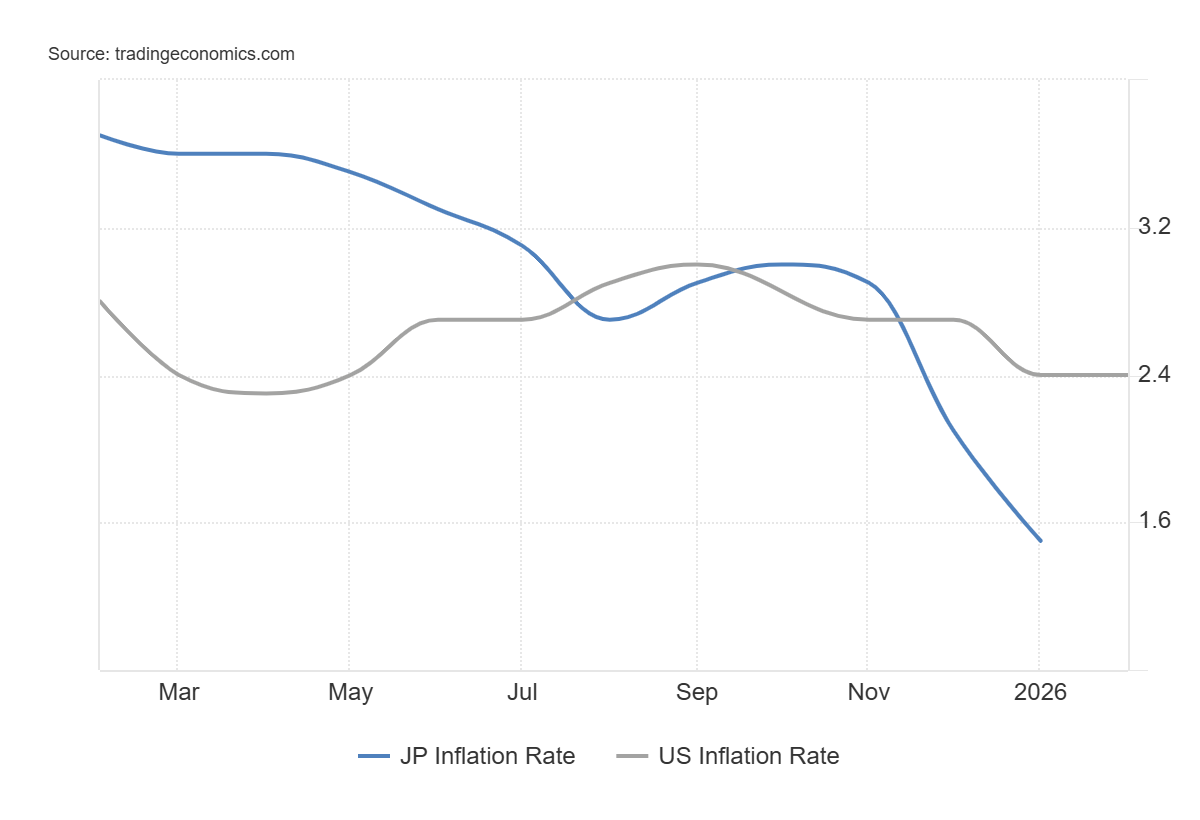
Source: TradingEconomics
However, the recent conflict in the Middle East introduces a new source of uncertainty. Rising oil prices could generate global inflationary pressures, increasing production costs and eventually feeding into consumer prices. This dynamic could slow the recent disinflation trend and reinforce a more cautious stance from central banks, extending the current neutral rate environment.
This shift in expectations is already being reflected in the market. In the United States, a few weeks ago there was a greater than 50% probability of a rate cut in June, but currently the probability of rates remaining unchanged for that meeting exceeds 75%, pushing expectations for potential cuts toward the end of the year.
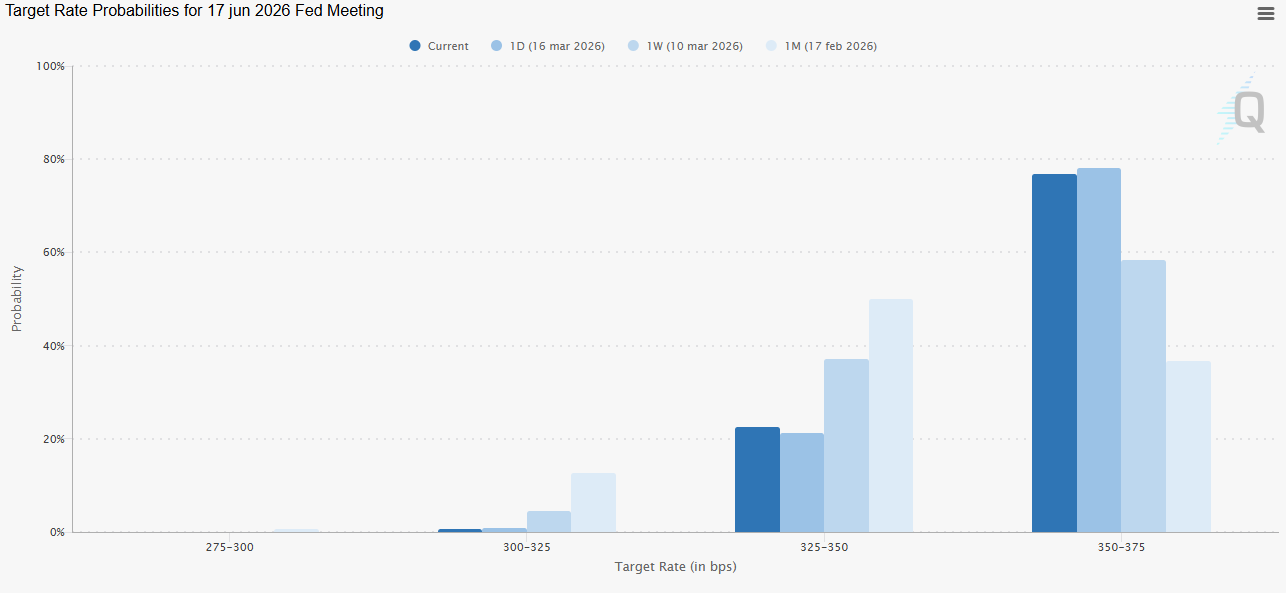
Source: CMEGROUP
With this in mind, it is important to remember that one of the main drivers behind the strength of the U.S. dollar against the yen is the interest rate differential, with U.S. rates around 3.75% compared to 0.75% in Japan. If both central banks maintain their current policy stance in the coming months, this differential could continue to favor the dollar.
Under this scenario, any attempts by the yen to recover could remain limited, as investors may continue to favor dollar-denominated assets. This could act as a catalyst for renewed dollar demand, potentially restoring buying pressure in USDJPY in the short term.
USD/JPY Technical Outlook
Source: StoneX, Tradingview
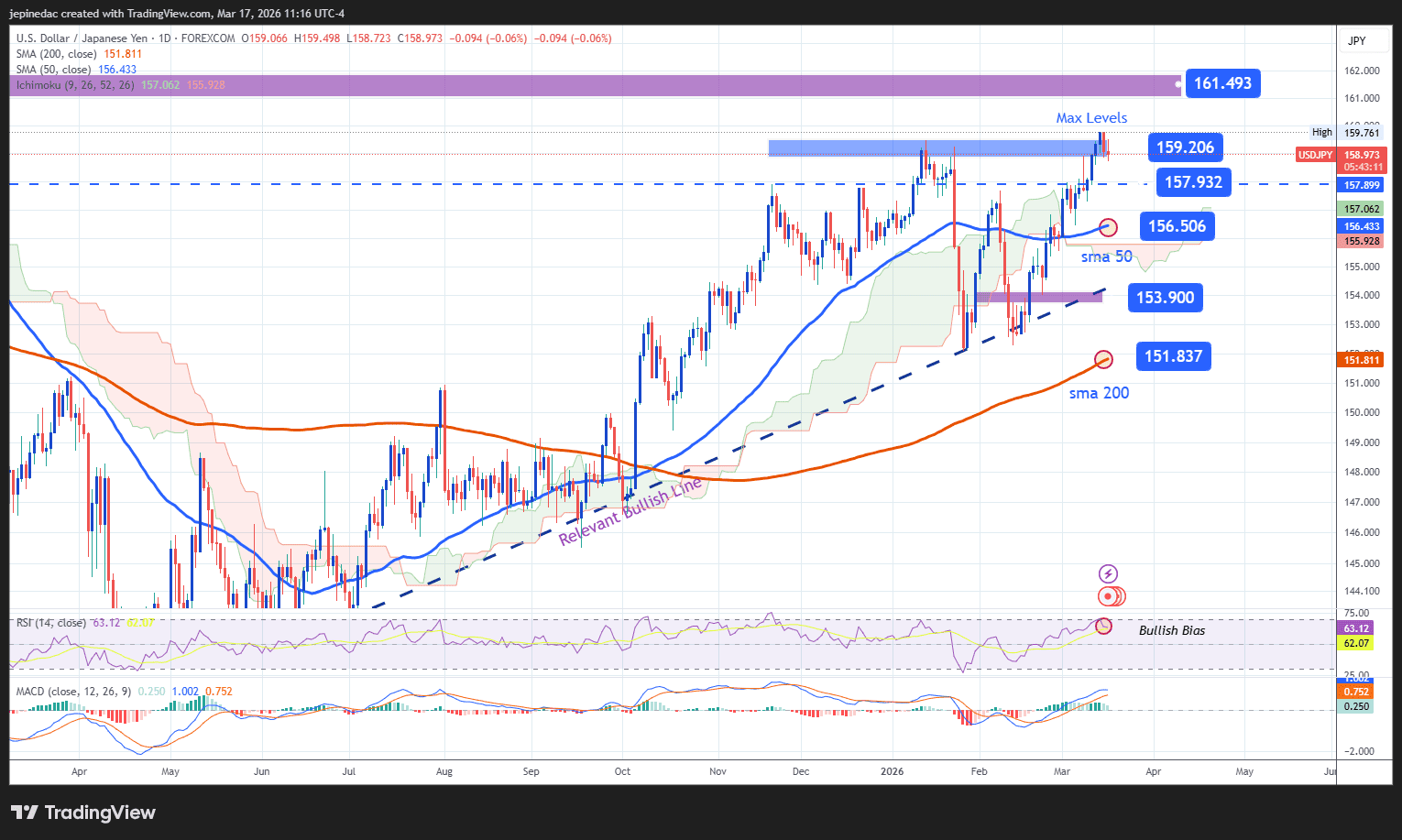
- The broader uptrend remains dominant: For several months, USDJPY price action has followed a consistent upward trendline, which continues to be the main technical structure to monitor. So far, no significant bearish corrections have emerged to challenge this formation, keeping the bullish bias intact in both the short and medium term. If the current selling pressure fails to gain traction, the pair could resume its uptrend continuation, especially if fundamental factors continue to support the dollar. In this sense, recent pullbacks may still be interpreted as corrective moves within a broader bullish structure.
- RSI: The RSI indicator, despite showing a slight pullback, remains above the 50 level, suggesting that bullish momentum continues to dominate over the last 14 periods. As long as these dynamic holds, the market may continue to favor scenarios where buying pressure regains strength.
- MACD: The MACD histogram shows a similar pattern, remaining above the zero line, which indicates that short-term moving averages continue to reflect a positive bias. If this persists, it could support the emergence of a new bullish impulse phase.
Key levels:
- 159.206 – Key resistance: Level aligned with the 2026 highs and the main upside barrier to monitor. A break above this level could confirm a dominant bullish bias and open the door to a more aggressive extension of the current uptrend.
- 157.932 – Near-term barrier: A recent neutrality zone that may act as intermediate support during short-term pullbacks. Moves toward this level would still be insufficient to challenge the broader uptrend.
- 156.506 – Key support: Level aligned with the 50-period simple moving average. A decisive break below this zone could begin to challenge the bullish structure and shift the outlook toward a more consistent bearish bias in the short term.
Written by Julian Pineda, CFA, CMT – Market Analyst
Follow him on: @julianpineda25