

Over the past five trading sessions, the USD/MXN pair recorded a decline of more than 1%, favoring the Mexican peso and halting the upward momentum the US dollar had shown in previous weeks. This bearish bias has remained firm, supported by expectations around the Bank of Mexico’s next moves and rising optimism regarding the trade dispute, with Mexico positioned as a key negotiation partner. As a result, the peso has strengthened, and the pair is now trading near the 18.50 level, a price not seen in over a year.

What’s Next for the Bank of Mexico?
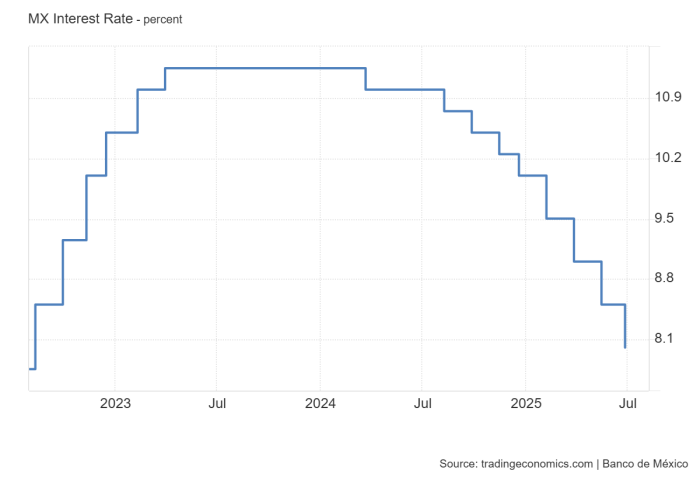
The Bank of Mexico currently holds one of the highest interest rates in global markets, at 8%, significantly above the 4.5% rate in the United States. This rate differential has favored inflows into peso-denominated assets, especially among investors seeking exposure to emerging markets. However, while this high yield has supported the peso in recent months, the currency’s appeal could start to fade if the central bank enters a more aggressive rate-cutting phase.
Inflation data in Mexico has been showing positive signs. As of June, the inflation rate stood at 4.32%, down from 4.42% in May, gradually moving closer to the central bank’s official target of 3% ± 1%.
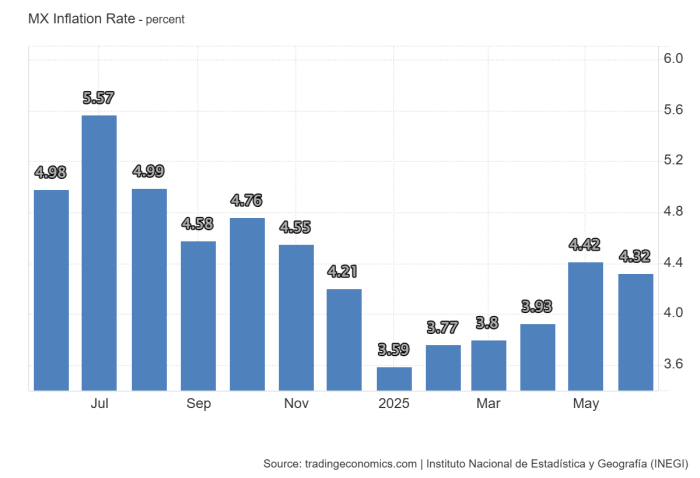
Source: TradingEconomics
With this ongoing disinflationary trend, the door is open for the central bank to resume its easing cycle. While rates remained unchanged at 8% in the last decision, the tone of the statement suggests the bank still leans toward a dovish stance. Markets now project a possible rate cut to 7.75% at the upcoming August 8 meeting, which would maintain the broader downward trend in Mexican rates.
Source: TradingEconomics
If rate cuts accelerate and become more frequent, the peso’s relative attractiveness could weaken, potentially shifting capital flows. In such a scenario, we could see renewed buying pressure on USD/MXN, especially if doubts emerge about the sustainability of the rate differential.
Trade War
Since July 12, the White House announced the potential implementation of a 30% tariff on imports from Mexico, with an effective date of August 1. According to US officials, the measure aims to address unfair trade practices and ongoing concerns about border security.
In response, Mexico has stated its willingness to negotiate, although it hasn’t ruled out countermeasures if a deal is not reached before the deadline. Despite the uncertainty, markets remain somewhat optimistic, especially after recent progress with Japan and the European Union, where tariff reductions have been successfully negotiated. This has created expectations that Mexico could reach a similar outcome, supporting the peso’s resilience in the short term.
However, if no deal is reached and the 30% tariffs take effect automatically, concerns about the Mexican economy could return quickly, likely triggering a shift in demand away from the peso and sparking a potential rebound in USD/MXN.
USD/MXN Technical Outlook
Source: StoneX, Tradingview
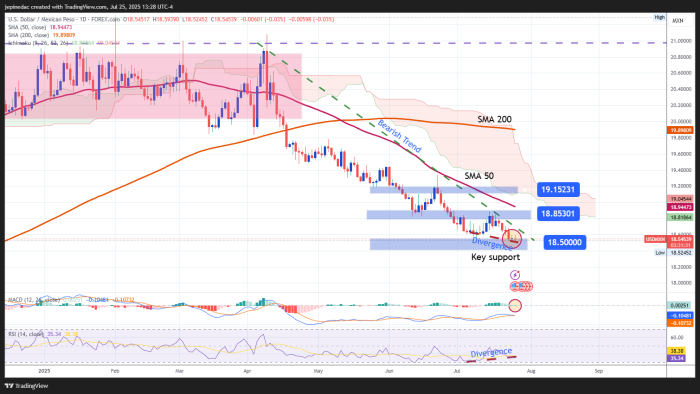
- Downtrend Holds: Since early April, the USD/MXN pair has been in a well-defined downtrend, with no significant bullish corrections in recent weeks. The price is now approaching a major support zone, which could trigger short-term upward corrections, especially if the market perceives that the current move is reaching exhaustion.
- MACD: The MACD histogram remains close to the zero line, indicating a lack of directional momentum in the short-term moving averages. This neutral setup is consistent with the pair’s approach to a critical support zone, which may lead to market indecision in the sessions ahead.
- RSI: The RSI is starting to post higher lows, while the price continues to form lower lows, creating a bullish divergence. This suggests the market may be experiencing structural imbalance, potentially paving the way for short-term buying pressure.
Key Levels:
- 18.50 – Key Support: This psychological level aligns with lows not seen since 2024. A sustained break below this zone could confirm a stronger bearish trend, reinforcing the current downward momentum.
- 18.85 – Nearby Barrier: This level corresponds to recent short-term highs. It may serve as a temporary resistance during potential bullish corrections.
- 19.15 – Major Resistance: This level marks highs not seen since June and is currently the main resistance zone for upward moves. If the price returns to this level, it could signal the end of the current downtrend.
Written by Julian Pineda, CFA – Market Analyst
Follow him at: @julianpineda25