
As we approach the middle of the month, the Mexican peso has so far managed to maintain solid strength at the start of the year. Currently, USD/MXN is posting a streak of three consecutive bearish sessions, with a decline of more than 0.6% in favor of the peso, in a context where the U.S. dollar has once again shown signs of indecision. Selling pressure has persisted even after the release of U.S. inflation data, suggesting that the strength of the so-called “super peso” could remain in place over the coming trading sessions, in the absence of economic catalysts that restore momentum to the dollar in the short term.

U.S. Inflation Data Is Released
Earlier today, U.S. annual inflation (CPI Y/Y) was released, coming in at 2.7%, in line with market expectations. This reading matches the levels observed in December and suggests that, for now, there is no meaningful pickup in inflation at the start of the year. As such, the data does not represent an immediate source of additional pressure for the Federal Reserve in the short term.

Source: TradingEconomics
The inflation data coming in as expected has reinforced a neutral environment in U.S. dollar price action. In fact, the DXY index, which measures the dollar’s strength against other currencies, has traded sideways around the 99-point area, indicating that the inflation release was not enough to trigger a clear bullish bias for the dollar, but rather highlighted a phase of confidence indecision.
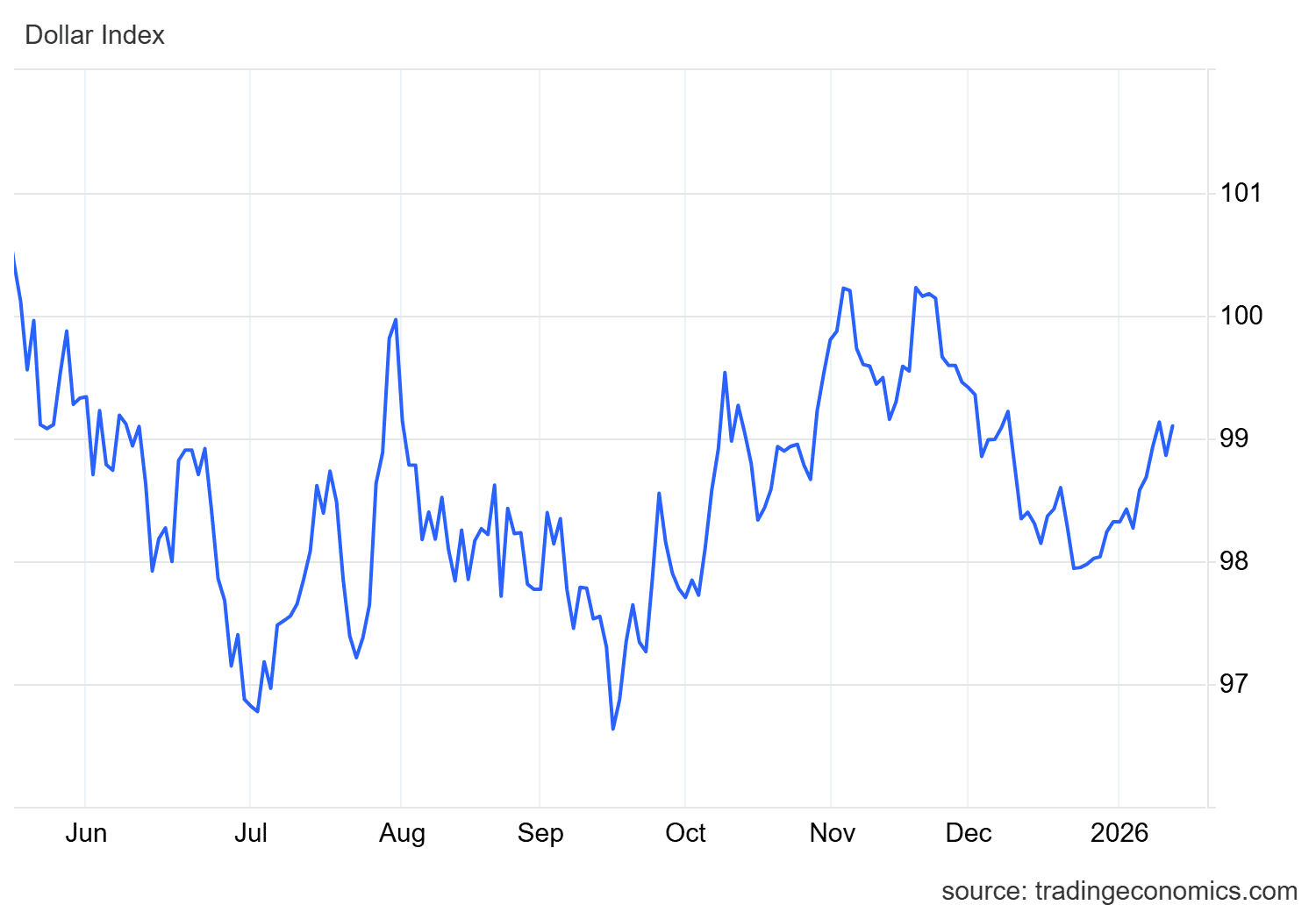
Source: TradingEconomics
In this context, currencies such as the Mexican peso, which has shown strong resilience against previous spikes in dollar strength over recent months, have begun to take advantage of this indecision surrounding U.S. monetary policy. Peso strength has allowed USD/MXN to print new relevant lows compared to prior months. As long as markets do not assign a meaningful probability to interest rate hikes in the United States—a scenario not supported by current inflation data—the peso may continue to gain ground and maintain sustained selling pressure on USD/MXN in the coming sessions.
Does the High Rate Continue to Support the Peso?
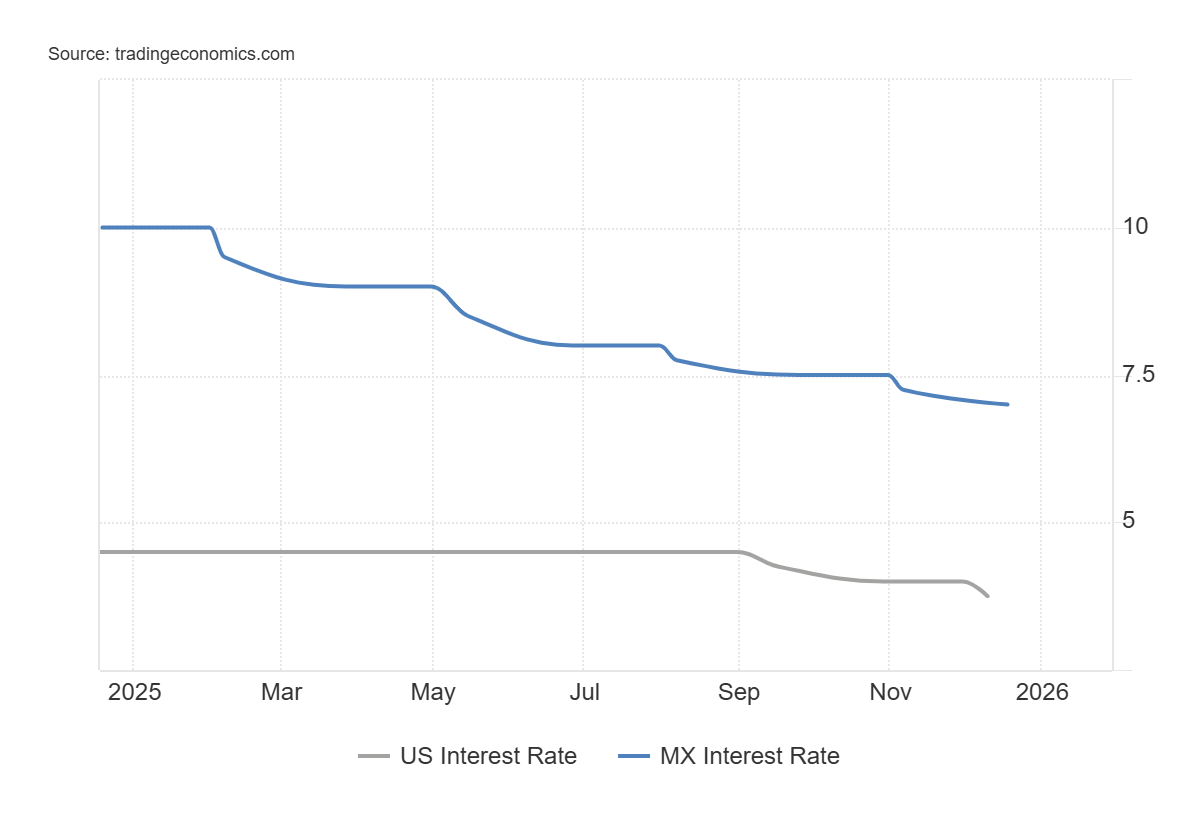
At this stage, it is important to recall that Banco de México continues to maintain a relatively high interest rate, close to 7%, well above the U.S. benchmark rate, which currently stands near 3.75%. This interest rate differential remains a key fundamental factor in the short term. In addition, there have been no recent signals from Mexico’s central bank pointing to aggressive rate cuts in upcoming decisions, reinforcing the stability of this differential.
Source: TradingEconomics
A wide interest rate differential tends to favor peso-denominated investments, particularly in fixed income, over dollar-denominated assets. As long as this differential remains attractive, it is likely to continue encouraging steady demand for the Mexican peso, at the expense of demand for U.S. dollar assets. This environment could continue to support persistent selling pressure in USD/MXN over the next trading sessions.
USD/MXN Technical Outlook
Source: StoneX, Tradingview
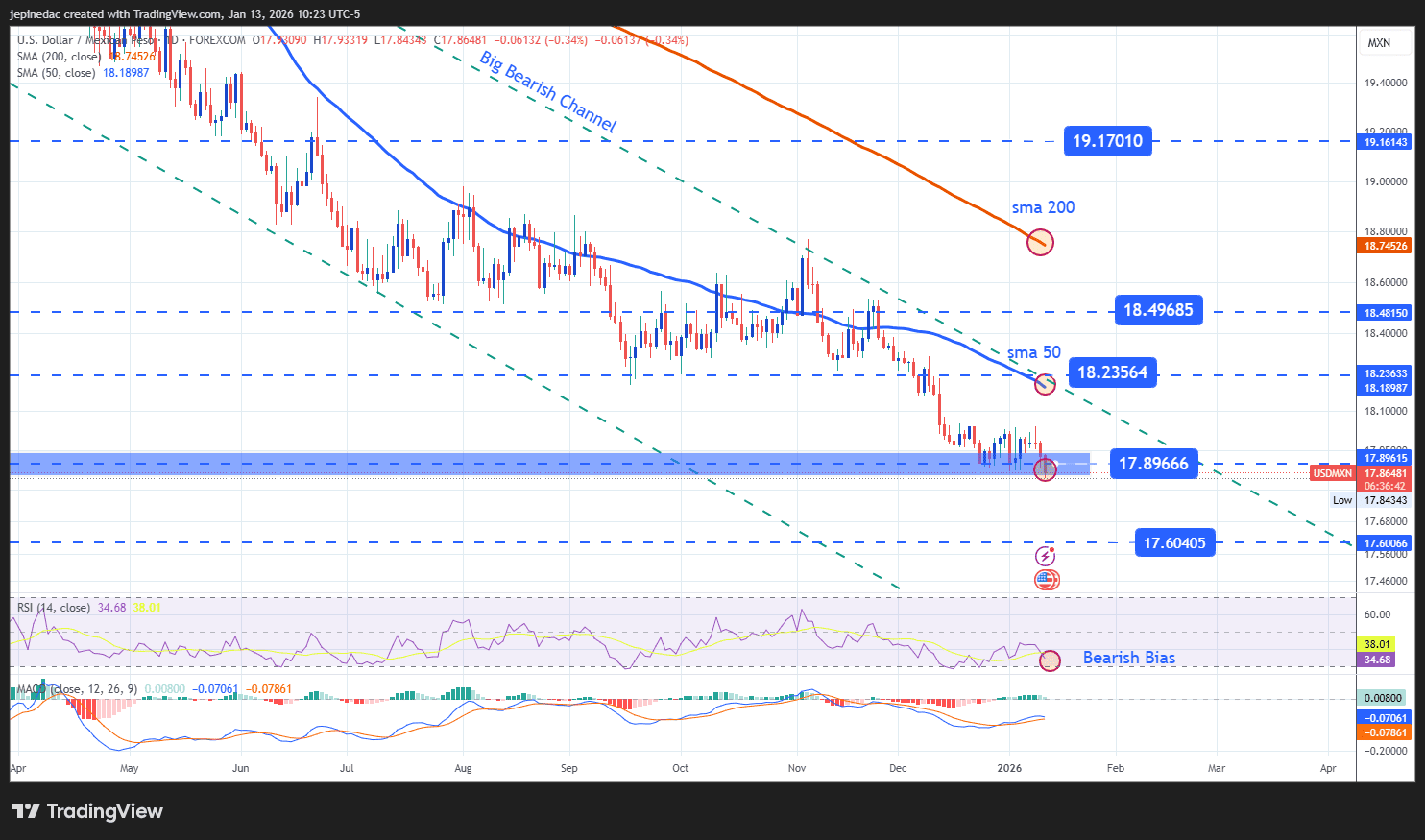
- The broader bearish channel remains dominant: In the early sessions of 2026, USD/MXN continues to respect the wide bearish channel that dominated much of 2025. So far, no meaningful bullish corrections have emerged to threaten this structure, leaving the bearish channel as the most relevant technical formation to monitor. As long as selling pressure holds, this channel is likely to continue guiding short-term price action and limiting the development of a meaningful bullish structure.
- RSI: The RSI maintains a negative slope, with readings below the neutral 50 level, suggesting that selling momentum continues to dominate on average over the past 14 sessions.
- MACD: The MACD shows a histogram that continues to drift toward the neutral zero line, indicating that short-term buying momentum has lost relevance. This behavior could be signaling the development of a more consistent bearish phase, reinforcing selling dominance in the short term.
Key Levels:
- 18.23 – Key resistance: A relevant resistance zone aligned with the 50-period simple moving average and the upper boundary of the bearish channel. Bullish moves above this level could put the bearish structure at risk and open the door to a more meaningful bullish bias.
- 17.89 – Current barrier: A level corresponding to the 2025 lows. A sustained break below this area would reinforce selling dominance and extend the prevailing bearish channel.
- 17.60 – Key support: A price zone not seen since July 2024. A sustained move toward this level could give way to an even more aggressive bearish channel in the coming sessions.
Written by Julian Pineda, CFA, CMT – Market Analyst
Follow him on: @julianpineda25