



AUD/USD Outlook: Two-part rates play, one-part risk proxy
A pickup in US inflation expectations, renewed geopolitical tensions and another bruising session for technology stocks combined to leave the Aussie under pressure overnight.
Share this:

- Sticky inflation expectations revive Fed hike fears
- Risk appetite deteriorates as tech stocks tumble
- Bearish engulfing pattern strengthens AUD/USD downside risks
- RBNZ, FOMC minutes headline today's event risk
AUD/USD came under pressure on Tuesday as both of its dominant drivers moved against it. As things stand, the pair is behaving like a two-part front-end rates pricing, one-part risk appetite play. If that relationship holds, traders should keep a close eye on US rate expectations, developments in the Strait of Hormuz and performance of risk assets in Asia on Wednesday.
A shift in market dynamics
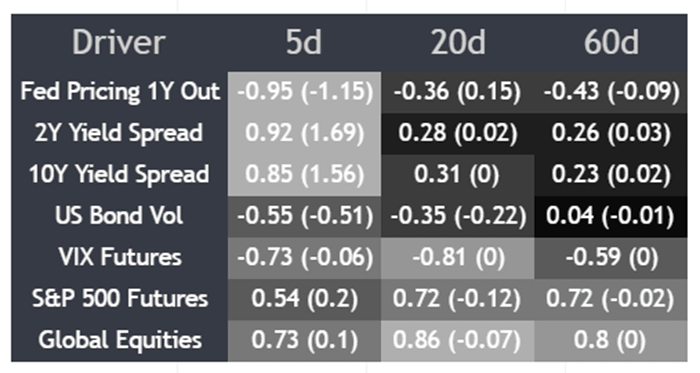
The correlation matrix below highlights an important shift in recent market dynamics. Rather than behaving as a pure risk proxy, AUD/USD has increasingly traded as a relative rates play over the past week, with Australia-US front-end yield spreads emerging as the dominant driver of price action.
Source: TradingView
Inflation expectations bite
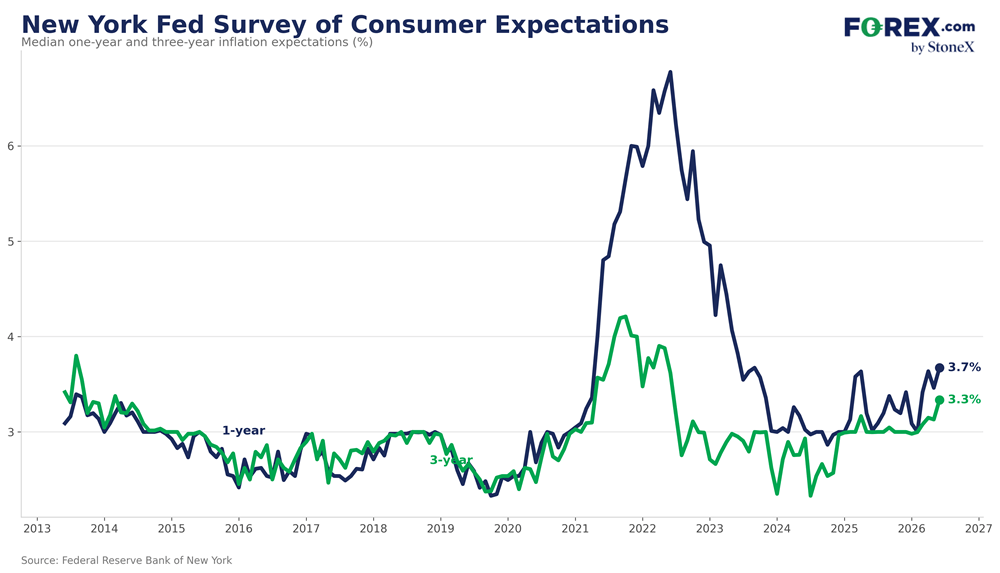
The biggest driver of the overnight repricing in Fed expectations came from the New York Fed's June Survey of Consumer Expectations. Median one-year inflation expectations rose 0.2 percentage point to 3.7%, the highest level since September 2023, while three-year expectations climbed by the same amount to 3.3%, the highest since June 2022. Crucially, both measures increased despite respondents expecting gasoline prices to rise at the slowest pace since August 2022.
Source: TradingView
With inflation having remained above target for more than five years, a renewed pickup in inflation expectations despite easing energy price pressures is unlikely to make for comfortable reading at the Federal Reserve.
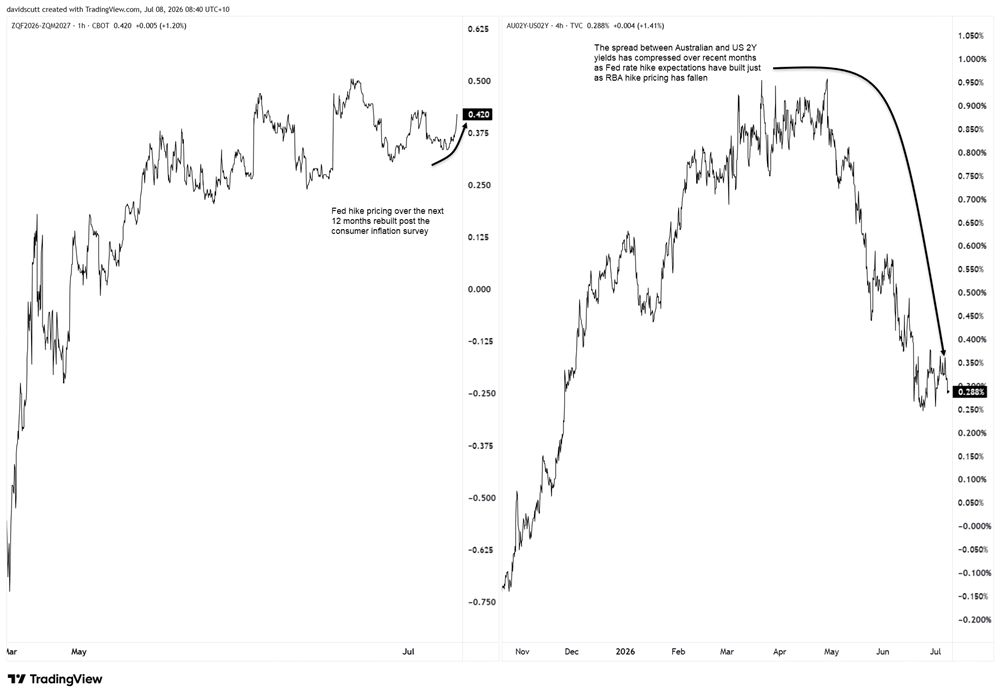
Markets responded by adding to Fed tightening bets, with futures now implying around 42 basis points of additional tightening over the next 12 months, up from around 33.5 basis points this time yesterday. While firmer oil prices and heavy Treasury issuance also helped push yields higher, the New York Fed's inflation expectations survey appeared to be the primary catalyst behind the repricing, coming in the absence of any other major US economic releases.
Source: TradingView
That helped lift US front-end Treasury yields relative to Australian government debt, extending the recent narrowing in the Australia-US two-year yield spread and adding to the downside pressure on AUD/USD.
Risk appetite retreats
Risk sentiment also proved to be a headwind for the Aussie. Technology stocks remained under pressure amid growing questions over whether excessive AI infrastructure spending remains warranted, with Amazon's latest bond offering attracting softer demand than a similar deal earlier this year. Even Samsung's blowout earnings earlier in the session failed to satisfy investors' lofty expectations, extending the recent bout of profit-taking across semiconductor stocks.
Geopolitical tensions also intensified after renewed attacks on commercial shipping in the Strait of Hormuz prompted the United States to revoke the licence permitting Iranian crude exports and launch retaliatory strikes against Iranian military targets, adding to the cautious tone across markets.
Today's key risks
Looking ahead, the first scheduled risk event comes at 11am AEST when the RBA’s chief economist Sarah Hunter speaks at the Australian Conference of Economists in Canberra. With little major Australian economic data released recently, the speech may not offer fresh insights in the outlook for monetary policy, although markets will be alert for any changes in tone.
Attention will then turn to the Reserve Bank of New Zealand's policy decision at midday AEST. While the event is centred on New Zealand, it often spills over into AUD/USD, with the Australian dollar typically moving in the same direction as the kiwi, albeit to a lesser extent.
The performance of Asian risk assets will also warrant close attention after Tuesday's heavy losses across Japanese and Korean technology stocks. Should that weakness extend into today's session, it would add another headwind for a currency that continues to display a meaningful positive relationship with broader measures of risk appetite.
Focus later in the session will then shift to the release of the June FOMC minutes, the first under Fed Chair Kevin Warsh. Traders should be prepared for the format and level of detail to differ from previous iterations. However, with half of policymakers projecting at least one rate hike this year and Warsh striking a hawkish tone at his post-meeting press conference, markets should approach the release expecting the minutes to reinforce that hawkish message.
Bears regain control
Source: TradingView
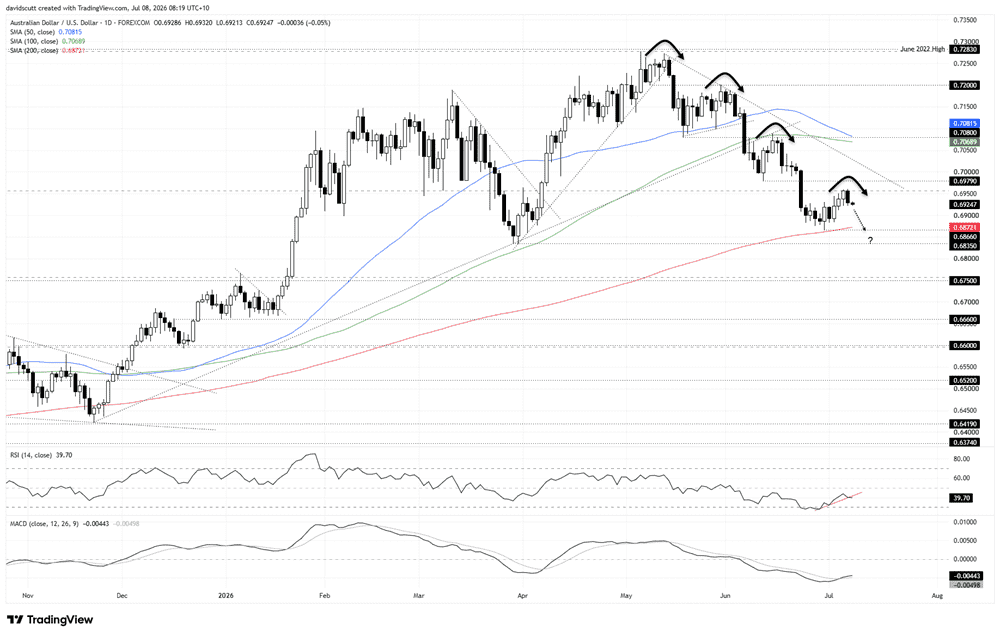
The technical picture has turned more constructive for bears following the formation of a engulfing candle on the daily timeframe on Tuesday. The reversal came after AUD/USD's rebound from just above the 200-day moving average stalled at the 23.6% Fibonacci retracement of the April 2025-June 2026 bull move, adding weight to the signal given it occurred at a well-defined resistance level. While confirmation is still required, the setup points to an increased risk of a retest of the 200-day moving average at 0.6872 and the late-June swing low at 0.6866.
More broadly, the pair remains in a well-defined downtrend, continuing to post lower highs and lower lows. Momentum indicators remain broadly bearish despite showing signs of stabilising. RSI (14) remains below the neutral 50 level and has broken the minor uptrend in place over the past fortnight, while MACD has crossed above its signal line but remains deeply negative. Rather than providing a green light for bulls, the crossover looks more like a warning that downside momentum may be easing rather than reversing. The bearish bias is reinforced by the 50 and 100-day moving averages, both of which are now sloping lower, leaving the broader technical backdrop favouring selling into rallies and downside breaks.
Outside the abovementioned levels, initial resistance is found at 0.6979, marking former support from mid-June. Above that, the downtrend from the June multi-year high intersects just above 0.7000 alongside the 50 and 100-day moving averages, with more resistance found at 0.7080. On the downside, a break below the 200-day moving average and the June swing low at 0.6866 would expose the late-March low at 0.6835. Beyond there, attention shifts to the 38.2% Fibonacci retracement of the April 2025-June 2026 bull move at 0.6757, which also coincides with a breakout zone from earlier this year.


The complete CFD trading experience
Award-winning platforms, competitive spreads, low commissions and dedicated support.
We live and breathe the markets and are dedicated to helping traders realise their ambitions as we continue to set the industry bar.
Economic calendar
Web Trader platform
Our sophisticated web-based platform is packed with features.
Related articles
Bitcoin Forecast: BTC/USD Bounces off $80K, 9-Month Highs In Play?
Despite apparent fundamental headwinds, Bitcoin’s price has held up relatively well, bouncing sharply off $80K support - where could it head next?

Gold Price Short-term Outlook: XAU/USD Holds Critical Support as Breakout Nears 10 15 2026
Gold is consolidating after a steep selloff, with momentum divergence raising the stakes for the next move ahead of the Fed decision.


USD/JPY Update: Can the Japanese Yen Sustain Its Recovery?
Short-term price action around the Japanese yen has started to show some relative improvement over recent sessions. This can be seen in the recent performance of USD/JPY, which has now recorded three consecutive daily declines in favor of the Japanese currency, resulting in a depreciation of roughly 0.35% over the period.

StoneX Europe Ltd may make third party material available on this website which may contain information included but not limited to the conditions of financial markets. The material is for information purposes only and does not contain, and should not be construed as containing, investment advice and/or investment recommendation and/or an investment research and/or an offer of or solicitation for any transactions in financial instruments; any decision to enter into a specific transaction shall be made by the client following an assessment by him/her of their situation.
StoneX Europe Ltd makes no representation or warranty and assumes no liability as to the accuracy or completeness of the information provided, nor any loss arising from any investment based on a recommendation, forecast or other information supplied. You should always seek independent advice as to your suitability to speculate in any related markets and your ability to assume the associated risks, if you are at all unsure. We are not under any obligation to update any such material. Any opinion made may be personal to the author and may not reflect the opinion of StoneX Europe Ltd.