







Australia Dollar Outlook: AUD/USD Stuck in the Headlines as China Trade War Escalates
AUD/USD is struggling as China trade tensions escalate, with price action closely tied to moves in USD/CNH. While Beijing is ramping up fiscal support to boost consumer spending, details remain thin, leaving the Aussie stuck in a headline-driven market. Can .6200 hold as support?
Share this:

- AUD/USD lags G10 peers, tracking USD/CNH and Hang Seng Tech futures
- China pledges more fiscal support, but stimulus details remain vague
- U.S. tariffs doubled to 20% on top of existing levies, raising concerns over China’s export model
- Buyers lurking beneath .6200, resistance seen near .6300
Summary
Whether it was the mere mention of the word ‘tariff’ during Donald Trump’s State of the Union address or disappointment with details outlined in a report from China’s National Development and Reform Commission (NDRC), AUD/USD has not enjoyed a strong Asian session. It sits at the bottom of the G10 FX leaderboard, taking directional cues for large periods from tick movements in the offshore-traded Chinese yuan and Hang Seng Tech Index futures. Yes, you read that right. For now, fleeting evidence of a turnaround in the Australian economy matters little for AUD/USD traders in this headline-driven environment.
AUD/USD Resumes Role as China Proxy
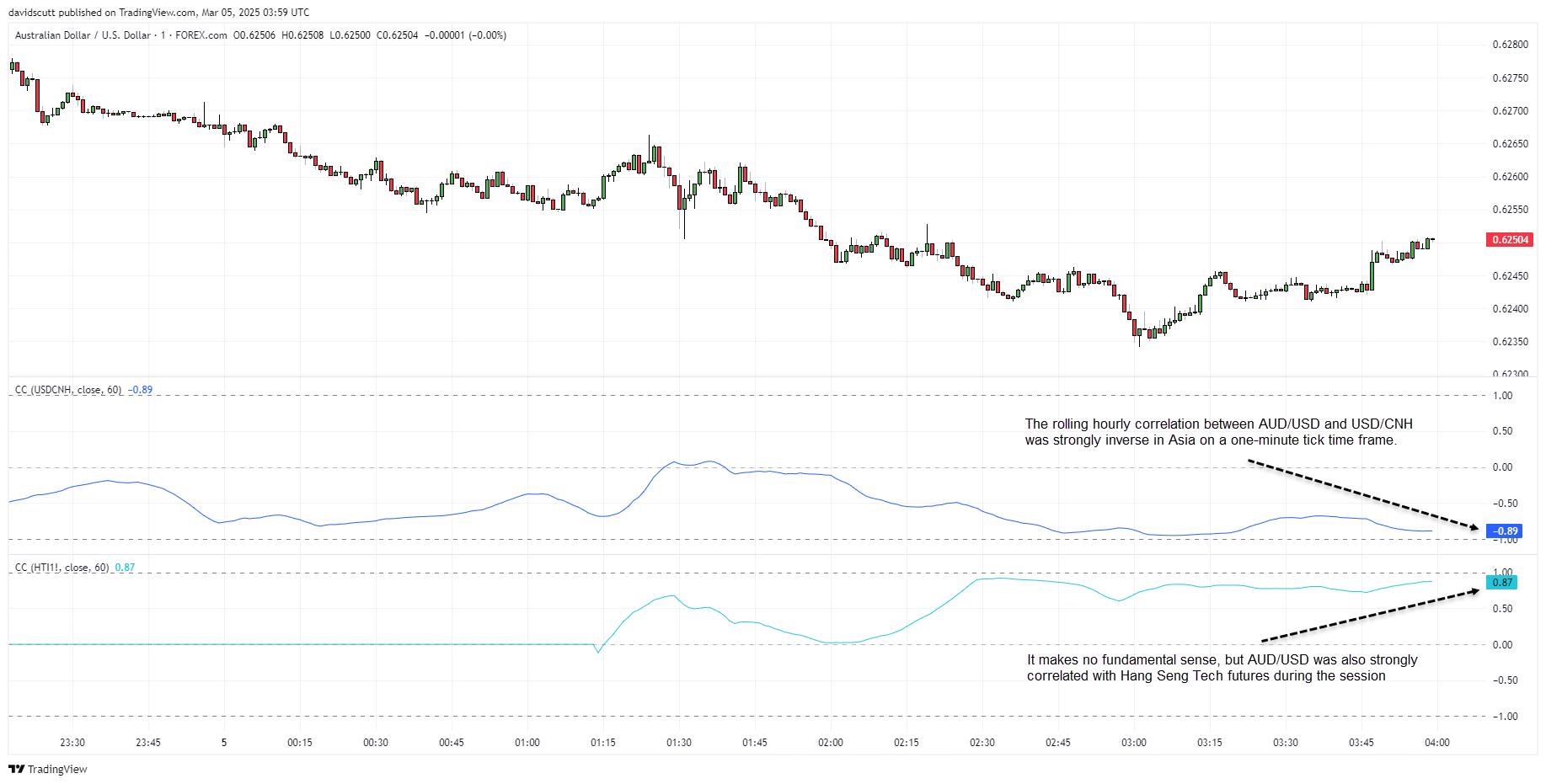
You can see how closely AUD/USD tracked moves in USD/CNH in the wake of the NDRC report, at one point holding a rolling hourly correlation coefficient of 0.95 using a one-minute tick. A similarly strong relationship was also seen between AUD/USD and Hang Seng Tech futures around the time physical markets opened on the Chinese mainland. The Aussie has been nothing but a pure-play China proxy in Asia.
Source: TradingView
China NDRC Report Provides Few Surprises
For what it’s worth, details from the NDRC report suggest Beijing is willing to boost household spending—the missing piece in China’s nascent economic rebound post-pandemic. Policymakers pledged increased fiscal support to keep growth on track, lifting the annual budget deficit to 4% of GDP. ¥300 billion was earmarked for consumer subsidies on EVs, appliances, and other goods. Plans to expand access to child, aged, and disability care were also flagged, though specifics were noticeably absent. The annual growth target was left unchanged at “around” 5%.
The push to foster spending comes as trade tensions with the U.S. escalate, threatening China’s export-driven growth model. On Tuesday, U.S. levies introduced since Donald Trump’s return to the Oval Office were doubled to 20% on top of existing import tariffs. With the risk of an escalating trade conflict, Beijing is becoming increasingly reliant on domestic demand to drive growth, making consumer sentiment a crucial swing factor—not just for the Chinese economy, but for the Aussie dollar this year.
USD/CNH: 7.3000 a Key Battleground
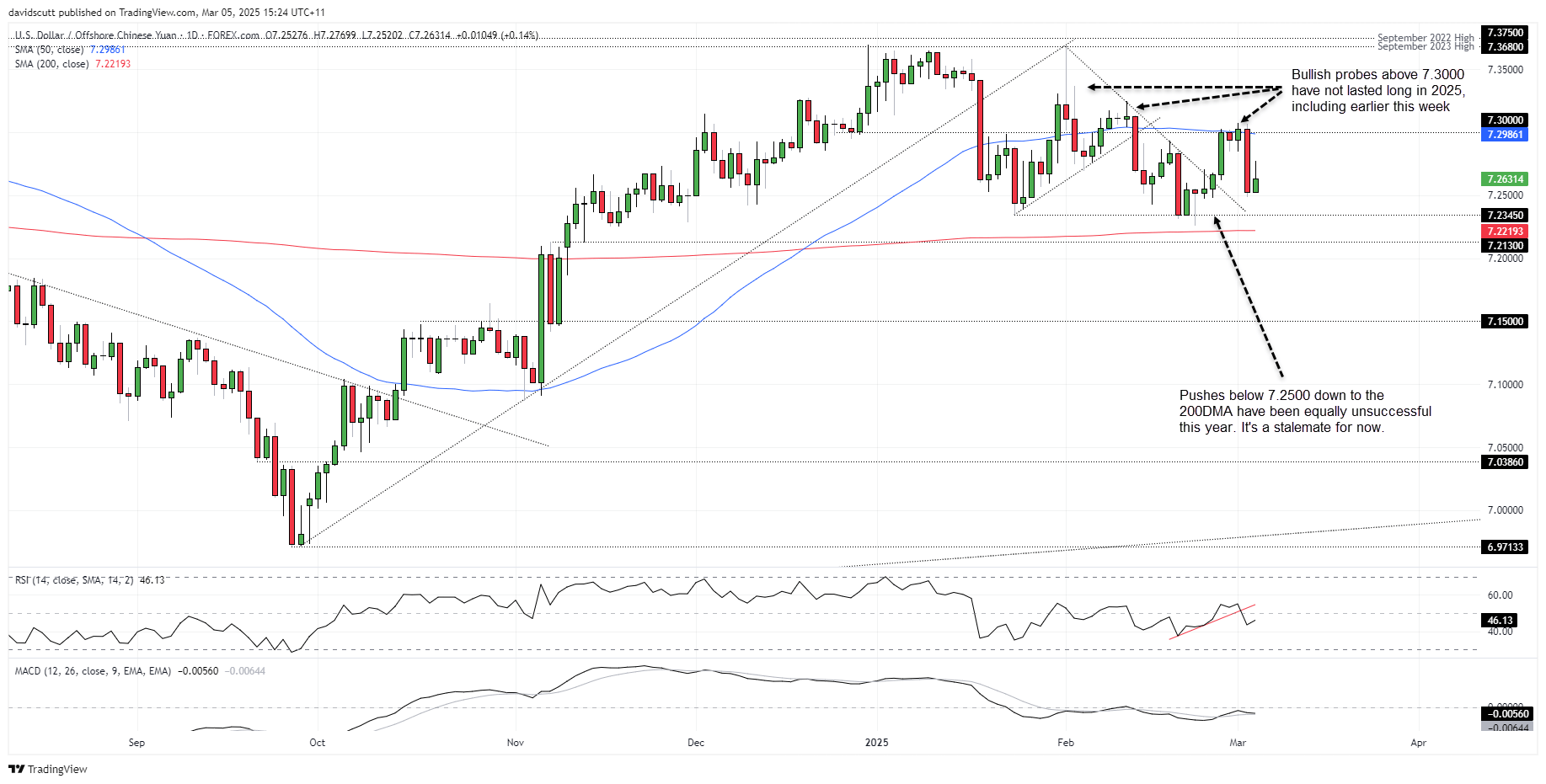
Given its often high correlation with the Australian dollar over longer timeframes, those trading AUD/USD may want to keep an eye on USD/CNH when evaluating directional risks. Right now, the picture from USD/CNH is one of relative stability, likely reflecting efforts by Chinese policymakers to counteract capital outflow risks as trade tensions with the U.S. heat up.
Source: TradingView
A key battleground sits at the 50-day moving average just below 7.3000—an important level. Bullish probes were repeatedly thwarted either side of last weekend, adding to the string of failures above this level earlier in the year. While bearish reversals have been equally unsuccessful on moves between 7.2500 and the 200-day moving average, the longer this stalemate persists, the harder it is to see AUD/USD resuming its bearish trend.
AUD/USD: Buyers Lurking Beneath .6200
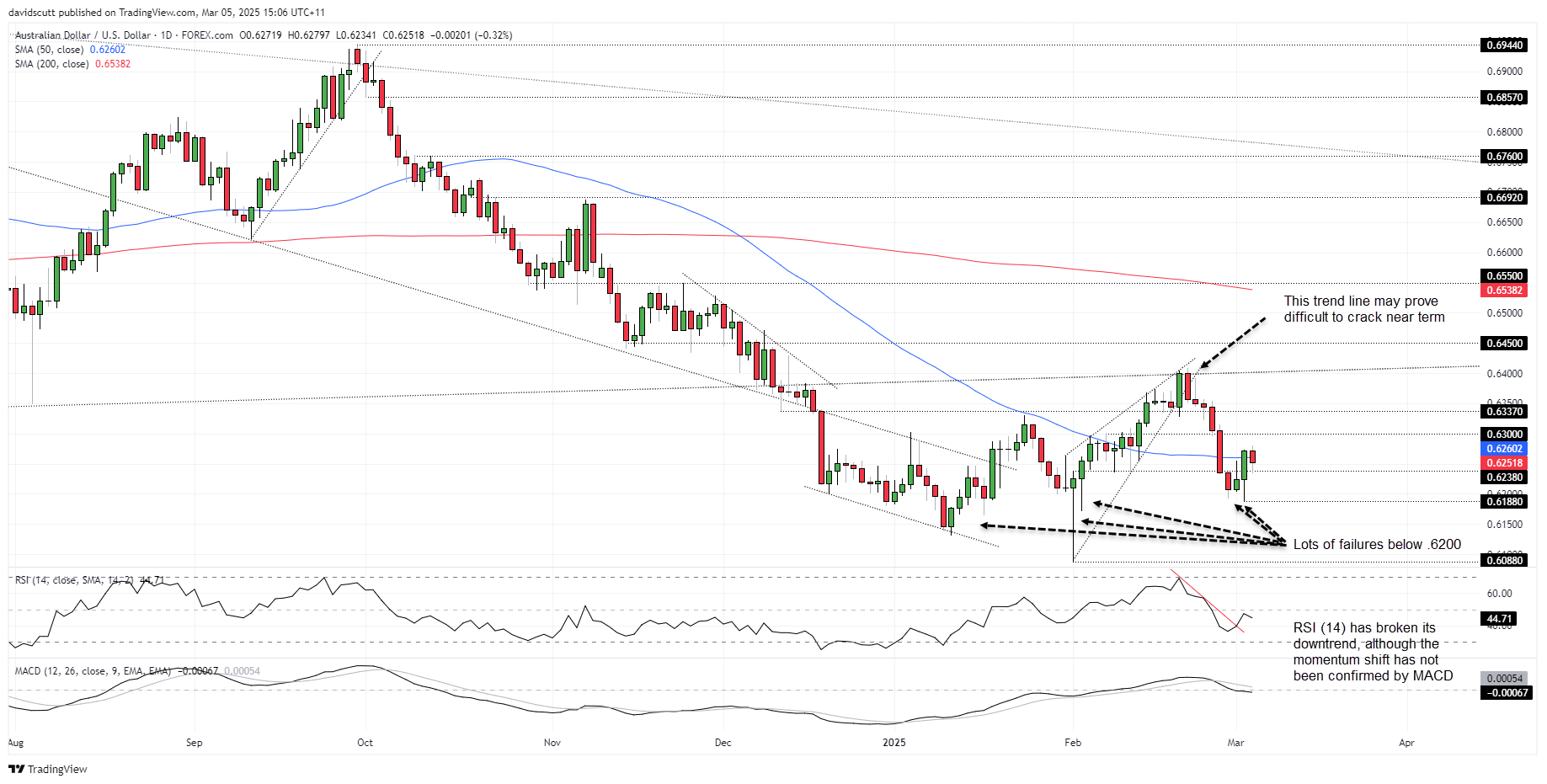
Unsurprisingly, given the recent price action in USD/CNH, bearish attacks beneath .6200 in AUD/USD have also failed this year. With so much pessimism already baked into the Aussie’s outlook, the near-term preference is to buy dips on moves below .6200.
Source: TradingView
The near-term directional bias remains higher, supported by the downtrend break in RSI (14) and the three-candle morning star pattern completed on Tuesday. Support levels to watch include .6238 and .6188. Resistance sits at .6300, .6337, and uptrend resistance near .6400.
Outside of tariff-related headlines, the key known event risk later Wednesday comes from the ISM Services PMI report for February. With U.S. economic sentiment increasingly fragile, any signs of acute weakness in this key sector could pressure the U.S. dollar—unless it sparks a significant lift in risk aversion.
-- Written by David Scutt
Follow David on Twitter @scutty
How to trade with City Index
You can trade with City Index by following these four easy steps:
- Open an account, or log in if you’re already a customer
• Open an account in the UK
• Open an account in Australia
• Open an account in Singapore
- Search for the market you want to trade in our award-winning platform
- Choose your position and size, and your stop and limit levels
- Place the trade
Related tags:
Latest market news




The complete CFD trading experience
Award-winning platforms, competitive spreads, low commissions and dedicated support.
We live and breathe the markets and are dedicated to helping traders realise their ambitions as we continue to set the industry bar.
Economic calendar
Web Trader platform
Our sophisticated web-based platform is packed with features.
Related articles
US Dollar Short-term Outlook: USD Rally on the Line as Midterms, NFP Loom 11 3 2026
DXY is testing pivotal support, with the weekly range breakout likely to determine the next major leg of the trend as key event risk unfolds.

Nasdaq 100 forecast: Stocks rebound but AI concerns linger
The Nasdaq 100 was finding some support at 28,000 after recent sell-off amid concerns about the AI trade. Even with oscillators oversold, the risk to the near-term forecast is tilted to the downside.

USD/JPY Analysis: Rising U.S. Yields Leave the Yen on the Defensive
As the first week of November progresses, renewed weakness in the Japanese yen is once again becoming evident in the short term. This dynamic can be seen in the recent performance of USD/JPY, which has posted two consecutive bullish sessions and gained more than 0.7%, reflecting a return of buying interest in the dollar while the yen continues to lose momentum.
StoneX Europe Ltd may make third party material available on this website which may contain information included but not limited to the conditions of financial markets. The material is for information purposes only and does not contain, and should not be construed as containing, investment advice and/or investment recommendation and/or an investment research and/or an offer of or solicitation for any transactions in financial instruments; any decision to enter into a specific transaction shall be made by the client following an assessment by him/her of their situation.
StoneX Europe Ltd makes no representation or warranty and assumes no liability as to the accuracy or completeness of the information provided, nor any loss arising from any investment based on a recommendation, forecast or other information supplied. You should always seek independent advice as to your suitability to speculate in any related markets and your ability to assume the associated risks, if you are at all unsure. We are not under any obligation to update any such material. Any opinion made may be personal to the author and may not reflect the opinion of StoneX Europe Ltd.