



Canadian Dollar Forecast: the USD/CAD Begins to Pull Back Amid Fed Uncertainty
Despite the strong buying pressure that has dominated USD/CAD over recent months, in the most recent two trading sessions the Canadian dollar has begun to recover gradually. Currently, the pair shows a short-term decline of around -0.3%. This bearish bias has strengthened as expectations rise for lower interest rates from the Federal Reserve, which has weakened the U.S. dollar.
Share this:

Despite the strong buying pressure that has dominated USD/CAD over recent months, in the most recent two trading sessions the Canadian dollar has begun to recover gradually. Currently, the pair shows a short-term decline of around -0.3%. This bearish bias has strengthened as expectations rise for lower interest rates from the Federal Reserve, which has weakened the U.S. dollar and allowed the Canadian dollar to gain ground. If this scenario continues, USD/CAD may experience a more pronounced weakness in its movements over the next sessions.


New Weakness in the U.S. Dollar?
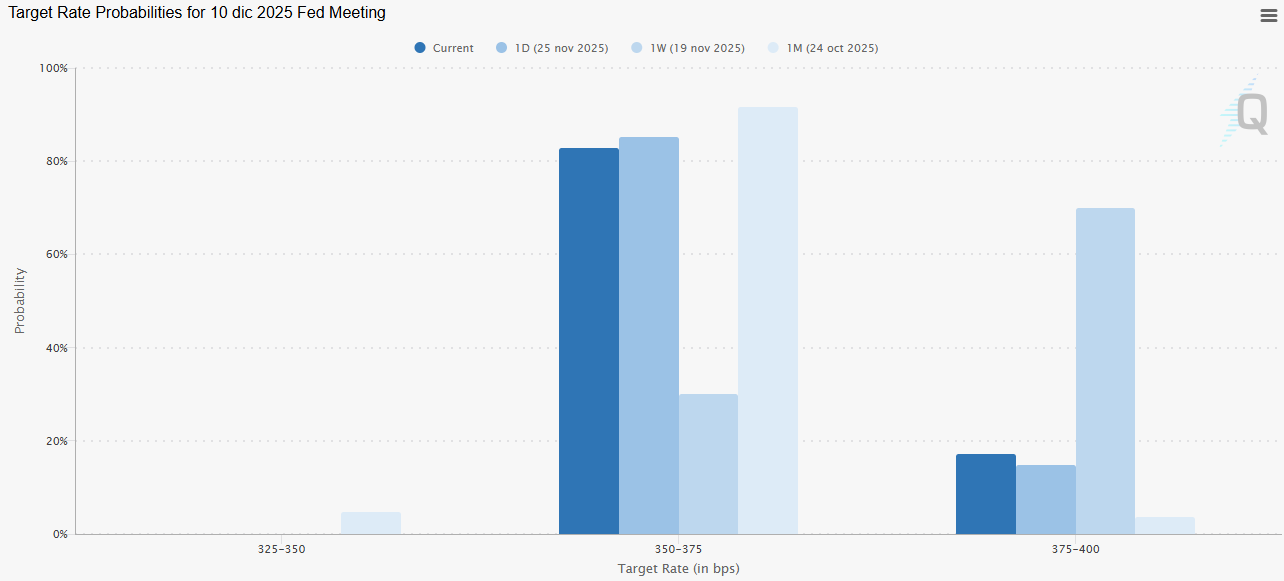
The past few weeks have been especially relevant for U.S. dollar fluctuations due to the constant shifts in expectations about what the Federal Reserve may decide in its final December meeting. This change is clearly reflected in the CME Group probability table, where a month ago the probability of a 0.25% rate cut exceeded 91%, last week it fell to 30%, and this week it has risen again to 80%. These movements show a marked indecision, driven by speculation regarding how the central bank is interpreting the economic data recently published for September in the United States.
Source: CMEGROUP
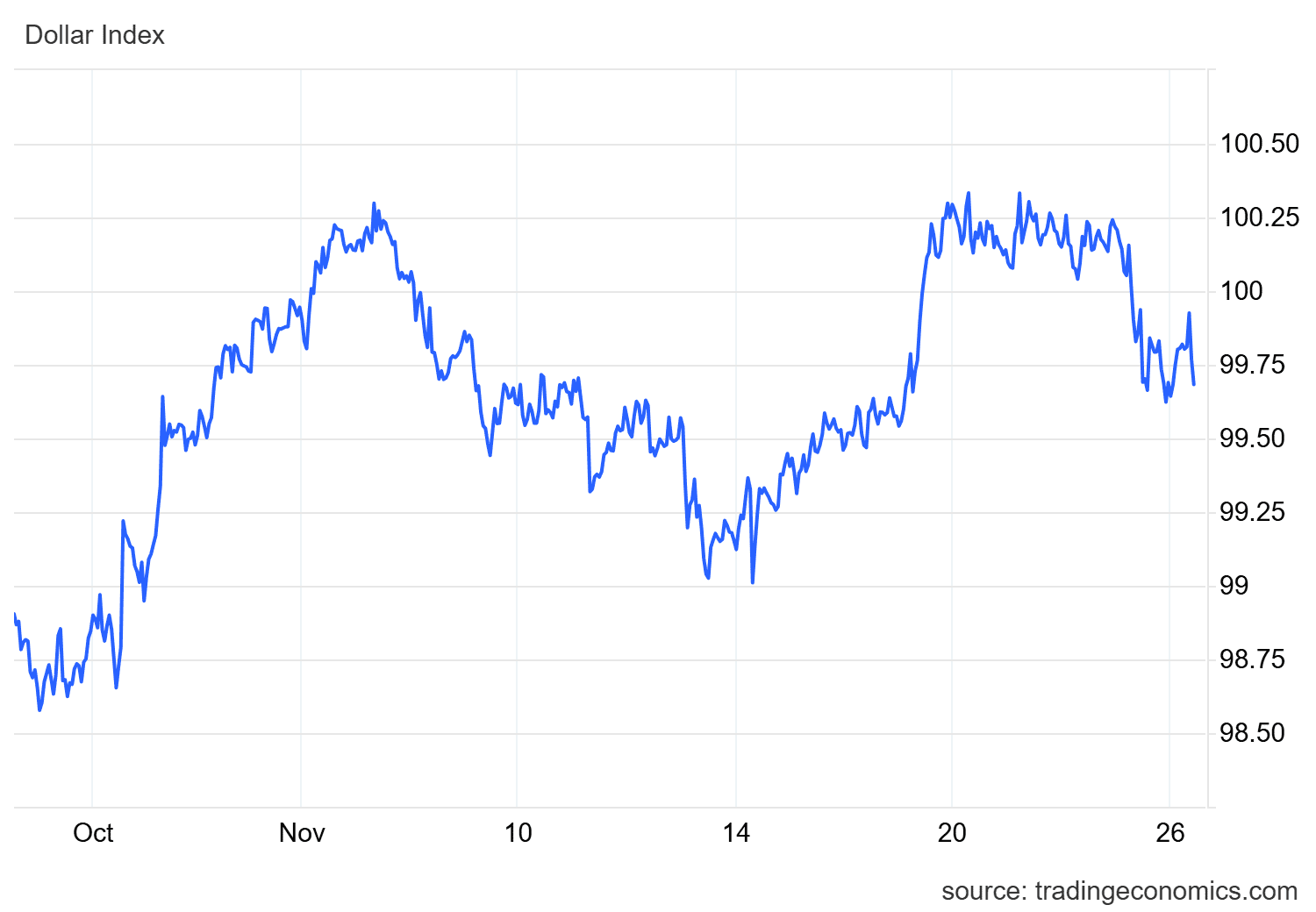
This uncertainty is also reflected in 10-year U.S. Treasury bonds, whose yield recently rose to 4.2%, but has since returned to the neutral area near 4.00%. When bonds offer less interest, demand for U.S. fixed income declines, which shifts confidence away from the dollar. This is clearly visible in the behavior of the DXY index, which just weeks ago remained above 100 points, but has now fallen toward 99.70, showing a short-term structural weakness in the U.S. dollar.
Fuente: TradingEconomics
Altogether, this uncertainty surrounding the Fed’s direction has limited short-term demand for U.S. dollars and allowed the Canadian dollar to gain ground. If this weakness in the U.S. dollar persists, it could lead to more consistent selling pressure on USD/CAD in upcoming sessions.
What Can Be Expected from the Bank of Canada?
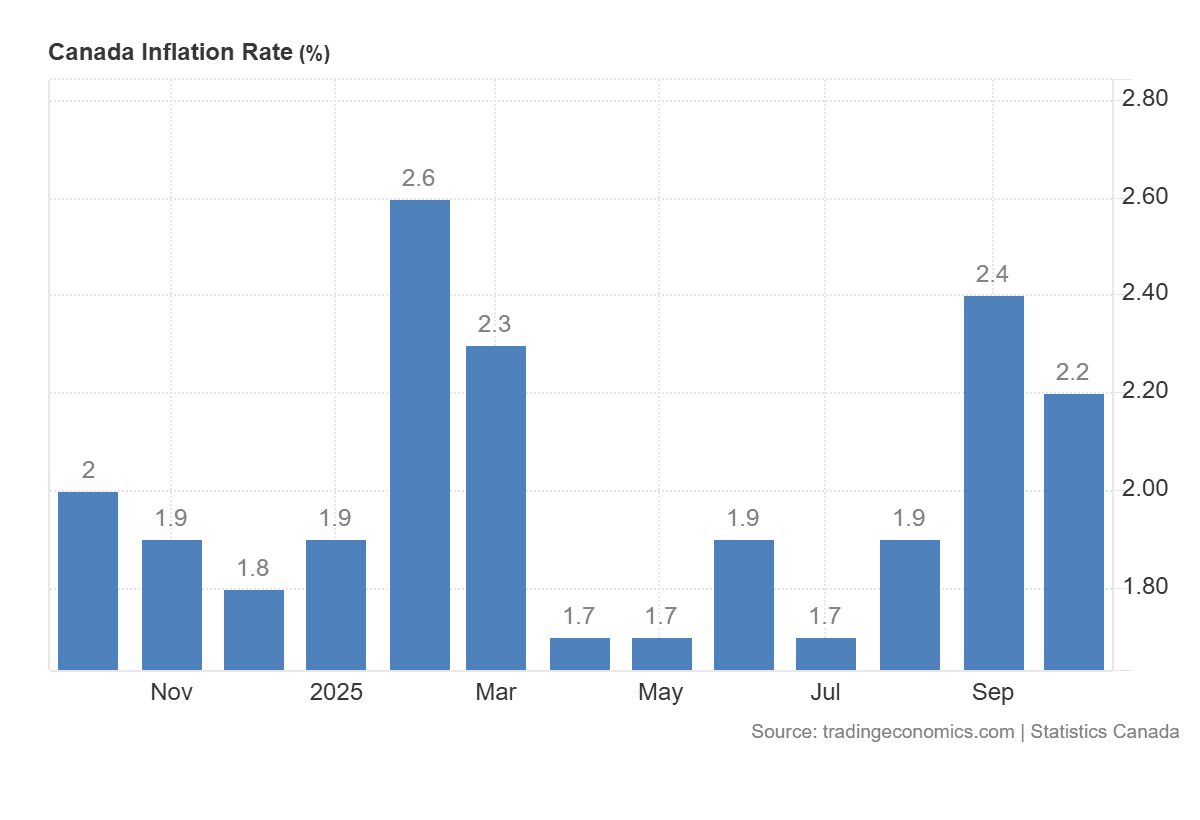
The general outlook of the Bank of Canada during the second half of 2025 has clearly focused on lowering the interest rate progressively. Since August, when the rate was at 2.75%, cuts have continued until reaching the current 2.25%, reflecting that in the short term the bank’s stance remains tilted toward lower rates. For its final decision of the year, scheduled for December 10, a new 0.25% cut is expected, mainly because recent data shows a slowdown in inflation. After peaking at 2.4% in September, inflation dropped to 2.2% in October, moving again toward the Bank of Canada’s 2.00% target.
Source: TradingEconomics
Given this, the decline in inflation reinforces the idea that the bank may continue cutting rates to counteract economic slowdown. However, a crucial point will be whether the Bank of Canada plans to maintain this easing cycle into 2026, since its current rate is lower than that of the United States. A wider rate differential in favor of the USD could restore dollar strength and generate dominant buying pressure on USD/CAD, especially if the Canadian central bank adopts a more aggressive tone in the coming months.
USD/CAD Technical Forecast

Source: StoneX, Tradingview
- Uptrend remains relevant: Despite the recent bearish corrections, USD/CAD has managed to maintain a solid upward trendline since approximately July 25, dominating much of the market movement in the second half of the year. However, as the price approaches a consistent resistance area, a more marked neutrality has emerged, which could open the door to short-term bearish corrections.
- RSI: The RSI shows a downward slope approaching the neutral level of 50, suggesting a balance between buying and selling momentum. If this continues, a period of indecision may consolidate in the next sessions.
- MACD: A similar scenario is seen in the MACD, whose histogram remains oscillating around the zero line, indicating neutrality in the strength of short-term moving averages and supporting the possibility of continued indecision in USD/CAD.
Key levels:
- 1.41174 – Major resistance: Corresponds to recent highs and represents the most important bullish barrier to consider. If the price manages to surpass this level, it could reactivate a bullish bias and reinforce the upward trendline that still dominates the chart and could guide medium-term movements if strong buying pressure consolidates.
- 1.40017 – Nearby barrier: Zone of indecision, coinciding with the 50-period simple moving average and the 38.2% Fibonacci retracement. It may act as a technical barrier against eventual bearish corrections.
- 1.39090 – Key support: Level that coincides with the 200-period simple moving average. If the price falls back to this area, it could break the current upward trend and lead to a short-term sideways range.
Written by Julian Pineda, CFA, CMT – Market Analyst
Follow him on: @julianpineda25


The complete CFD trading experience
Award-winning platforms, competitive spreads, low commissions and dedicated support.
We live and breathe the markets and are dedicated to helping traders realise their ambitions as we continue to set the industry bar.
Economic calendar
Web Trader platform
Our sophisticated web-based platform is packed with features.
Related articles

USD/JPY weekly outlook: Quarter turn scrambles rates regime
USD/JPY’s tight relationship with front-end US rates broke down sharply last week, but quarter-turn flows and positioning suggest the disconnect may prove temporary.


USD/CAD forecast: rally could accelerate above June highs at 1.4250
USD/CAD recovered quickly after weaker US jobs data, keeping the bullish trend in focus. A move above the June highs could accelerate the rally as inflation keeps the Fed under pressure.


USD Sets Fresh Yearly High as EUR/USD Drops Dramatically, USD/JPY Stable
Well, it was a week of USD strength that wasn’t entirely pushed by USD/JPY, as a strong sell-off in EUR/USD has pushed the major pair to its most oversold state in a decade.
StoneX Europe Ltd may make third party material available on this website which may contain information included but not limited to the conditions of financial markets. The material is for information purposes only and does not contain, and should not be construed as containing, investment advice and/or investment recommendation and/or an investment research and/or an offer of or solicitation for any transactions in financial instruments; any decision to enter into a specific transaction shall be made by the client following an assessment by him/her of their situation.
StoneX Europe Ltd makes no representation or warranty and assumes no liability as to the accuracy or completeness of the information provided, nor any loss arising from any investment based on a recommendation, forecast or other information supplied. You should always seek independent advice as to your suitability to speculate in any related markets and your ability to assume the associated risks, if you are at all unsure. We are not under any obligation to update any such material. Any opinion made may be personal to the author and may not reflect the opinion of StoneX Europe Ltd.