



Currency Pair of the Week EURUSD
Will this run continue or is it time for a correction?
Share this:

The EUR/USD has had quite a run over the last few weeks, trading from a low of 1.0800 on May 18th to a high of 1.1385 on Friday. Will this run continue or is it time for a correction?
Last week, stimulus continued in Europe as the ECB increased PEPP by 600 billion Euros and said they would extend the program through 2021 and would reinvest the maturing principal until the end of 2022. In addition, Germany agreed they would add in another 130 billion Euros to their stimulus funding. Also, 2 weeks ago, the EU proposed additional and revised language to the France/Germany proposal, which included 500 billion Euros in grants and 240 billion Euros in loans. With huge supply of funds, logic would suggest that the Euro should be lower.
The economic data has not been kind to the Euro either. Just looking at Germany alone, one may expect the Euro to be lower. Germany reported a 26% drop in April factory orders on Friday (EUR/USD did actually trade lower that day.) And as recently as today, industrial output was worse than expected, coming in at -17.9% vs -16.8% expected. In addition, UK/EU Brexit talks have stalled, which is also not supportive for the Euro.
However, there is one caveat that has been overlooked so far here, and it is that of the tremendous weakness of the US Dollar! As we discussed in the chart of the week in the week ahead report, the US Dollar Index and the S&P 500 have a -.94 correlation coefficient, meaning that the DXY and the S&P 500 trade inversely with each other 94% of the time! As the Euro makes up a majority of the DXY index, it makes sense that the Euro would also trade in the opposite direction of the DXY. Therefore, stocks and EUR/USD have a high positive correlation and trade together a majority of the time. So, as the S&P 500 goes, so does EUR/USD.
In addition, the Fed meets on Wednesday. As with all central bank meetings lately, the key to determining if the EUR/USD continues its move higher will be to see if the Fed is still in extreme dovish mode. Remember, the ECB is already in negative rate territory while the Fed has rates at 0%. So, who has more room to lower rates if needed? The Fed. And if the Fed goes negative, the US Dollar will weaken, and EUR/USD bid will continue.
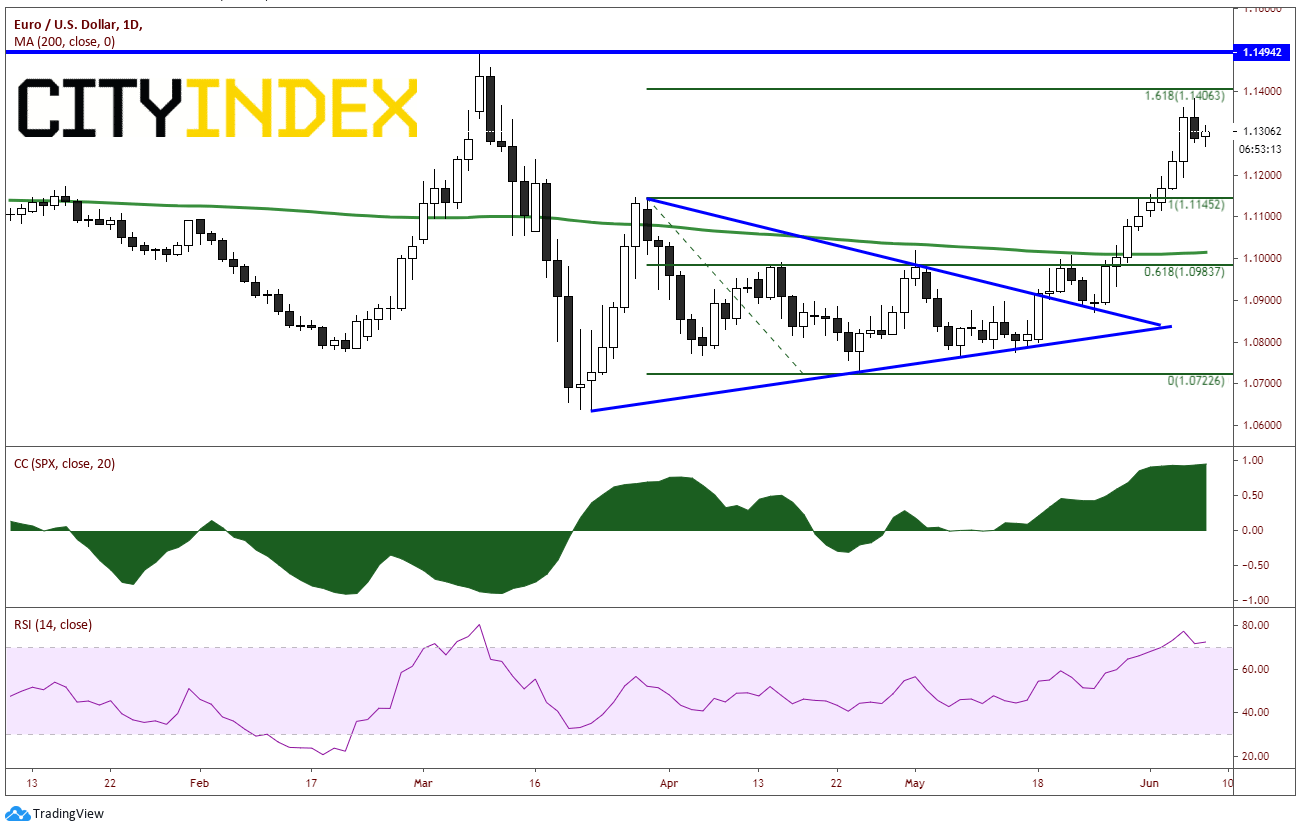
Technically, we can see on the daily EUR/USD chart below that the correlation coefficient between the EUR/USD and the S&P 500 is indeed high, at +.96. Price traded out of the symmetrical triangle and moved aggressively towards the 161.8% Fibonacci extension from the highs on March 30th to the lows of April 24th, near 1.1400. The RSI turned lower on Friday, however, still remains in overbought territory. There may be some profit taking or unwind from the trade ahead of the FOMC meeting on Wednesday.
Source: Tradingiew, City Index
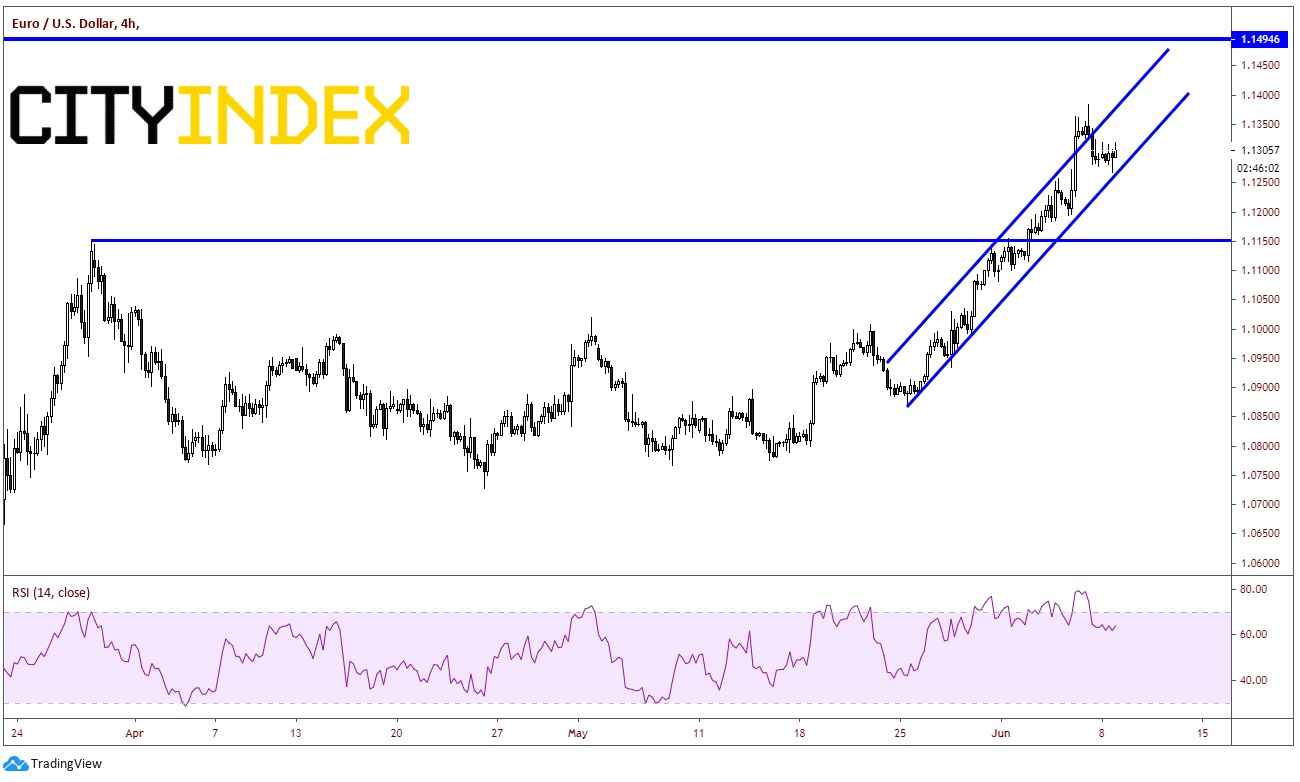
On a 4-hour timeframe, EUR/USD has been in a strong upward channel since May 25th. Last week, the pair had a false breakout above the top of the channel and traded back into it. First support is at the bottom of the channel near 1.1300. If price breaks below the channel, the next support is horizontal support near 1.1150, where buyers may be aggressive to buy the dip. If price moves higher, initial resistance is Friday’s highs near 1.1400 and then the highs from early March near 1.1495.
Source: Tradingiew, City Index
The next move in EUR/USD will depend on one of two things: 1) Stocks: with such a high correlation at the moment, if stocks turn lower, EUR/USD is likely to follow 2) The Fed Interest Rate Decision on Wednesday: depending on the degree of dovishness, it could affect the US Dollar, which is turn will affect the Euro. In addition, watch for potential profit taking ahead of the FOMC meeting on Wednesday!
The EUR/USD has had quite a run over the last few weeks, trading from a low of 1.0800 on May 18th to a high of 1.1385 on Friday. Will this run continue or is it time for a correction?
Last week, stimulus continued in Europe as the ECB increased PEPP by 600 billion Euros and said they would extend the program through 2021 and would reinvest the maturing principal until the end of 2022. In addition, Germany agreed they would add in another 130 billion Euros to their stimulus funding. Also, 2 weeks ago, the EU proposed additional and revised language to the France/Germany proposal, which included 500 billion Euros in grants and 240 billion Euros in loans. With huge supply of funds, logic would suggest that the Euro should be lower.
The economic data has not been kind to the Euro either. Just looking at Germany alone, one may expect the Euro to be lower. Germany reported a 26% drop in April factory orders on Friday (EUR/USD did actually trade lower that day.) And as recently as today, industrial output was worse than expected, coming in at -17.9% vs -16.8% expected. In addition, UK/EU Brexit talks have stalled, which is also not supportive for the Euro.
However, there is one caveat that has been overlooked so far here, and it is that of the tremendous weakness of the US Dollar! As we discussed in the chart of the week in the week ahead report, the US Dollar Index and the S&P 500 have a -.94 correlation coefficient, meaning that the DXY and the S&P 500 trade inversely with each other 94% of the time! As the Euro makes up a majority of the DXY index, it makes sense that the Euro would also trade in the opposite direction of the DXY. Therefore, stocks and EUR/USD have a high positive correlation and trade together a majority of the time. So, as the S&P 500 goes, so does EUR/USD.
In addition, the Fed meets on Wednesday. As with all central bank meetings lately, the key to determining if the EUR/USD continues its move higher will be to see if the Fed is still in extreme dovish mode. Remember, the ECB is already in negative rate territory while the Fed has rates at 0%. So, who has more room to lower rates if needed? The Fed. And if the Fed goes negative, the US Dollar will weaken, and EUR/USD bid will continue.
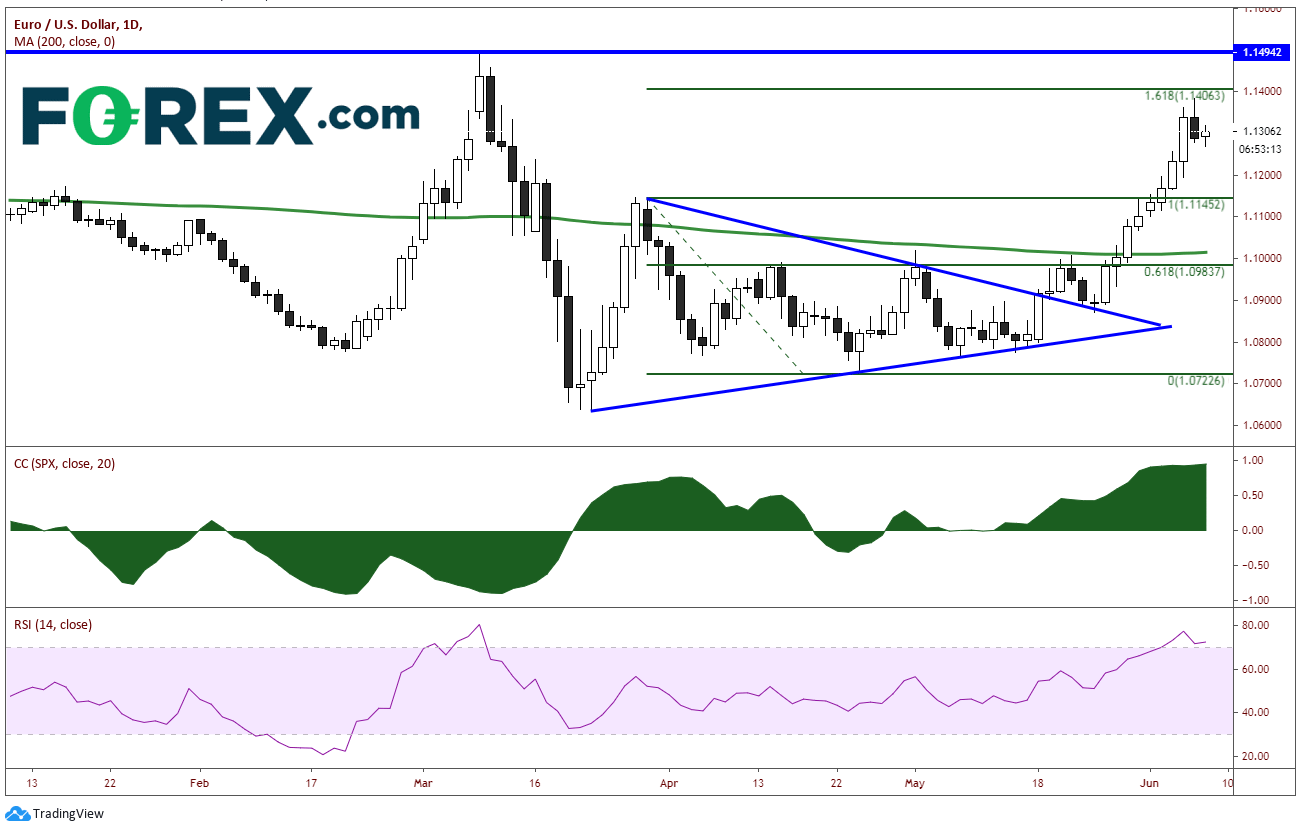
Technically, we can see on the daily EUR/USD chart below that the correlation coefficient between the EUR/USD and the S&P 500 is indeed high, at +.96. Price traded out of the symmetrical triangle and moved aggressively towards the 161.8% Fibonacci extension from the highs on March 30th to the lows of April 24th, near 1.1400. The RSI turned lower on Friday, however, still remains in overbought territory. There may be some profit taking or unwind from the trade ahead of the FOMC meeting on Wednesday.
Source: Tradingiew, Forex.com
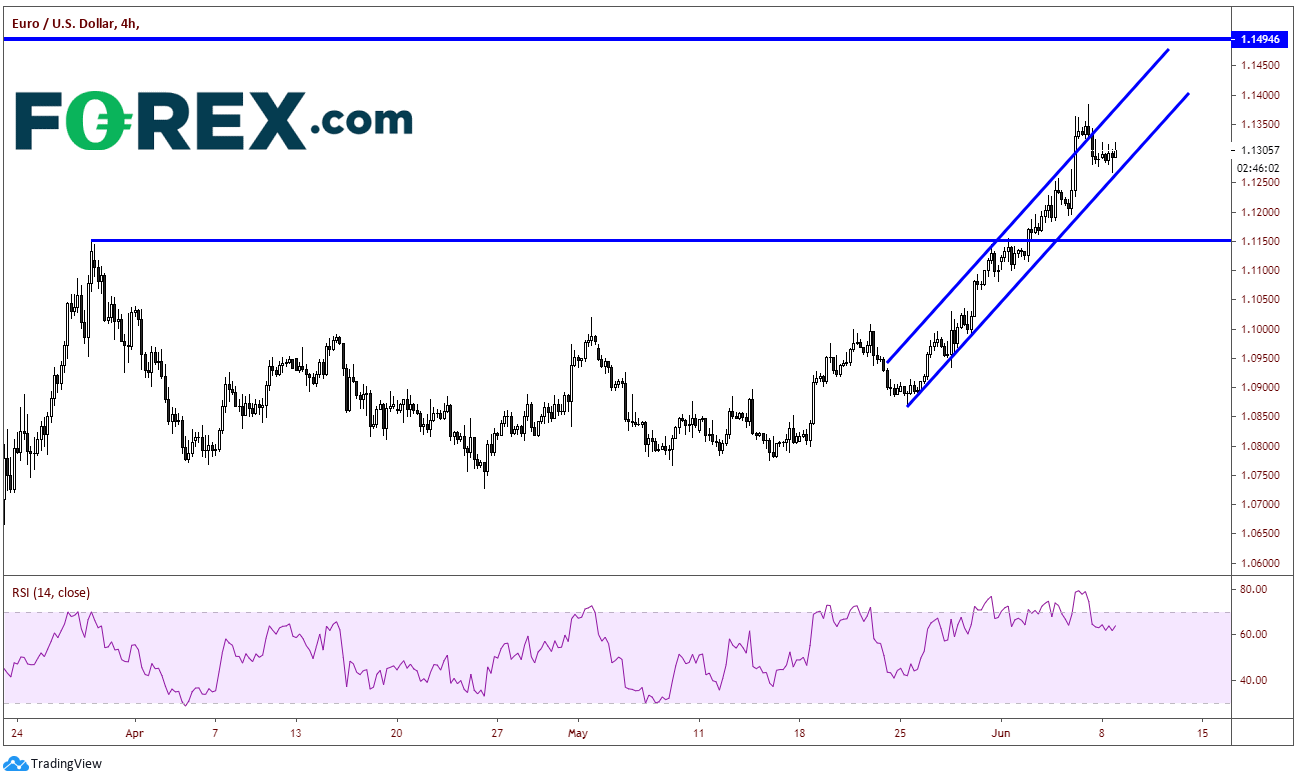
On a 4-hour timeframe, EUR/USD has been in a strong upward channel since May 25th. Last week, the pair had a false breakout above the top of the channel and traded back into it. First support is at the bottom of the channel near 1.1300. If price breaks below the channel, the next support is horizontal support near 1.1150, where buyers may be aggressive to buy the dip. If price moves higher, initial resistance is Friday’s highs near 1.1400 and then the highs from early March near 1.1495.
Source: Tradingiew, Forex.com
The next move in EUR/USD will depend on one of two things: 1) Stocks: with such a high correlation at the moment, if stocks turn lower, EUR/USD is likely to follow 2) The Fed Interest Rate Decision on Wednesday: depending on the degree of dovishness, it could affect the US Dollar, which is turn will affect the Euro. In addition, watch for potential profit taking ahead of the FOMC meeting on Wednesday!
Related tags:
Latest market news




The complete CFD trading experience
Award-winning platforms, competitive spreads, low commissions and dedicated support.
We live and breathe the markets and are dedicated to helping traders realise their ambitions as we continue to set the industry bar.
Economic calendar
Web Trader platform
Our sophisticated web-based platform is packed with features.
Related articles
Swiss Franc Short-term Outlook: USD/CHF Selloff Nears Critical Support Ahead of NFP 11 4 2026
USD/CHF bears are closing in on critical trend support, with the next reaction likely to determine whether the October decline has further to run.

USD/CAD Forecast: Canadian Dollar Gains Ground After U.S. Midterm Elections
The trading week continues to unfold and the recovery in the Canadian dollar has once again become a relevant theme in the short term. This can be clearly seen in the recent performance of USD/CAD, which is down nearly 0.4% during the session, reflecting a consistent recovery in the CAD against the U.S. dollar.


Euro Technical Outlook: EUR/USD Support Reversal Sets Up Breakout Test Ahead of NFP 11 4 2026
Euro bulls are attempting to build on the rebound from recent lows, but pivotal resistance still stands in the way of a larger EUR/USD recovery.
StoneX Europe Ltd may make third party material available on this website which may contain information included but not limited to the conditions of financial markets. The material is for information purposes only and does not contain, and should not be construed as containing, investment advice and/or investment recommendation and/or an investment research and/or an offer of or solicitation for any transactions in financial instruments; any decision to enter into a specific transaction shall be made by the client following an assessment by him/her of their situation.
StoneX Europe Ltd makes no representation or warranty and assumes no liability as to the accuracy or completeness of the information provided, nor any loss arising from any investment based on a recommendation, forecast or other information supplied. You should always seek independent advice as to your suitability to speculate in any related markets and your ability to assume the associated risks, if you are at all unsure. We are not under any obligation to update any such material. Any opinion made may be personal to the author and may not reflect the opinion of StoneX Europe Ltd.