



Marktbrief: DAX Slides as Oil Stays Above $100 and Risk‑Off Deepens
Markets remain dominated by geopolitics and energy shocks as oil holds above $100 amid escalating Iran conflict risks and disruption around the Strait of Hormuz. Emergency reserve releases have failed to calm supply fears, pushing inflation risks higher, delaying rate cuts and supporting the USD. Equities stay defensive, with the DAX under pressure near key technical support as volatility remains elevated.
Share this:

1. Geopolitics + Energy Shock Remain Dominant
The Iran conflict continues to overwhelm macro data, keeping markets volatile and risk‑averse.
Oil prices remain above $100/bbl, driven by threats to shipping through the Strait of Hormuz, drone attacks on regional energy assets, and repeated warnings from Iran that it may escalate against energy infrastructure in the region.
Emergency stock releases (IEA, SPR) are seen as slow and insufficient to offset near‑term physical disruptions.
2. Iran Conflict: Escalation, Wider Involvement Risk
The US allegedly struck all military targets on Kharg Island (Iran’s key oil export hub) but left oil infrastructure intact—for now. Trump warned this could change if shipping is disrupted.
Trump claimed Iran’s military capability is “100% destroyed” and said negotiations are not yet viable; Pentagon estimates the war could last 4–6 weeks.
The US is pushing for a multinational coalition to escort ships through Hormuz, calling on NATO members and China to participate; refusal could strain alliances. South Korea, Australia, Japan already declined until now. German Foreign Minister Johann Wadephul says “I don’t see that NATO has made any decision in this direction or could assume responsibility for the Strait of Hormuz. If that were the case, then the NATO bodies would address it accordingly,”
Iran threatened retaliation against US banks and companies in the Gulf if its energy assets are hit and warned residents in Dubai and Doha of potential attacks.
Drone attacks disrupted operations in Dubai airport, Saudi Arabia, Iraq and Fujairah, temporarily halting some of the biggest airport connection terminals.
3. Global Equities: Defensive Bias Persists
US equities fell again, with Energy, Utilities and Staples outperforming while Tech, Materials and Communication Services lagged.
S&P 500 −0.6%, Nasdaq −0.6%, Dow −0.3%.
Currently US Index futures are mainly in the green between 0.40% - 0.74%
Macro data was secondary:
Q4 GDP revised sharply lower (0.7% vs 1.4%).
PCE broadly in line, JOLTS showed resilience but with signs of AI‑related disruption.
Asia weaker: Japan hit by energy uncertainty despite emergency oil releases; China/HK mixed as investors balanced strong data with geopolitical and trade risks.
Europe opened uneventfully with losses around -0.05% to -0.35%, due to a remaining fragile sentiment given energy costs and trade uncertainty.
4. Inflation & Monetary Policy: Cuts Still Pushed to Q4
US core PCE rose to 3.1% YoY, further away from the Fed’s 2% target.
Markets still price the first Fed rate cut only in Q4, as inflation data has not yet reflected the full energy shock.
Consumer sentiment (University of Michigan) softened, but not enough to shift policy expectations.
We are awaiting US Industrial production for February later in the day to get an insight on industrial production.
Big week for Central bank focus this week: Fed, BoJ, RBA, BoE, ECB, with oil‑driven inflation risks the key variable.
5. Fixed Income & FX
Bond markets stabilised after last week’s selloff, but remain vulnerable to further oil upside.
USD remains firm, supported by haven demand and reduced rate‑cut expectations.
JPY volatile, with Japan and South Korea reiterating readiness to act against excessive FX moves.
EUR and GBP rebounded modestly as the dollar paused, but remain pressured by growth and energy risks.
6. Commodities Beyond Oil
Oil highly volatile, swinging around $100/bbl as headlines alternate between military escalation and shipping coordination talks. Tug of war between Iran and the USA amplify the volatility.
Gold directionless around $5,000/oz: geopolitics supportive, but higher yields and USD cap upside.
Copper subdued, reflecting cautious risk appetite despite strong Chinese activity data.
Bitcoin strengthened toward $74k, benefiting from volatility and liquidity dynamics.
7. China: Strong Data, Export‑Led Momentum
China surprised positively:
Industrial production +6.3% YoY
Retail sales +2.8% YoY
Fixed asset investment +1.8% YTD
Earlier export data (+21.8% YoY) confirms export‑led growth, supported by semiconductors, autos, ships and high‑end industrial goods.
Despite strong momentum, authorities acknowledge external uncertainties such as energy price volatility and ongoing pressure on the housing market.
8. Trade Policy: Rising Structural Risk
The US is considering new Section 301 tariffs against China, the EU, Japan and others, citing structural overcapacity and unfair state practices.
Legal challenges to the use of emergency tariff powers raise the risk of refunds and policy uncertainty.
US–China talks in Paris were described as constructive, but tensions remain around rare earths, aircraft purchases and forced‑labour investigations.
9. Financial System & Corporate Signals
Large private credit vehicles (Morgan Stanley, BlackRock, Blue Owl) saw withdrawals or redemption limits, signalling pockets of liquidity stress.
JPMorgan reportedly restricting lending tied to software companies, hinting at tighter credit conditions.
Earnings focus this week includes Accenture, Micron, General Mills, and major European corporates.
10. Bottom Line
Energy and geopolitics remain the single most important drivers of markets.
Inflation risks are skewed upward, pushing rate cuts further out and favouring the USD.
Equity leadership remains defensive, while trade policy and liquidity concerns add a second layer of risk.
Until clarity emerges on Hormuz security and the duration of the Iran conflict, volatility is likely to stay elevated.
11. DAX – Technical Analysis
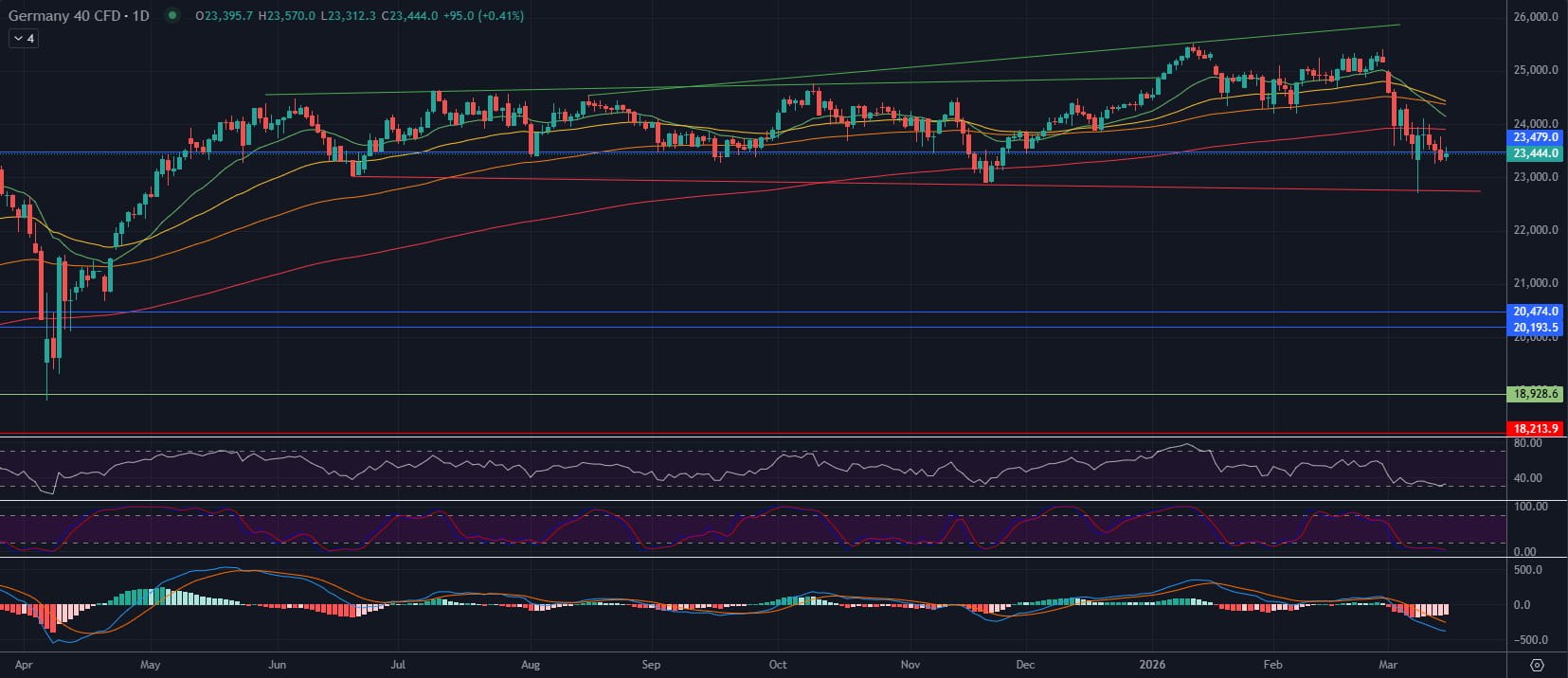
The Germany 40 has broken down from the upper consolidation zone and is now trading below the 50‑day and 100‑day moving averages, signaling a clear loss of bullish momentum. Price is testing the key support area around 23,400–23,500, which also aligns closely with the 200‑day SMA. This level is technically critical, as it has acted as a medium‑term pivot multiple times over the past year. A sustained hold above it could allow the index to stabilize, while a decisive daily close below would likely expose further downside toward 22,800 and potentially 21,900.
Momentum indicators remain bearish. MACD is firmly negative and still trending lower, confirming downside dominance, while RSI sits below 40, reflecting persistent selling pressure without yet reaching extreme oversold conditions. Stochastics is weak and struggling to turn higher, suggesting limited short‑term recovery strength. Overall, the daily trend has shifted bearish, and only a recovery back above 24,000–24,200 would signal stabilization; until then, rallies are likely to face selling pressure.
-Philip Papageorgiou – Markt Analyst
--X ex Twitter: PhilipForexCom


The complete CFD trading experience
Award-winning platforms, competitive spreads, low commissions and dedicated support.
We live and breathe the markets and are dedicated to helping traders realise their ambitions as we continue to set the industry bar.
Economic calendar
Web Trader platform
Our sophisticated web-based platform is packed with features.
Related articles

Gold Price Forecast: XAU/USD Rebounds as Bulls Defend Critical Support 10 10 2026
Gold has bounced from a major inflection zone, but bulls still need follow-through as next week’s CPI report puts the recovery to the test.


USD/JPY weekly outlook: US inflation threatens to break the stalemate
USD/JPY has barely budged in October, with the price trapped between key moving averages. Could US inflation finally deliver the catalyst needed to break the stalemate?


Australian Dollar Short-term Outlook: AUD/USD Rebound Challenges September Downtrend 10 9 2026
Aussie is pressing a key trend barrier after rebounding from support, with next week’s CPI report poised to test the recovery.
StoneX Europe Ltd may make third party material available on this website which may contain information included but not limited to the conditions of financial markets. The material is for information purposes only and does not contain, and should not be construed as containing, investment advice and/or investment recommendation and/or an investment research and/or an offer of or solicitation for any transactions in financial instruments; any decision to enter into a specific transaction shall be made by the client following an assessment by him/her of their situation.
StoneX Europe Ltd makes no representation or warranty and assumes no liability as to the accuracy or completeness of the information provided, nor any loss arising from any investment based on a recommendation, forecast or other information supplied. You should always seek independent advice as to your suitability to speculate in any related markets and your ability to assume the associated risks, if you are at all unsure. We are not under any obligation to update any such material. Any opinion made may be personal to the author and may not reflect the opinion of StoneX Europe Ltd.