



EUR/USD breakout puts dollar pressure valve in focus
A $40 trillion debt pile, rising interest costs and a more interventionist Treasury are giving dollar bears something to think about. EUR/USD sits at the centre of that debate.
Share this:
- Larger Treasury buybacks hint at yield suppression
- US fiscal pressure building beneath the surface
- Relative yields differentials remain key for dollar
- EUR/USD technicals favour bullish bias
If the dollar debasement narrative is going to show up anywhere in the FX universe, you’d imagine the euro would be the obvious place. It carries the largest weighting in the US Dollar Index, giving EUR/USD outsized influence as a gauge of broader dollar sentiment.
Signal matters more than the size
The dollar was absolutely hammered on Wednesday as the US Treasury stepped in to support the long end of the bond market, announcing it will double planned buyback sizes for 10 to 30-year debt to at least $4 billion per operation. While the increase is slated to run through to early November, the final line of the statement hints it may be extended, or even increased, further.
On its own, the increase in buybacks is little more than a rounding error relative to the sheer size of the US public debt pool, and even that’s being generous. But the size of the intervention is arguably less important than the signal it sends.
Source: US Treasury, FOREX.com
More debt, more interest, more pressure
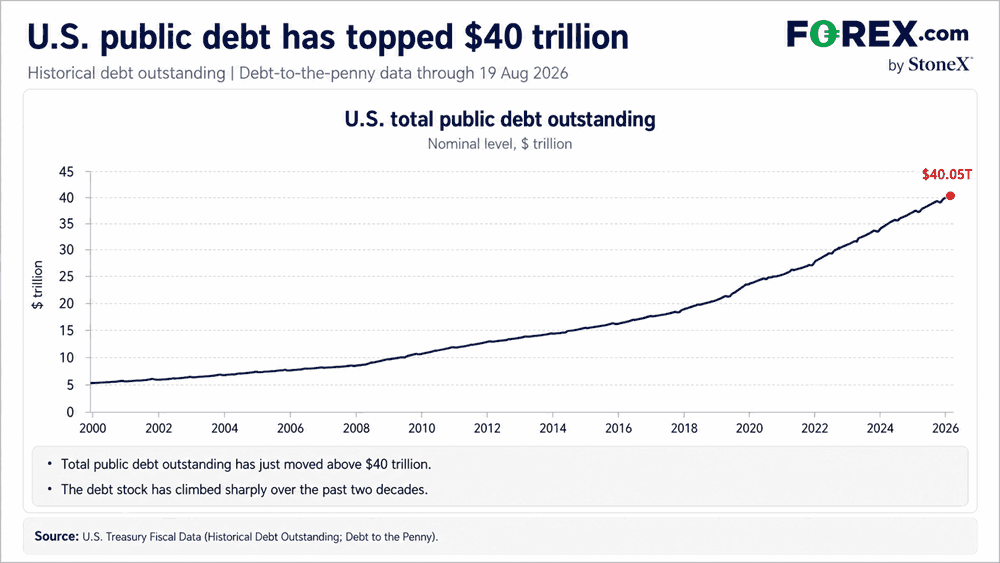
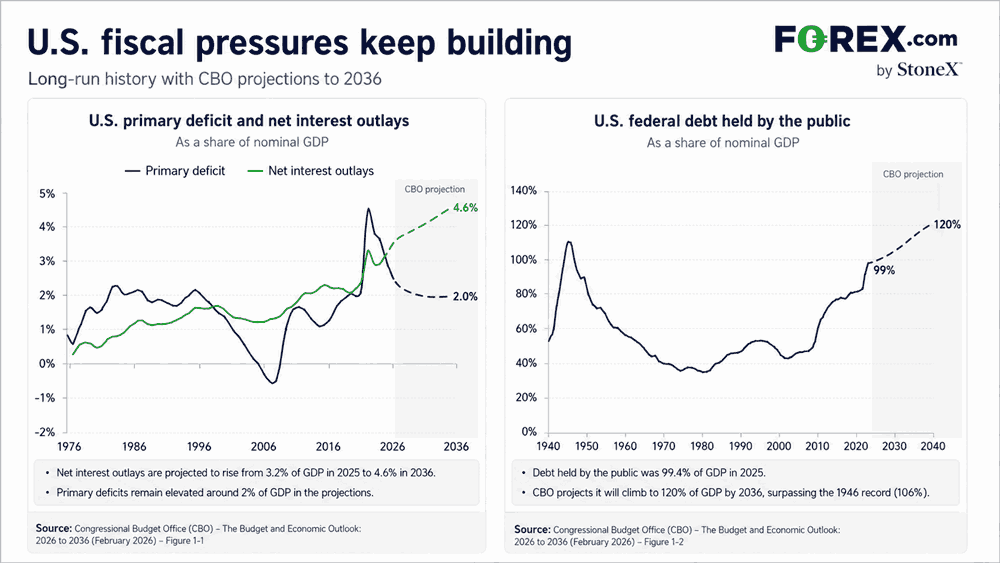
US public debt has now topped $40 trillion, debt held by the public is around 100% of GDP, primary deficits remain large and net interest costs continue to climb. Put simply, the amount of debt the private sector is being asked to absorb keeps on increasing.
Source: CBO, FOREX.com
Left to market forces, that should require greater compensation to attract capital, particularly further out the curve where uncertainty is greatest. Yields must rise until sufficient capital is attracted to absorb the supply.
But if Treasury continually intervenes to counter that adjustment by supporting longer-dated bond prices and limiting the rise in yields, it does not make the underlying borrowing requirement disappear. It simply restricts one of the prices through which the adjustment can occur.
That’s where the dollar comes in.
When bond pressure spills into FX
If the supply of US debt keeps growing while the yield available to compensate investors is prevented from rising as much as it otherwise would, the attractiveness of US assets deteriorates. Some of the adjustment can therefore arrive through a weaker currency instead.
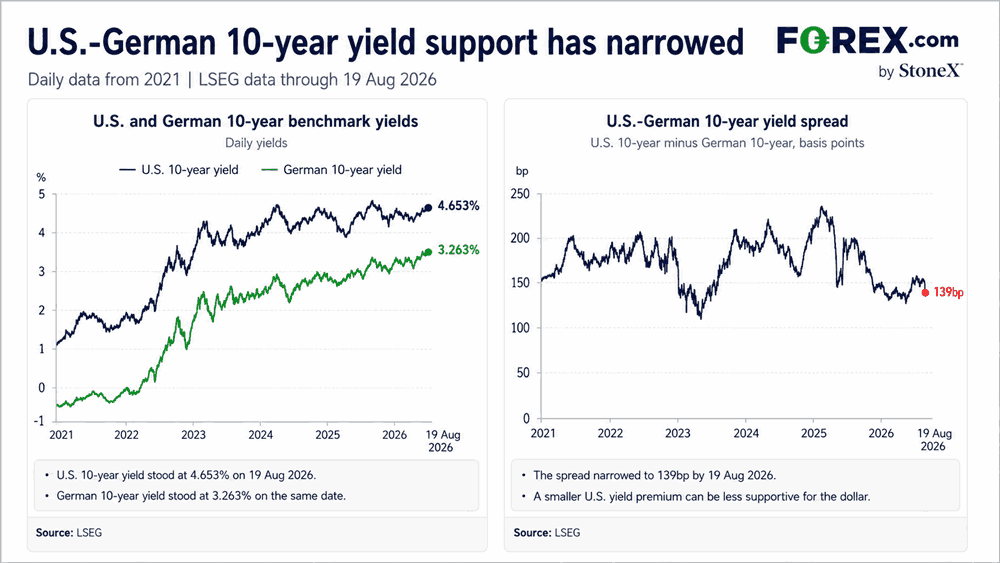
The US still offers a sizeable yield premium over Germany, but the 10-year spread has narrowed to 139 basis points. If that relative advantage continues to shrink while Treasury becomes more interventionist at the long end, it provides a mechanism where pressure can migrate from bonds into the dollar, and quickly.
Source: LSEG, FOREX.com
That does not mean the debasement trade is suddenly back in full force. But if Treasury turns tinkering into a tsunami of interventionist operations in an attempt to quash yields and offset the consequences of an unsustainable fiscal trajectory, you can understand why investors may start looking at the big dollar as the pressure valve.
I’m not saying we’re at that point yet, but it’s not difficult to see the risk.
And if that pressure begins to materialise, EUR/USD is likely to be one of the places where it shows up given the sheer depth of euro-denominated capital markets.
First reaction not the final word
The broader debasement argument is a longer-term risk rather than the immediate trading question. But in the nearer term, the focus is whether the initial market reaction to the buyback announcement can be sustained.
Long-dated yields reversed, with short covering in the latter likely amplifying the move, but that does not guarantee longer-lasting success and, on its own, is unlikely to change the broader trend.
As such, there is a risk that at least some of Wednesday’s move is reversed in the near term. But to keep that fundamental view in check, the technical picture provides the guardrails.
Chase the breakout or fade the move?
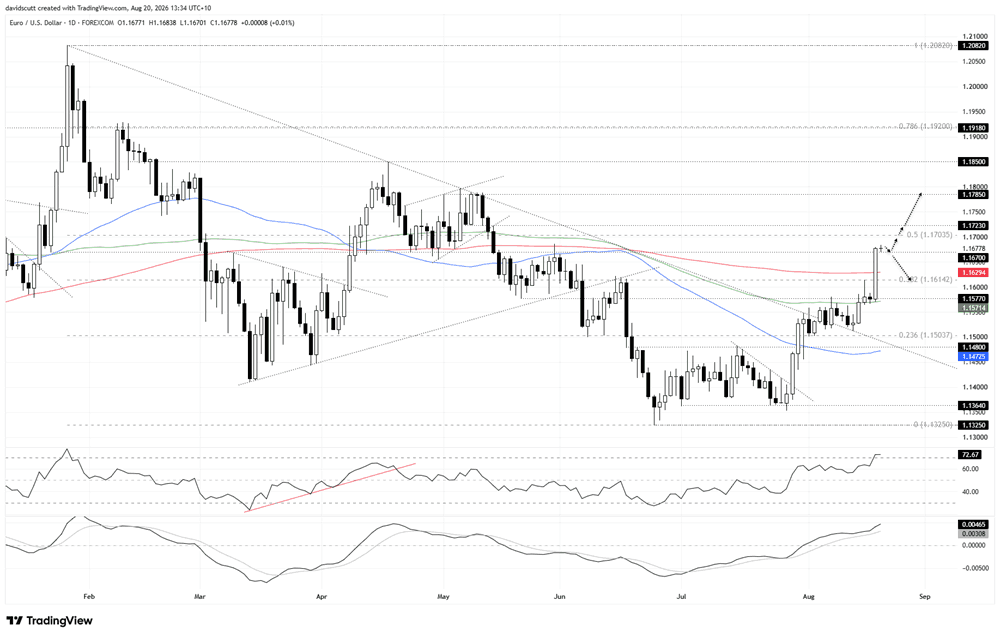
Source: TradingView
EUR/USD was among the top performers following the Treasury announcement, surging back above the 200-day moving average for the first time since May. The move eventually stalled just above 1.1670, a level that has acted as both support and resistance for lengthy periods over the course of this year.
Given the history of the level, it looms as the one to watch today when assessing whether to chase the move or position for a reversal.
From a directional perspective, the message from the oscillators is bullish. RSI (14) continues to set higher highs and has just ticked into overbought territory around 73, suggesting some risk of a short-term reversal. Even so, MACD continues to provide a complementary signal, diverging away from the signal line while holding in positive territory.
Overall, both indicators favour long setups over shorts.
Overhead, there are a number of minor levels to consider, including the 50% retracement of the January to June bear move, along with 1.1723, which may now flip to offering resistance having acted previously as support. Realistically though, bulls looking for an extension of Wednesday’s breakout would likely have 1.1785 in mind, a level that capped gains for a period back in April and May, followed by 1.1850 and the 78.6% retracement at 1.1920.
If reversal risks were to materialise and the pair moves back beneath 1.1670 and holds there, shorts could be considered with a stop above for protection, targeting the 200-day moving average, followed by the 38.2% Fib retracement at 1.1614.
Latest market news




The complete CFD trading experience
Award-winning platforms, competitive spreads, low commissions and dedicated support.
We live and breathe the markets and are dedicated to helping traders realise their ambitions as we continue to set the industry bar.
Economic calendar
Web Trader platform
Our sophisticated web-based platform is packed with features.
Related articles
Canadian Dollar Short-term Outlook: USD/CAD Five-Week Rally Hits a Wall at Major Resistance 10 14 2026
USD/CAD is holding near fresh yearly highs, but bearish divergence and a well-defined October range raise the stakes at major resistance.

EUR/USD Analysis: Euro Loses Ground After a Stronger-Than-Expected U.S. CPI Report
The trading week continues to unfold and weakness around the euro has once again become increasingly evident in the short term. This can be seen in the recent performance of EUR/USD, which has declined roughly 0.3% over the last three trading sessions, highlighting renewed strength in the U.S. dollar.

USD/JPY forecast: hot US CPI lifts the pair above its 200-day average
Hotter-than-expected US inflation has pushed USD/JPY above its 200-day moving average, putting 160 and the risk of Bank of Japan intervention back in focus. The breakout still needs to hold, and a failure could send the pair sharply lower.

StoneX Europe Ltd may make third party material available on this website which may contain information included but not limited to the conditions of financial markets. The material is for information purposes only and does not contain, and should not be construed as containing, investment advice and/or investment recommendation and/or an investment research and/or an offer of or solicitation for any transactions in financial instruments; any decision to enter into a specific transaction shall be made by the client following an assessment by him/her of their situation.
StoneX Europe Ltd makes no representation or warranty and assumes no liability as to the accuracy or completeness of the information provided, nor any loss arising from any investment based on a recommendation, forecast or other information supplied. You should always seek independent advice as to your suitability to speculate in any related markets and your ability to assume the associated risks, if you are at all unsure. We are not under any obligation to update any such material. Any opinion made may be personal to the author and may not reflect the opinion of StoneX Europe Ltd.