



EUR/USD Outlook: The dollar regains strength amid escalating geopolitical tensions
At the start of the week, EUR/USD has shown a significant decline, falling more than 1% in the short term, with price action clearly favoring the US dollar. The strong selling pressure emerging in the pair is mainly driven by the renewed escalation of geopolitical tensions in the Middle East.
Share this:

At the start of the week, EUR/USD has shown a significant decline, falling more than 1% in the short term, with price action clearly favoring the US dollar.
The strong selling pressure emerging in the pair is mainly driven by the renewed escalation of geopolitical tensions in the Middle East, which has generated consistent short-term demand for US dollars. As long as uncertainty and risk perception continue to favor safe-haven assets, selling pressure is likely to remain relevant for EUR/USD in the coming trading sessions.


New geopolitical tensions
Over the weekend, coordinated attacks by the United States and Israel against Iran were reported, including bombings in strategic areas of Tehran and other key locations. The conflict escalated to the point where official Iranian sources confirmed the death of the country’s supreme leader.
Iran responded quickly with retaliatory missile and drone attacks targeting positions in neighboring countries, primarily in Israeli territory and US military facilities.
This situation remains unresolved and has increased risk perception in international markets. One of the main concerns centers on the Strait of Hormuz, through which more than 20% of the world’s oil and natural gas is transported.
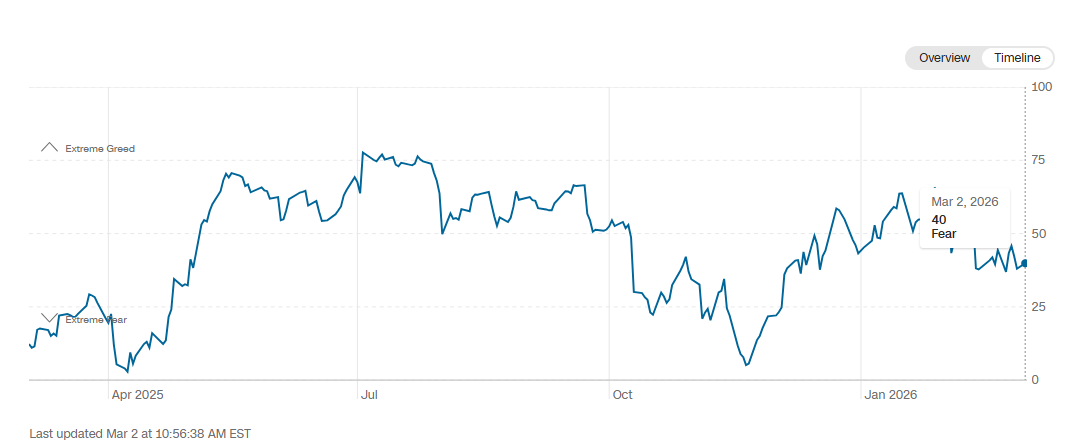
This uncertainty is now reflected in confidence indicators such as the Fear and Greed Index, which remains around 40 points, within the “fear” zone. The indicator shows a negative slope, highlighting that confidence is not recovering but rather that market uncertainty has been steadily increasing in recent sessions.
Source: CNN
This scenario has been particularly relevant for the fixed-income market. US Treasury bonds, considered safe-haven assets, have reacted to the rise in geopolitical risk. It is important to remember that these instruments are often among the primary references when markets seek capital preservation and stability during periods of heightened uncertainty.
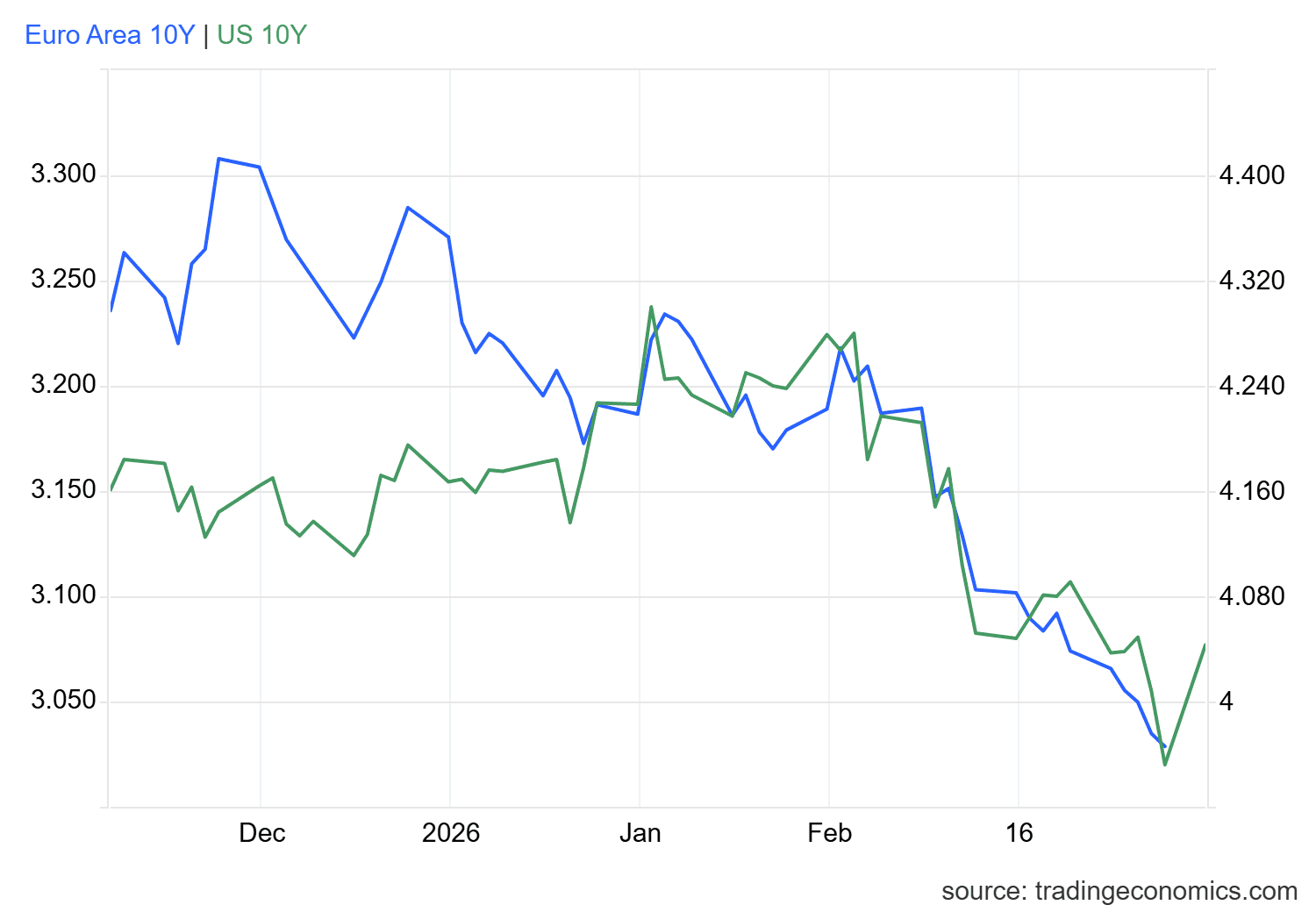
The yield on the 10-year US Treasury note, which was hovering near 3.94% last week, has regained momentum and is now trading above 4.00%. In contrast, 10-year European government bond yields remain below 3.00%, widening the rate differential and reinforcing the relative attractiveness of the US market.
Source: TradingEconomics
This move has supported short-term strength in the US dollar. Higher US bond yields can attract foreign capital seeking refuge or stability, strengthening demand for dollars relative to the euro.
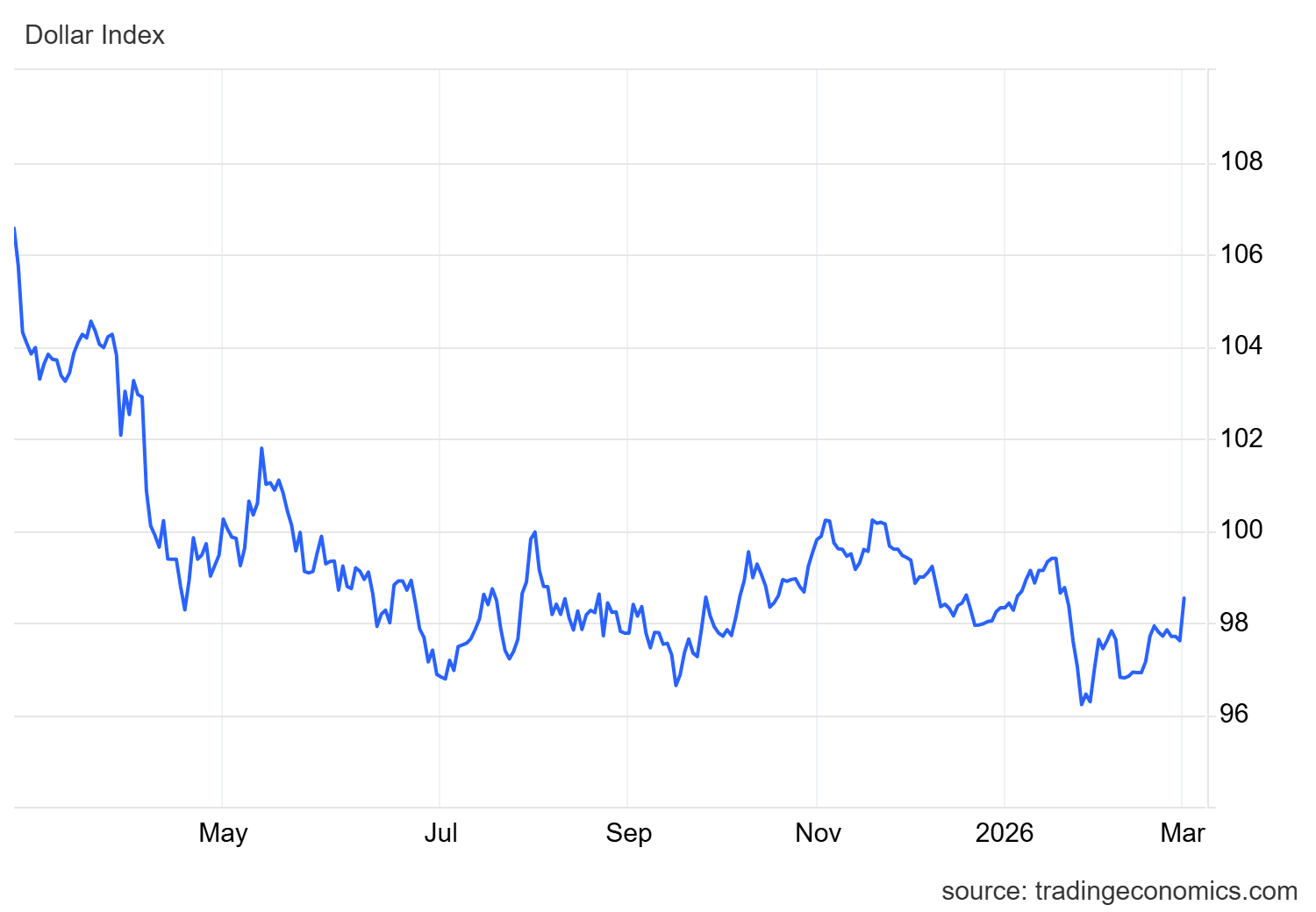
This behavior is already reflected in the DXY index, which measures the dollar’s strength against its main peers. The index is currently advancing above 98.5 points, once again showing a positive short-term slope and suggesting a consistent recovery in demand for the US currency.
Source: TradingEconomics
Overall, the geopolitical escalation has benefited the US fixed-income market more than the European market in the short term, strengthening the dollar against the euro. If demand for safe-haven assets persists, more consistent selling pressure could develop in EUR/USD in the coming sessions.
Technical outlook for EUR/USD
Source: StoneX, Tradingview
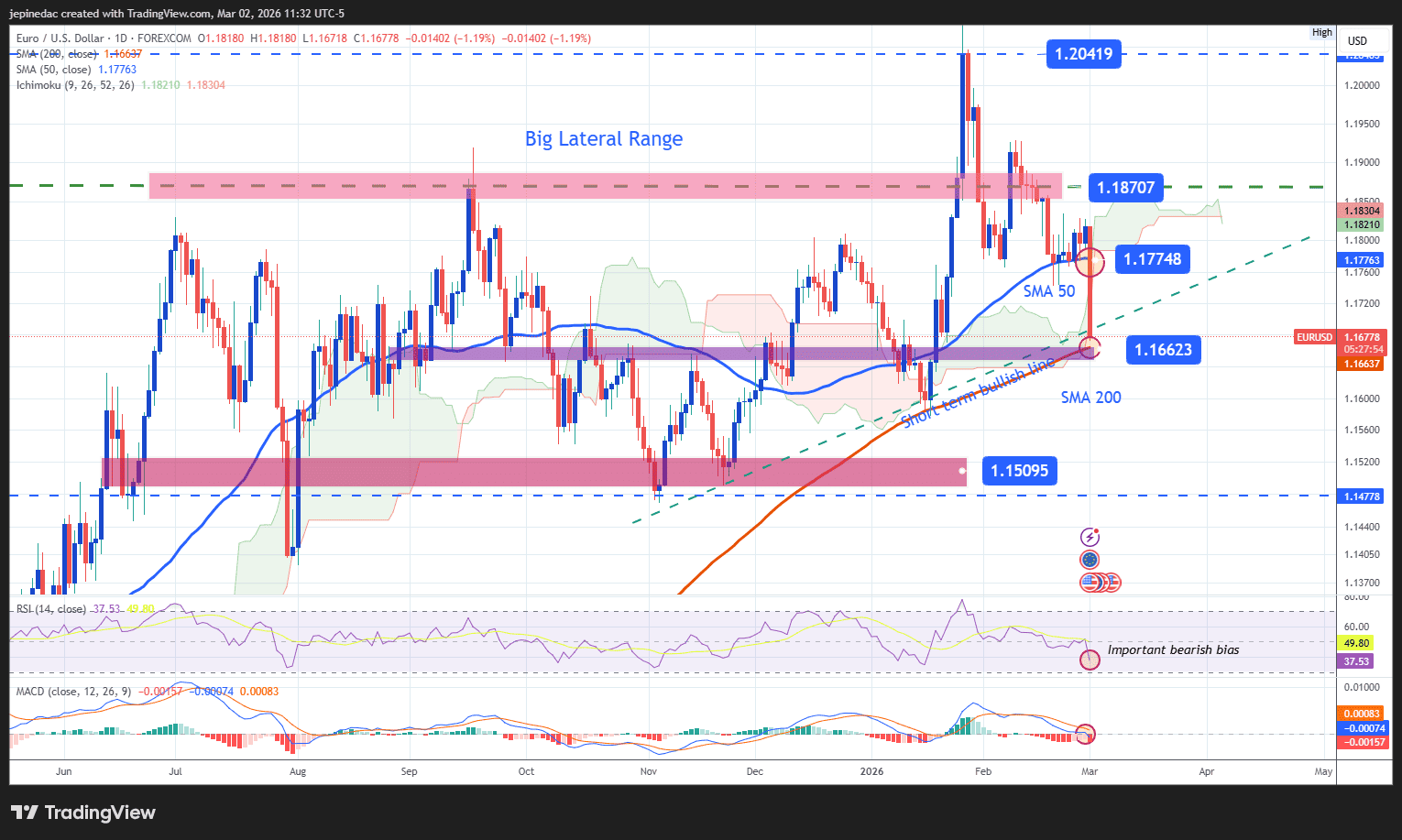
- Uptrend at risk: Since November 2025, EUR/USD had been attempting to form an upward trendline based on higher lows. However, in recent sessions, selling pressure has begun to gain traction, putting this technical structure at risk. If downside momentum continues to intensify, a break of the upward trendline could be confirmed, opening the door to a phase of greater weakness and indecision in the short term.
- RSI: The RSI remains below the neutral 50 level, indicating that average momentum over the past 14 sessions shows selling dominance. If the indicator continues to decline, it could reinforce stronger short-term bearish pressure.
- MACD: The MACD presents a similar scenario, with the histogram oscillating below the zero line. This reflects that short-term moving averages maintain a bearish bias, supporting the possibility of continued weakness in the pair as long as this dynamic persists.
Key levels:
- 1.18707 – Relevant resistance: Level aligned with the upper boundary of the broader sideways range observed in recent months. Sustained moves above this zone could reactivate a bullish bias and validate the re-establishment of an upward structure.
- 1.17784 – Near-term barrier: Recent neutrality zone aligned with the 50-period simple moving average. If price consolidates again in this area, it could reinforce a short-term indecisive and sideways scenario.
- 1.16623 – Key support: Level aligned with the 200-period simple moving average. Moves toward this zone could reinforce the bearish bias, confirm the weakening of the prior bullish structure, and open the door to more dominant downside pressure in the coming sessions.
Written by Julian Pineda, CFA, CMT – Market Analyst
Follow him on: @julianpineda25



The complete CFD trading experience
Award-winning platforms, competitive spreads, low commissions and dedicated support.
We live and breathe the markets and are dedicated to helping traders realise their ambitions as we continue to set the industry bar.
Economic calendar
Web Trader platform
Our sophisticated web-based platform is packed with features.
Related articles

USD/JPY Update: Can the Japanese Yen Sustain Its Recovery?
Short-term price action around the Japanese yen has started to show some relative improvement over recent sessions. This can be seen in the recent performance of USD/JPY, which has now recorded three consecutive daily declines in favor of the Japanese currency, resulting in a depreciation of roughly 0.35% over the period.

EUR/USD Sell-Off Snaps Back, What’s the True Trend?
EUR/USD was mired in an aggressive continuation of the sell-off after CPI yesterday, but a strong rally from the lows illustrates a stretched marked showing elements of exhaustion.


US Dollar Technical Outlook: DXY, Treasury Yields Retreat Despite Hot CPI 10 15 2026
The US Dollar is testing major support despite hotter inflation as Fed pushback cools yields and forces markets to reassess the path for tightening.

StoneX Europe Ltd may make third party material available on this website which may contain information included but not limited to the conditions of financial markets. The material is for information purposes only and does not contain, and should not be construed as containing, investment advice and/or investment recommendation and/or an investment research and/or an offer of or solicitation for any transactions in financial instruments; any decision to enter into a specific transaction shall be made by the client following an assessment by him/her of their situation.
StoneX Europe Ltd makes no representation or warranty and assumes no liability as to the accuracy or completeness of the information provided, nor any loss arising from any investment based on a recommendation, forecast or other information supplied. You should always seek independent advice as to your suitability to speculate in any related markets and your ability to assume the associated risks, if you are at all unsure. We are not under any obligation to update any such material. Any opinion made may be personal to the author and may not reflect the opinion of StoneX Europe Ltd.