


EUR/USD, USD/JPY: Shutdown leaves traders hanging on private data for direction
When “second-tier” data become market movers, volatility isn’t far behind. With the shutdown sidelining official U.S. reports, traders are hanging on every tick from private labour surveys, sending the dollar on a rollercoaster against the euro and yen.
Share this:

- Shutdown leaves markets leaning on private U.S. data for rate clues
- Conflicting ADP and Challenger signals spark big swings in FX and bonds
- EUR/USD, USD/JPY moves hint at potential trend shift
Summary
With the shutdown silencing official data, private U.S. releases like ADP and Challenger are driving the market narrative, sparking volatility in yields and currencies and producing price signals in EUR/USD and USD/JPY that may prove unreliable.
Second-Tier Surveys Dominating Direction
While traders may be accused of jumping at shadows, U.S. data once considered second tier are now driving major market moves, particularly those tied to the labour market. Just look at the attention the ADP and Challenger surveys have received this week, dominating headlines where they’d normally be overlooked. But with no official data forthcoming due to the government shutdown, they’re all markets have to assess the outlook for the U.S. economy and interest rates, providing conflicting signals that have sparked large swings in rates and forex markets.
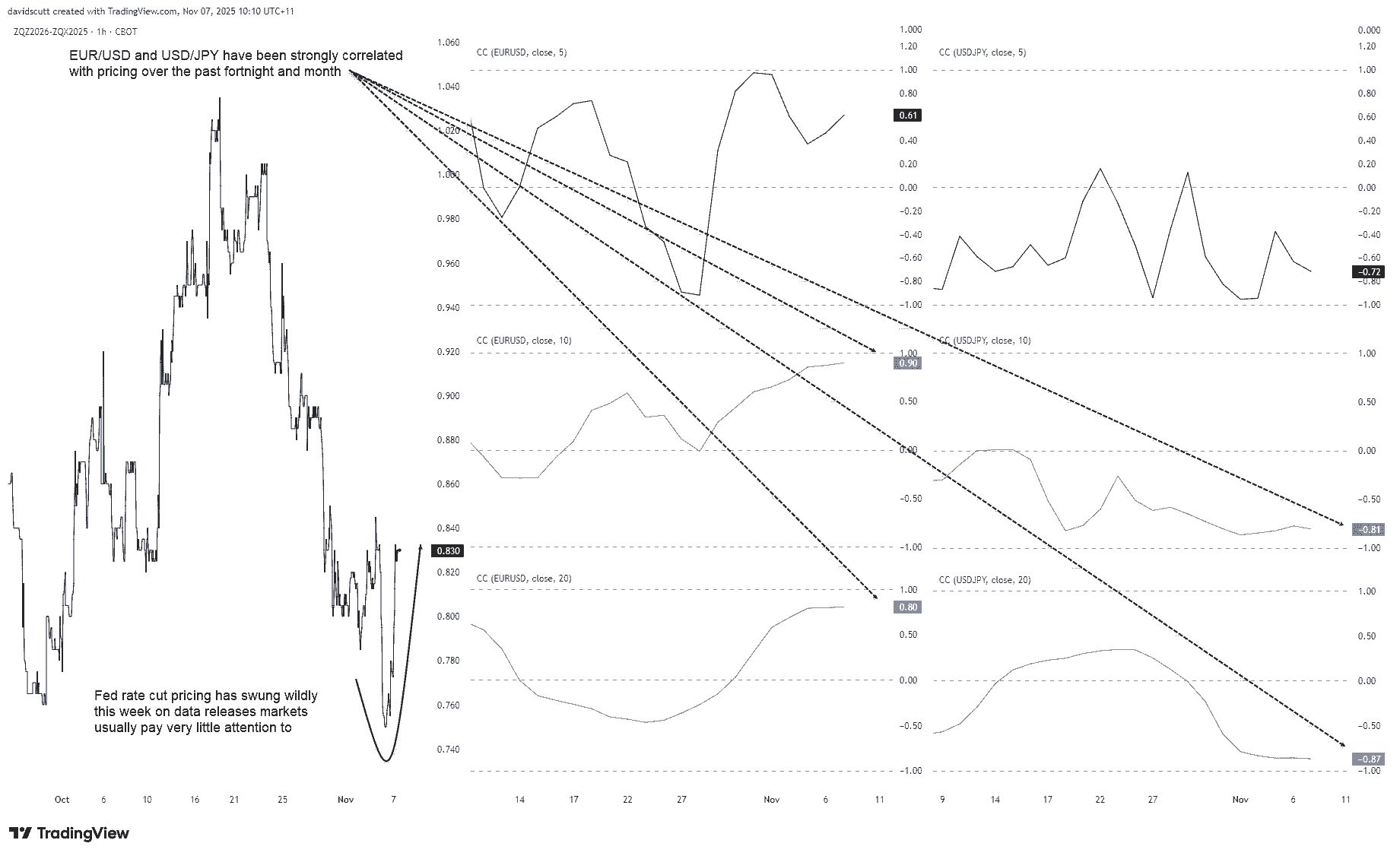
The influence of these private surveys is highlighted below, showing how changes in Fed rate cut pricing have influenced EUR/USD and USD/JPY direction over the past week, fortnight and month.
Source: TradingView
The left pane tracks the shape of the Fed funds futures curve between November 2025 and December 2026, offering a rough guide to how many cuts are priced in over the period. Until Thursday, the trend had been towards fewer cuts, with the total falling as low as 75 basis points on Wednesday following solid reads from the ADP and ISM services PMI for October. However, data from Challenger, Gray & Christmas 24 hours later revealed October layoffs surged to the highest level since 2003, pushing pricing back up to 83 basis points.
These data points—usually ignored in what’s traditionally a nonfarm payrolls week—are now major market movers, and not just in the rates space. As shown by the rolling correlation coefficients between Fed rate cut pricing and EUR/USD and USD/JPY, they’re also having a significant impact on the dollar, especially over the past fortnight and month. For EUR/USD, the correlations sit at 0.9 and 0.8, while USD/JPY comes in at -0.8 and -0.86, respectively.
Fed Rate Cut Pricing Key
When you account for market convention on how these pairs trade, it suggests that, more often than not over those periods, moves in rate cut pricing have gone in the opposite direction to the dollar—as seen on Thursday when the USD softened as rate cut pricing swelled. That helped deliver price signals in both EUR/USD and USD/JPY suggesting a trend change may be emerging.
EUR/USD Delivers Bullish Signal
Source: TradingView
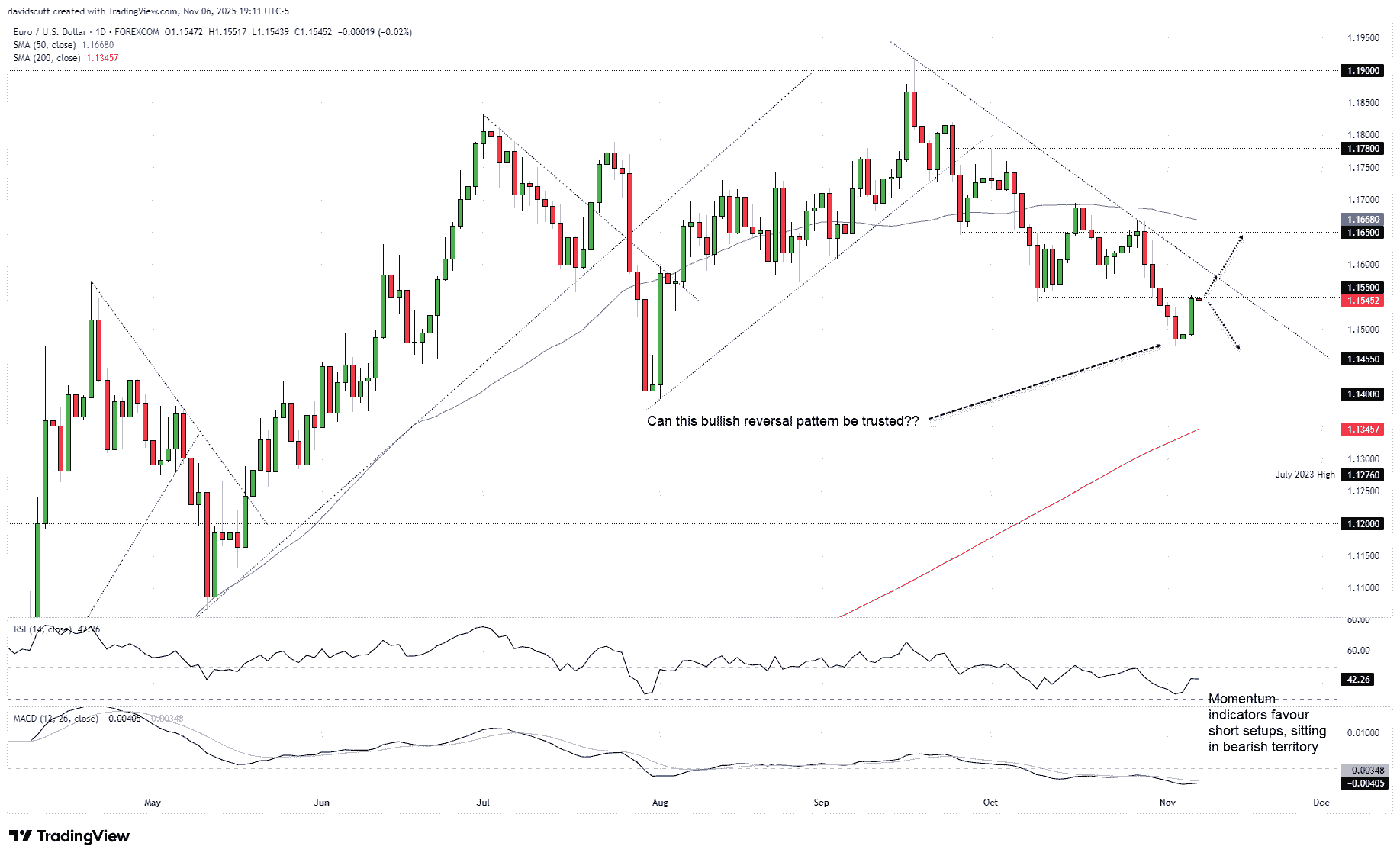
On the EUR/USD daily chart, a three-candle morning star was completed Thursday—a bullish reversal pattern that warns of upside risk. The strong move saw the pair push back to 1.1550, where it’s done plenty of work either side of over the past month. While it may only be a minor level, it can be used to establish fresh setups depending on how near-term price action evolves.
Should the bullish signal prove reliable—which I have some doubts about given it was derived from a second-tier survey known for its volatility—longs could be established above 1.1550 with a stop beneath for protection, targeting the September downtrend initially, found around 1.1600 today. If that were to be broken, 1.1650 and the 50-day moving average are other options to consider. But if price stalls at 1.1550, the setup could be flipped, allowing shorts to be established beneath with a stop above, targeting either Wednesday’s low or support at 1.1455. RSI (14) and MACD signals remain bearish, with both sitting at levels where short setups are favoured.


USD/JPY Breakdown Underway?
Source: TradingView
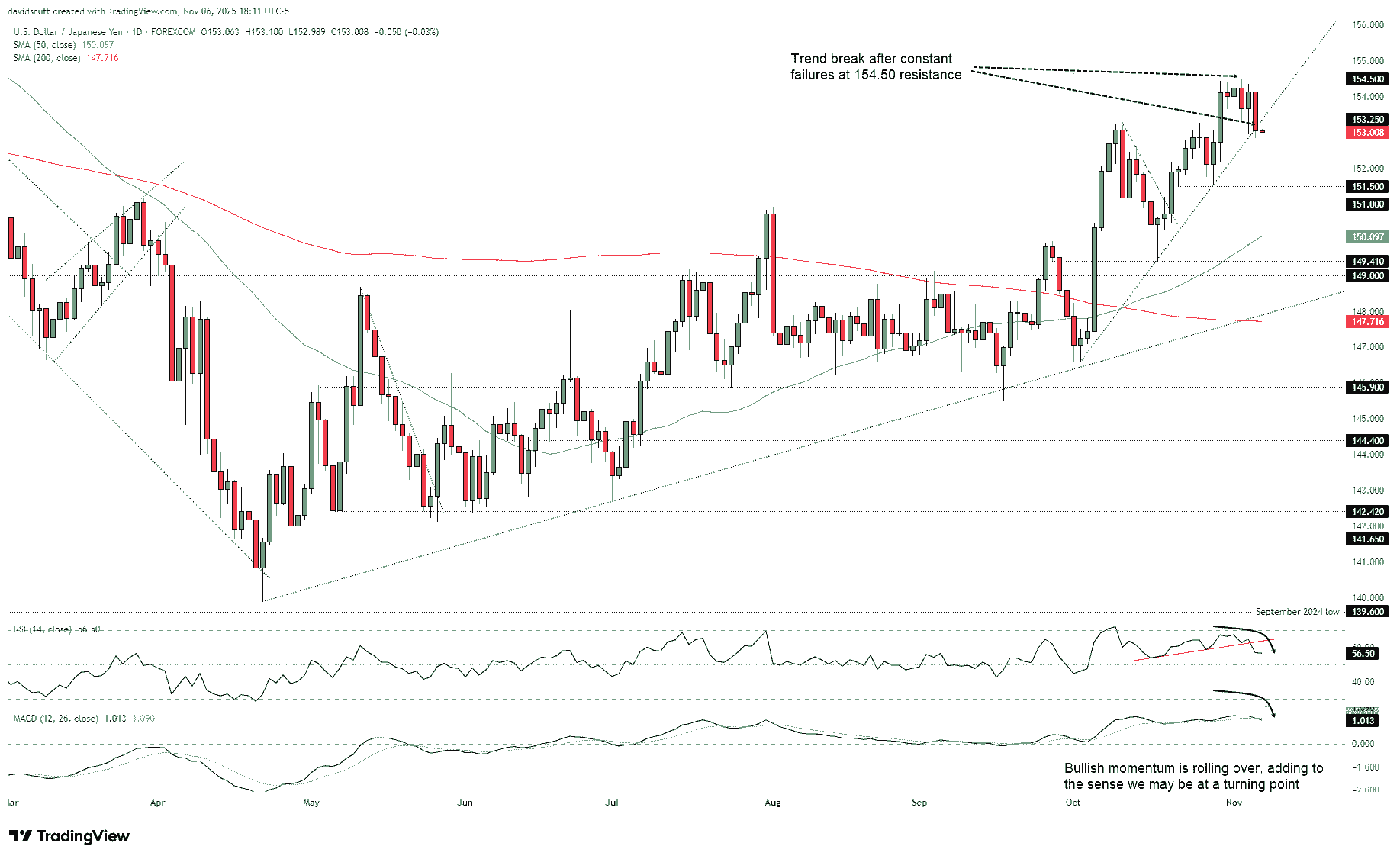
While it fell just short of being an engulfing candle, there was a large bearish reversal in USD/JPY during Thursday’s session, seeing it break the uptrend dating back to early October. Right now, it’s clinging to a horizontal support zone running from 153.25 down to 153.00.
As mentioned in a note earlier this week, even before the large increase in Fed rate cut pricing on Thursday, the bullish move in USD/JPY was looking fatigued, struggling to break resistance at 154.50 even with the less dovish Fed outlook. With RSI (14) breaking its uptrend and rolling over towards neutral territory—mirroring the crossover seen in MACD—it feels like directional risks may be shifting lower.
Should the pair break beneath 153.00 and hold there, shorts could be established below with a stop above, targeting either minor support at 151.50 or a more pronounced level at 151.00. Alternatively, if the pair manages to hold above 153.00, watch for a possible reversal back above the October trend. If that were to occur, it would signal a potential retest of 154.50 resistance, allowing longs to be established above the trendline with a stop below for protection.


The complete CFD trading experience
Award-winning platforms, competitive spreads, low commissions and dedicated support.
We live and breathe the markets and are dedicated to helping traders realise their ambitions as we continue to set the industry bar.
Economic calendar
Web Trader platform
Our sophisticated web-based platform is packed with features.
Related articles
USD/CAD shooting star puts September surge on notice
USD/CAD has printed a clear bearish reversal pattern after an extraordinary September surge, but confirmation may depend heavily on how US Treasury yields react to Friday’s payrolls report.

USD/MXN Analysis: Is Super Peso Starting to Fade?
Over recent trading sessions, the Mexican peso has continued to show signs of weakness against the U.S. dollar. This can already be seen in USD/MXN, which has gained more than 1.7% over the last three sessions, highlighting sustained buying pressure in favor of the dollar in the short term.


Canadian Dollar Analysis: USD/CAD Returns to July Highs Ahead of NFP
The Canadian dollar continues to face one of its most challenging environments in recent months when it comes to maintaining strength against the U.S. dollar. The weakness of the Canadian currency is clearly reflected in USD/CAD, which has now recorded nine consecutive bullish sessions and gained more than 1.7% during that period.
StoneX Europe Ltd may make third party material available on this website which may contain information included but not limited to the conditions of financial markets. The material is for information purposes only and does not contain, and should not be construed as containing, investment advice and/or investment recommendation and/or an investment research and/or an offer of or solicitation for any transactions in financial instruments; any decision to enter into a specific transaction shall be made by the client following an assessment by him/her of their situation.
StoneX Europe Ltd makes no representation or warranty and assumes no liability as to the accuracy or completeness of the information provided, nor any loss arising from any investment based on a recommendation, forecast or other information supplied. You should always seek independent advice as to your suitability to speculate in any related markets and your ability to assume the associated risks, if you are at all unsure. We are not under any obligation to update any such material. Any opinion made may be personal to the author and may not reflect the opinion of StoneX Europe Ltd.