






The Week Head CB Meetings and NFP
RBA and BOC hold meeting, AU release GDP and NFP is on Friday for US and Canada
Share this:

Monday 2nd September
- AU manufacturing PMI, company profits, business inventories
- NZ trade balance
- JP business capex, manufacturing PMI
- CN manufacturing PMI
- EZ, FR, DE, UK manufacturing PMI (final reads)
Tuesday 3nd September
- South Korean CPI and GDP
- AU current account, retail sales, RBA cash rate decision
- UK construction PMI
- EZ producer prices
- CA manufacturing PMI
- US ISM Manufacturing
Wednesday 4nd September
- AU services PMI, GDP
- CN Services PMI
- EZ, FR, DE, UK services PMI, EZ retail sales
- CA trade balance, BOC cash rate decision
Thursday 5nd September
- AU trade balance
- DE industrial orders
- US ADP employment/jobless claims, services PMI, ISM non-manufacturing PMI
Friday 6nd September
- AU construction
- JP household spending, leading/coincident indicator
- DE industrial output
- EZ employment (final), GDP (revised)
- US Nonfarm payroll
- CA employment
Chinese Manufacturing PMI: USD/CNH, AUD, NZD and JPY pairs, Copper, China A50, Hang Seng
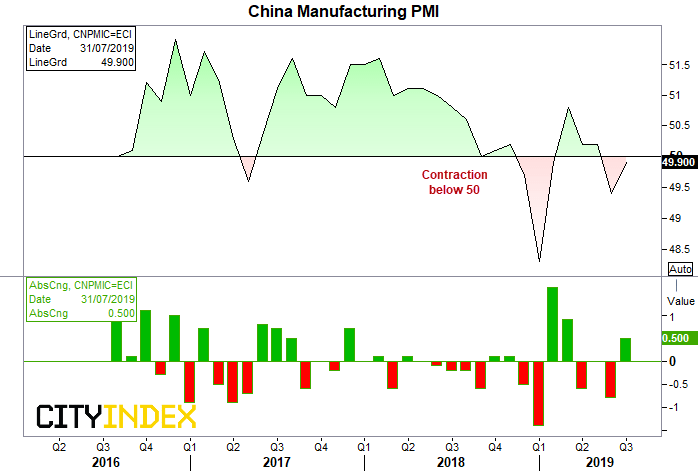
China’s manufacturing sector has contracted two consecutive months, adding to the chorus of calls for a global slowdown. That said, the rate of contraction slowed in July, and if PMI is to climb back above 50, we’d expect a bout of risk-on for the session. AUD pairs are particularly sensitive to the data as they’re key trade partners, but Chinese indices and copper also make decent markets to monitor around the data’s release.
RBA Cash Rate Decision and Q3 GDP: AUD pairs, ASX200
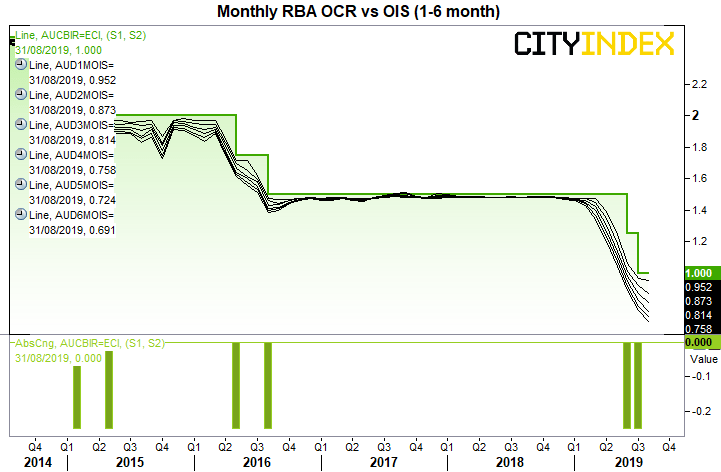
At time of writing, the RBA rate indicator expects just an 11% chance of a 25 cut on Tuesday. This moves to 74% for a cut in October and a 115% cut (ie fully priced in) for November. This is no major surprise, given they cut by 25 bps in June and July and their August minutes provided a ‘steady as she goes’ approach, whilst emphasising external risks such as the trade war. Moreover, GDP data is out on Wednesday and they’d likely want this data on hand before easing further. Yet this still could be a high volatility event if there is a notable shift in tone with their statement.
As for GDP, RBA expect growth to average around 2.5% this year. With Q1 GDP hitting 1.8%, it’s not off to a great start and, with ANZ expecting it to drop to 1.1% in Q2 and the consensus at 1.4%, economists seem doubtful that RBA are on track to achieve their 2019 growth target. Expect AUD to remain under pressure and bring forward easing expectation should it hit 1.3% YoY or less.
BoC Rate Decision
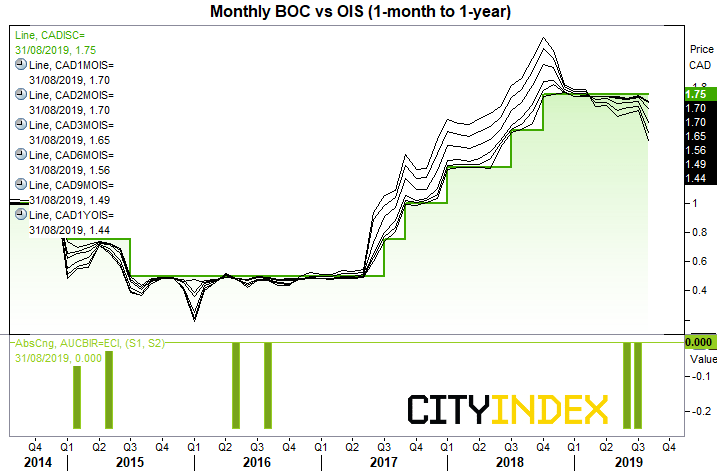
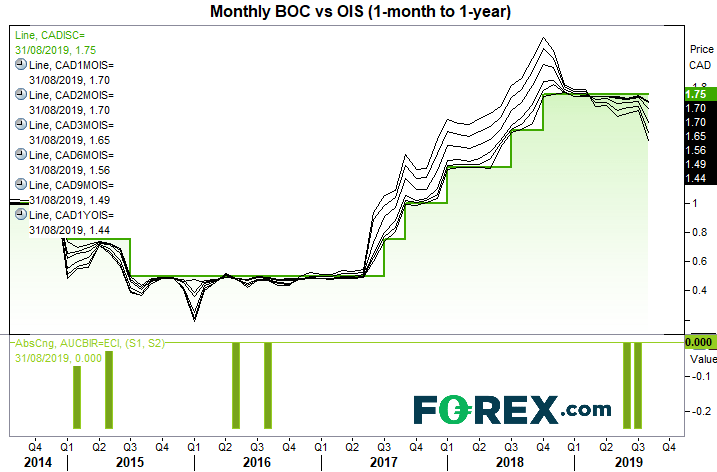
It’s unlikely BoC will change policy next week, given inflation remains around 2% has not ‘dipped’ as expected. Moreover, the 1-month OIS suggests less than a 20% chance of a cut at their next meeting. Still, markets suspect the next direction will be a cut, with 6-month OIS pricing in around 74% chance and a 25bps cut being bullish priced in by April next year. So we’ll keep a close eye on the statement to see if there is a dovish twist, although chances are it will reiterate their need to monitor the energy sector and the impact of ‘trade conflicts’ whilst remaining optimistic over domestic growth.
US ISM Manufacturing: USD pairs, US indices, WTI, Gold, Silver
Global PMI remain under pressure and traders are waiting to see if manufacturing PMI dips below the 50% threshold to show the sector contracting. It’s an important gauge for markets as it can lead GDP by 6-9 months, so any weakness here will translate to lower growth expectations, earnings for companies and therefor prices.
US and CA Nonfarm payroll: USD and CAD pairs, US indices, WTI, Gold, Silver
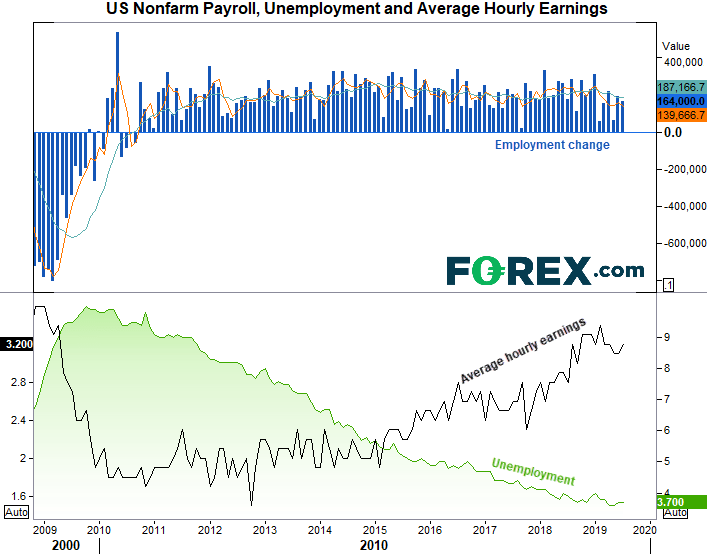
Employment is expected to soften to 155k, well below the 1-month average of 187.16 and unemployment is expected to hold steady at 3.7%. With ADP employment released on Thursday, and a 3-month correlation of 0.81, we could see NFP revised if ADP misses expectations. However, average hourly earnings may be the better read to follow as it has been trending notably higher on an annualised basis, so traders use it as an inflationary gauge (and therefor, a better read of how the Fed are likely to react). That said, as the CME FedWatch tool suggests 95.8% chance for Fed to cut 25bps in September, it’s hard to see any such data will remove this almost given event. For that, we’d need to see a solid breakthrough in trade talks which, at present, appear unlikely to appear on the horizon.
Take note that Canada release employment data alongside NFP, which places USD/CAD in the sights of the volatility crossbow. CAD/CHF and CAD/JPY are also pairs to consider, if you want to focus on the Canadian employment side of things.
Monday 2nd September
- AU manufacturing PMI, company profits, business inventories
- NZ trade balance
- JP business capex, manufacturing PMI
- CN manufacturing PMI
- EZ, FR, DE, UK manufacturing PMI (final reads)
Tuesday 3nd September
- South Korean CPI and GDP
- AU current account, retail sales, RBA cash rate decision
- UK construction PMI
- EZ producer prices
- CA manufacturing PMI
- US ISM Manufacturing
Wednesday 4nd September
- AU services PMI, GDP
- CN Services PMI
- EZ, FR, DE, UK services PMI, EZ retail sales
- CA trade balance, BOC cash rate decision
Thursday 5nd September
- AU trade balance
- DE industrial orders
- US ADP employment/jobless claims, services PMI, ISM non-manufacturing PMI
Friday 6nd September
- AU construction
- JP household spending, leading/coincident indicator
- DE industrial output
- EZ employment (final), GDP (revised)
- US Nonfarm payroll
- CA employment
Chinese Manufacturing PMI: USD/CNH, AUD, NZD and JPY pairs, Copper, China A50, Hang Seng
China’s manufacturing sector has contracted two consecutive months, adding to the chorus of calls for a global slowdown. That said, the rate of contraction slowed in July, and if PMI is to climb back above 50, we’d expect a bout of risk-on for the session. AUD pairs are particularly sensitive to the data as they’re key trade partners, but Chinese indices and copper also make decent markets to monitor around the data’s release.
RBA Cash Rate Decision and Q3 GDP: AUD pairs, ASX200
At time of writing, the RBA rate indicator expects just an 11% chance of a 25 cut on Tuesday. This moves to 74% for a cut in October and a 115% cut (ie fully priced in) for November. This is no major surprise, given they cut by 25 bps in June and July and their August minutes provided a ‘steady as she goes’ approach, whilst emphasising external risks such as the trade war. Moreover, GDP data is out on Wednesday and they’d likely want this data on hand before easing further. Yet this still could be a high volatility event if there is a notable shift in tone with their statement.
As for GDP, RBA expect growth to average around 2.5% this year. With Q1 GDP hitting 1.8%, it’s not off to a great start and, with ANZ expecting it to drop to 1.1% in Q2 and the consensus at 1.4%, economists seem doubtful that RBA are on track to achieve their 2019 growth target. Expect AUD to remain under pressure and bring forward easing expectation should it hit 1.3% YoY or less.
BoC Rate Decision
It’s unlikely BoC will change policy next week, given inflation remains around 2% has not ‘dipped’ as expected. Moreover, the 1-month OIS suggests less than a 20% chance of a cut at their next meeting. Still, markets suspect the next direction will be a cut, with 6-month OIS pricing in around 74% chance and a 25bps cut being bullish priced in by April next year. So we’ll keep a close eye on the statement to see if there is a dovish twist, although chances are it will reiterate their need to monitor the energy sector and the impact of ‘trade conflicts’ whilst remaining optimistic over domestic growth.
US ISM Manufacturing: USD pairs, US indices, WTI, Gold, Silver
Global PMI remain under pressure and traders are waiting to see if manufacturing PMI dips below the 50% threshold to show the sector contracting. It’s an important gauge for markets as it can lead GDP by 6-9 months, so any weakness here will translate to lower growth expectations, earnings for companies and therefor prices.
US and CA Nonfarm payroll: USD and CAD pairs, US indices, WTI, Gold, Silver
Employment is expected to soften to 155k, well below the 1-month average of 187.16 and unemployment is expected to hold steady at 3.7%. With ADP employment released on Thursday, and a 3-month correlation of 0.81, we could see NFP revised if ADP misses expectations. However, average hourly earnings may be the better read to follow as it has been trending notably higher on an annualised basis, so traders use it as an inflationary gauge (and therefor, a better read of how the Fed are likely to react). That said, as the CME FedWatch tool suggests 95.8% chance for Fed to cut 25bps in September, it’s hard to see any such data will remove this almost given event. For that, we’d need to see a solid breakthrough in trade talks which, at present, appear unlikely to appear on the horizon.
Take note that Canada release employment data alongside NFP, which places USD/CAD in the sights of the volatility crossbow. CAD/CHF and CAD/JPY are also pairs to consider, if you want to focus on the Canadian employment side of things.
Related tags:



Open an account in minutes
Experience award-winning platforms with fast and secure execution.
Economic calendar
Web Trader platform
Our sophisticated web-based platform is packed with features.
Related articles

Australian Dollar Outlook: AUD/USD Bears Eye March Low as US CPI Looms
Australian Dollar Outlook: AUD/USD Bears Eye March Low as US CPI Looms


Extreme Euro Shorts Meet Renewed US Dollar Strength | COT Report
Euro net-shorts hit an 11-year extreme as the US dollar rebounds. COT positioning reveals growing pressure on sterling and commodity currencies.

EUR/USD Forecast: Euro Under Pressure After Strong NFP Data
As the trading week comes to an end, the euro has once again struggled to sustain a meaningful recovery against the U.S. dollar, highlighting renewed weakness within EUR/USD price action. During the final trading session of the week, the pair declined nearly 0.7%, reflecting that confidence around the European currency remains limited in the short term.

StoneX Financial Ltd (trading as "FOREX.com") is an execution-only service provider. This material, whether or not it states any opinions, is for general information purposes only and it does not take into account your personal circumstances or objectives. This material has been prepared using the thoughts and opinions of the author and these may change. However, FOREX.com does not plan to provide further updates to any material once published and it is not under any obligation to keep this material up to date.
This material is short term in nature and may only relate to facts and circumstances existing at a specific time or day. Nothing in this material is (or should be considered to be) financial, investment, legal, tax or other advice and no reliance should be placed on it. No opinion given in this material constitutes a recommendation by FOREX.com or the author that any particular investment, security, transaction or investment strategy is suitable for any specific person.
The material has not been prepared in accordance with legal requirements designed to promote the independence of investment research. Although FOREX.com is not specifically prevented from dealing before providing this material, FOREX.com does not seek to take advantage of the material prior to its dissemination. This material is not intended for distribution to, or use by, any person in any country or jurisdiction where such distribution or use would be contrary to local law or regulation. For further details see our full non-independent research disclaimer and quarterly summary.