



Australian inflation is the latest ‘hot beat’ on the dancefloor
Economic data beats are usually a good thing, unless it is in the guise of much higher than expected (and already elevated) inflation.
Share this:

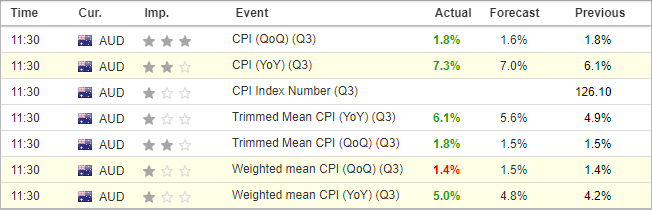
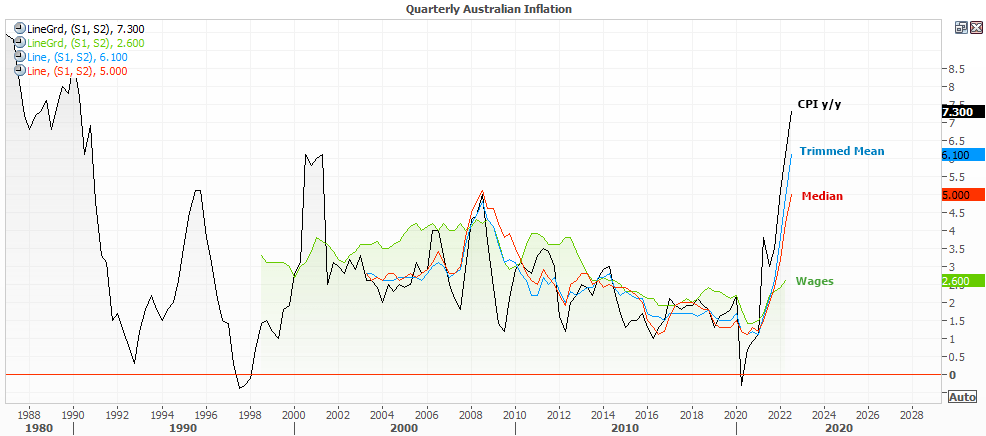
Australian consumer prices rose at the annual pace of 7.3% y/y – above the 7% forecast and up from 6.1% in Q2. The RBA’s preferred measures of inflation also came in hotter than expected, with Trimmed mean rising 6.1% y/y (5.6% expected) and weighed mean at 5% y/y (4.8% expected). The newly released monthly y/y inflation print rose to 7.3% - which is a record high as the series only goes back to October 2018. Furthermore, core CPI has now beaten the median economic forecasts for five consecutive quarters. Basically, inflation is hot.
Looking into the monthly basket of inflation shows that the baulk of price increases food and non-alcohol beverages and housing (both at 3.2% y/y). This is a trend we’re seeing the world over, and I’m sure most would agree that inflation for these subsets are actually much higher for many. And with inflation running so sot, the question now is whether the ‘finely balanced’ debate between a 25bp or 50bp hike remains finely balanced at all.
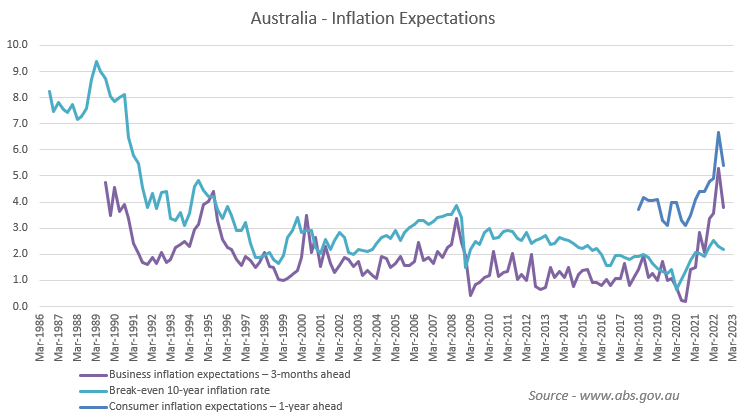
From the RBA’s latest statement: “Medium-term inflation expectations remain well anchored, and it is important that this remains the case”.
The RBA seem to be hanging their hat on that fact that inflation expectations (or at least some measures of them) remain relatively low, and as Governor Lowe pointed out the RBA are basing their policy decisions on inflation expectations – which are lower than current levels of inflation. So perhaps the time to begin assuming a 50bp hike is when we see evidence that inflation expectations are turning higher. And as of the latest report, +3 month business expectation, +1 year consumer inflation expectations and the 10-year breakeven rate have seemingly moved lower. With that said, ING have already upped their forecast for a 50bp hike at their November meeting, which would take rates to 3.1%.
AUD/NZD daily chart:
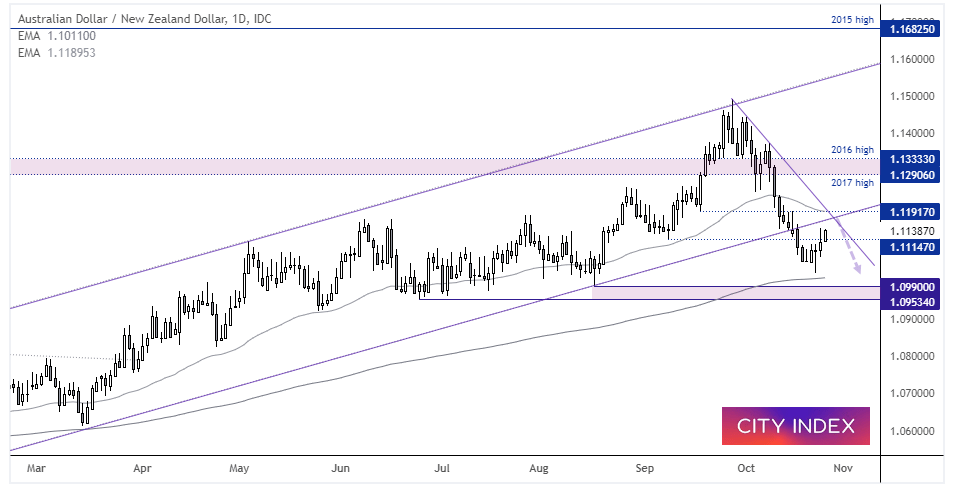
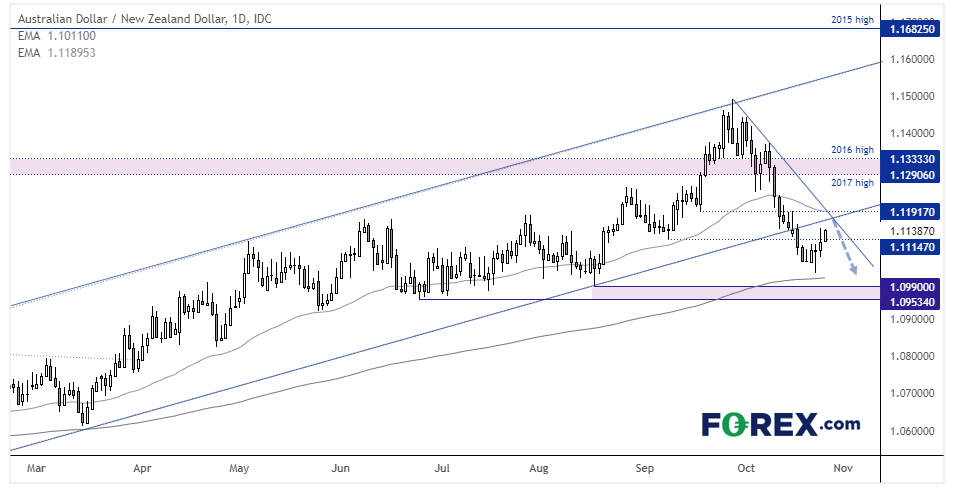
AUD/NZD is trading back near yesterday’s high as it retraces against its decline from around 1.1500. Given Europe and the US is yet to react, the pair has the potential to continue higher over the near-term. But as I suspect the RBA will stick to a 25bp hike, and the market has the potential to figure this out, I’m now looking for areas of weakness to fade into – such as the 1.1190 low or the lower trendline.
How to trade with City Index
You can easily trade with City Index by using these four easy steps:
- Open an account, or log in if you’re already a customer
• Open an account in the UK
• Open an account in Australia
• Open an account in Singapore
- Search for the company you want to trade in our award-winning platform
- Choose your position and size, and your stop and limit levels
- Place the trade
How to trade with FOREX.com
Follow these easy steps to start trading with FOREX.com today:
- Open a Forex.com account, or log in if you’re already a customer.
- Search for the pair you want to trade in our award-winning platform.
- Choose your position and size, and your stop and limit levels.
- Place the trade.
Related tags:



Open an account in minutes
Experience award-winning platforms with fast and secure execution.
Economic calendar
Web Trader platform
Our sophisticated web-based platform is packed with features.
Related articles
China's steel slump leaves iron ore bulls under the pump
Iron ore has broken major support, threatening a return to the lows of 2022 as mounting evidence of weakness in China's steel sector reinforces the bearish outlook.

USD/JPY, AUD/JPY: Central Bank Divergence Creates Two-Way Risk
USD/JPY eyes a breakout above 160, while AUD/JPY faces further losses as Fed, RBA and BoJ interest rate expectations diverge.
Gold and silver forecast: Precious metals extend drop but seasonality hopes keeps bullish case alive
It has been a risk off session so far today with stocks, gold and especially silver (-4%) all taking a drop. Gold has fallen to a fresh 2026 low and its now more than $100 below the psychologically important $4,000 mark. A firmer US dollar, rising US rate expectations and fading safe-haven demand have combined to undermine the metal, despite continued central bank buying. This year has so far been a bad one for gold.

StoneX Financial Ltd (trading as "FOREX.com") is an execution-only service provider. This material, whether or not it states any opinions, is for general information purposes only and it does not take into account your personal circumstances or objectives. This material has been prepared using the thoughts and opinions of the author and these may change. However, FOREX.com does not plan to provide further updates to any material once published and it is not under any obligation to keep this material up to date.
This material is short term in nature and may only relate to facts and circumstances existing at a specific time or day. Nothing in this material is (or should be considered to be) financial, investment, legal, tax or other advice and no reliance should be placed on it. No opinion given in this material constitutes a recommendation by FOREX.com or the author that any particular investment, security, transaction or investment strategy is suitable for any specific person.
The material has not been prepared in accordance with legal requirements designed to promote the independence of investment research. Although FOREX.com is not specifically prevented from dealing before providing this material, FOREX.com does not seek to take advantage of the material prior to its dissemination. This material is not intended for distribution to, or use by, any person in any country or jurisdiction where such distribution or use would be contrary to local law or regulation. For further details see our full non-independent research disclaimer and quarterly summary.