



CPI preview: Headline inflation may ease, but Fed more worried about rising core prices
The potential for a continued rise in “core” inflation is what the Fed is worried about, and it is the component of the CPI report that could cement another 75bps interest rate hike...
Share this:

When is the September US CPI report?
The US Bureau of Labor Statistics (BLS) will release the September Consumer Price Index (CPI) report Thursday, October 13 at 8:30 ET.
What are economists expecting for September CPI?
Consensus expectations are for headline CPI to come in at 0.2% m/m, 8.1% y/y, with the Core (ex-food and -energy) CPI report expected to print at 0.4% m/m, 6.5% y/y.
CPI preview
When it comes to markets, change is the only constant.
Back in the early 1980s, the US trade balance was THE monthly economic release to watch for traders. For the 2010s, THE top-tier monthly release was the Non-Farm Payrolls (NFP) report. And now, while traders still keep an eye on trade balance readings and employment, THE release to watch each month is the US CPI report.
With the Fed clearly satisfied with the level of employment, the other half of its dual mandate, price stability, is the sole factor driving monetary policy decisions at the world’s most important financial institution. Though the central bank reportedly favors the more arcane Core Personal Consumption Expenditures (PCE) measure of price pressures, the general US populace (and by extension, politicians heading into a key mid-term election cycle) is more focused on the CPI reading.
As we noted above, traders are expecting the headline CPI reading to moderate to 8.1% y/y from 8.3% y/y last month. Notably, an as-expected print would also bring the 3-month annualized rate of consumer inflation to just 1.2% from above 10% in both Q1 and Q2 of this year. However, the core inflation rate is likely to be stickier, with the year-over-year core CPI reading expected to rise to 6.5% from 6.3% last month; this potential for a continued rise in “core” inflation is what the Fed is worried about, and it is the component of the CPI report that could cement another 75bps interest rate hike from the Fed early next month.
According to the CME’s FedWatch tool, Fed Funds futures traders are already pricing in about an 80% chance of such a move in November. Perhaps more importantly, after a solid jobs report last week, traders have started to open the door for yet another 75bps hike in the FOMC’s December meeting, and therefore a hotter-than-expected inflation reading on Thursday could still lead to another leg higher in the greenback and a continuation lower in risk assets.
Technical view: USD/JPY
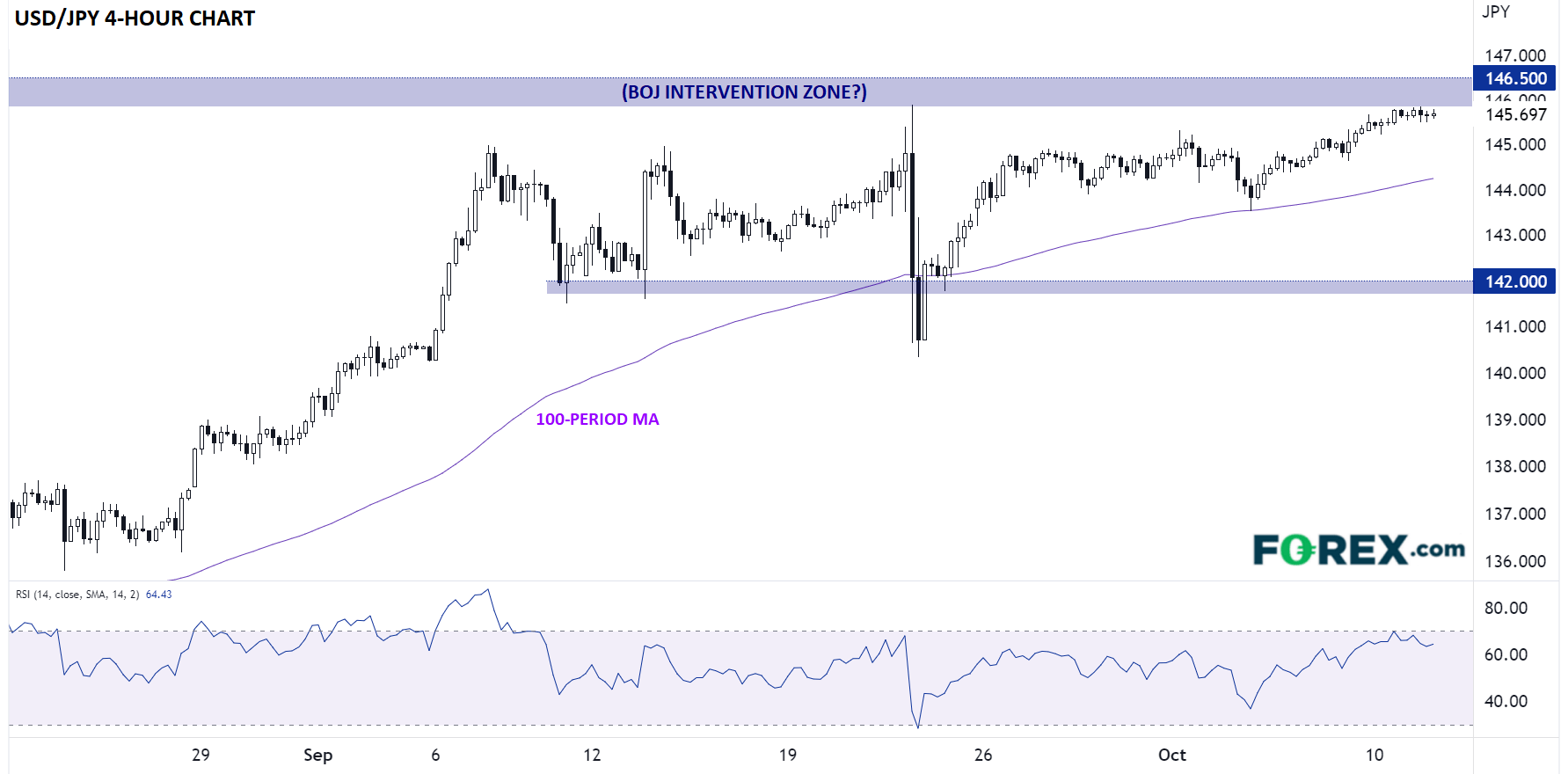
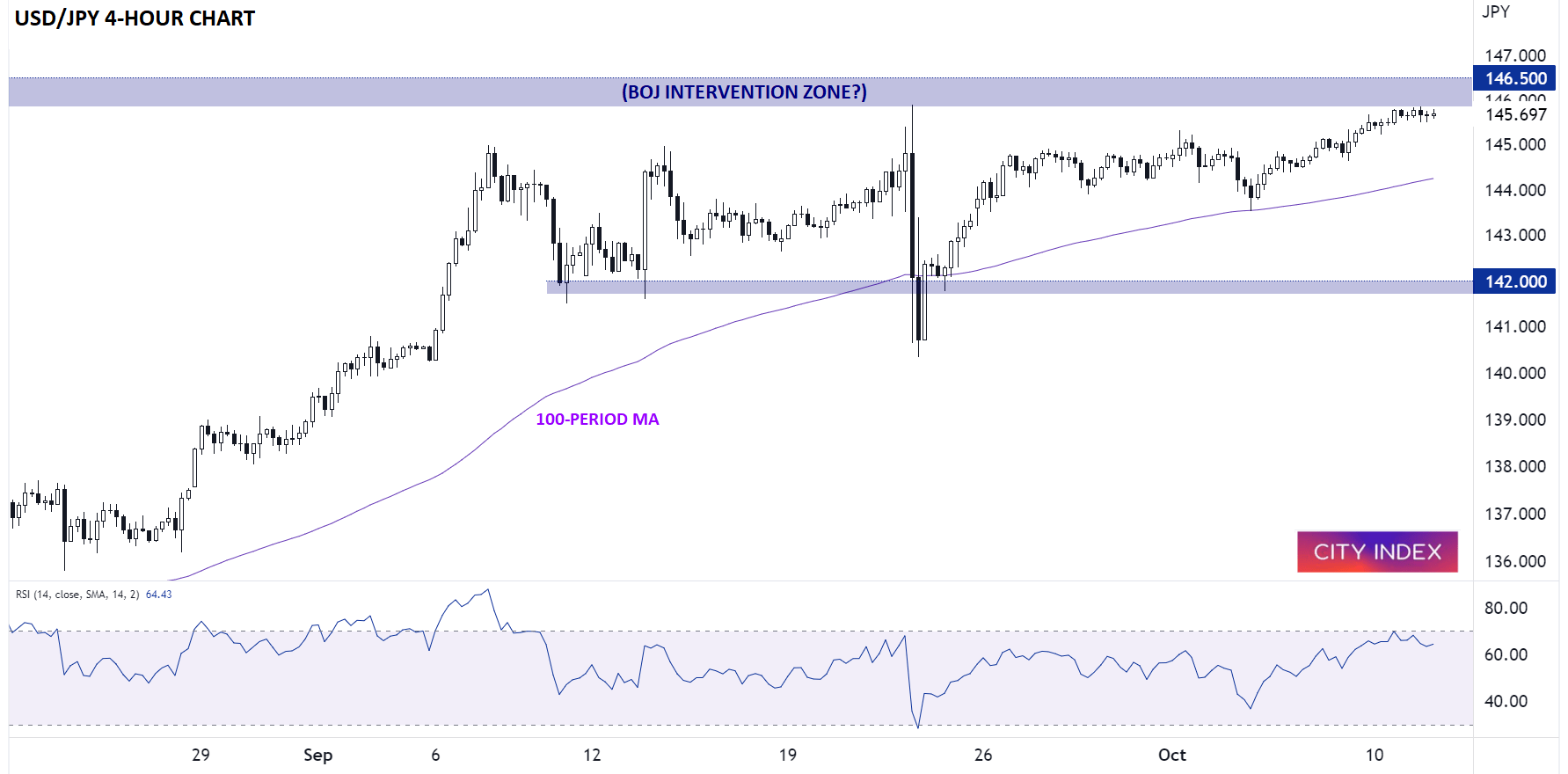
As the chart below shows, USD/JPY is once again probing 30+ year highs above 145.00. Traders are understandably wary of pushing rates higher as the pair is within a couple dozen pips of where the BOJ intervened to support the yen last month, but an elevated inflation reading may give them the confidence to push the pair above 146.00 and prompt the BOJ to push back its Maginot Line toward 150.00 as the gap in relative economic performance on either side of the Pacific widens.
Alternatively, a sharp slowdown in US price pressures could lead to a quick drop in USD/JPY, with room down to test the bottom of the range over the last month in the 142.00 area.
Source: TradingView, StoneX
When is the September US CPI report?
The US Bureau of Labor Statistics (BLS) will release the September Consumer Price Index (CPI) report Thursday, October 13 at 8:30 ET.
What are economists expecting for September CPI?
Consensus expectations are for headline CPI to come in at 0.2% m/m, 8.1% y/y, with the Core (ex-food and -energy) CPI report expected to print at 0.4% m/m, 6.5% y/y.
CPI preview
When it comes to markets, change is the only constant.
Back in the early 1980s, the US trade balance was THE monthly economic release to watch for traders. For the 2010s, THE top-tier monthly release was the Non-Farm Payrolls (NFP) report. And now, while traders still keep an eye on trade balance readings and employment, THE release to watch each month is the US CPI report.
With the Fed clearly satisfied with the level of employment, the other half of its dual mandate, price stability, is the sole factor driving monetary policy decisions at the world’s most important financial institution. Though the central bank reportedly favors the more arcane Core Personal Consumption Expenditures (PCE) measure of price pressures, the general US populace (and by extension, politicians heading into a key mid-term election cycle) is more focused on the CPI reading.
As we noted above, traders are expecting the headline CPI reading to moderate to 8.1% y/y from 8.3% y/y last month. Notably, an as-expected print would also bring the 3-month annualized rate of consumer inflation to just 1.2% from above 10% in both Q1 and Q2 of this year. However, the core inflation rate is likely to be stickier, with the year-over-year core CPI reading expected to rise to 6.5% from 6.3% last month; this potential for a continued rise in “core” inflation is what the Fed is worried about, and it is the component of the CPI report that could cement another 75bps interest rate hike from the Fed early next month.
According to the CME’s FedWatch tool, Fed Funds futures traders are already pricing in about an 80% chance of such a move in November. Perhaps more importantly, after a solid jobs report last week, traders have started to open the door for yet another 75bps hike in the FOMC’s December meeting, and therefore a hotter-than-expected inflation reading on Thursday could still lead to another leg higher in the greenback and a continuation lower in risk assets.
Technical view: USD/JPY
As the chart below shows, USD/JPY is once again probing 30+ year highs above 145.00. Traders are understandably wary of pushing rates higher as the pair is within a couple dozen pips of where the BOJ intervened to support the yen last month, but an elevated inflation reading may give them the confidence to push the pair above 146.00 and prompt the BOJ to push back its Maginot Line toward 150.00 as the gap in relative economic performance on either side of the Pacific widens.
Alternatively, a sharp slowdown in US price pressures could lead to a quick drop in USD/JPY, with room down to test the bottom of the range over the last month in the 142.00 area.
Source: TradingView, StoneX
How to trade with City Index
You can trade with City Index by following these four easy steps:
- Open an account, or log in if you’re already a customer
• Open an account in the UK
• Open an account in Australia
• Open an account in Singapore
- Search for the market you want to trade in our award-winning platform
- Choose your position and size, and your stop and limit levels
- Place the trade

Open an account in minutes
Experience award-winning platforms with fast and secure execution.
Economic calendar
Web Trader platform
Our sophisticated web-based platform is packed with features.
Related articles

NZD/USD Forecast: Kiwi faces historic breakdown as RBNZ survey looms
NZD/USD is teetering above support that held through the pandemic and Liberation Day turmoil. With RBNZ hawks repeatedly disappointed, today's inflation expectations survey could open the door to a slide towards the GFC lows.

USD/JPY, AUD/JPY: Central Bank Divergence Creates Two-Way Risk
USD/JPY eyes a breakout above 160, while AUD/JPY faces further losses as Fed, RBA and BoJ interest rate expectations diverge.


DXY, GBP/USD, AUD/USD, USD/CAD, USD/JPY, Gold Weekly Technical Outlook 11 16 2026
Sr. Technical Strategist Michael Boutros highlights the levels that matter on the USD Majors, commodities, and equity indices charts this week.

StoneX Financial Ltd (trading as "FOREX.com") is an execution-only service provider. This material, whether or not it states any opinions, is for general information purposes only and it does not take into account your personal circumstances or objectives. This material has been prepared using the thoughts and opinions of the author and these may change. However, FOREX.com does not plan to provide further updates to any material once published and it is not under any obligation to keep this material up to date.
This material is short term in nature and may only relate to facts and circumstances existing at a specific time or day. Nothing in this material is (or should be considered to be) financial, investment, legal, tax or other advice and no reliance should be placed on it. No opinion given in this material constitutes a recommendation by FOREX.com or the author that any particular investment, security, transaction or investment strategy is suitable for any specific person.
The material has not been prepared in accordance with legal requirements designed to promote the independence of investment research. Although FOREX.com is not specifically prevented from dealing before providing this material, FOREX.com does not seek to take advantage of the material prior to its dissemination. This material is not intended for distribution to, or use by, any person in any country or jurisdiction where such distribution or use would be contrary to local law or regulation. For further details see our full non-independent research disclaimer and quarterly summary.